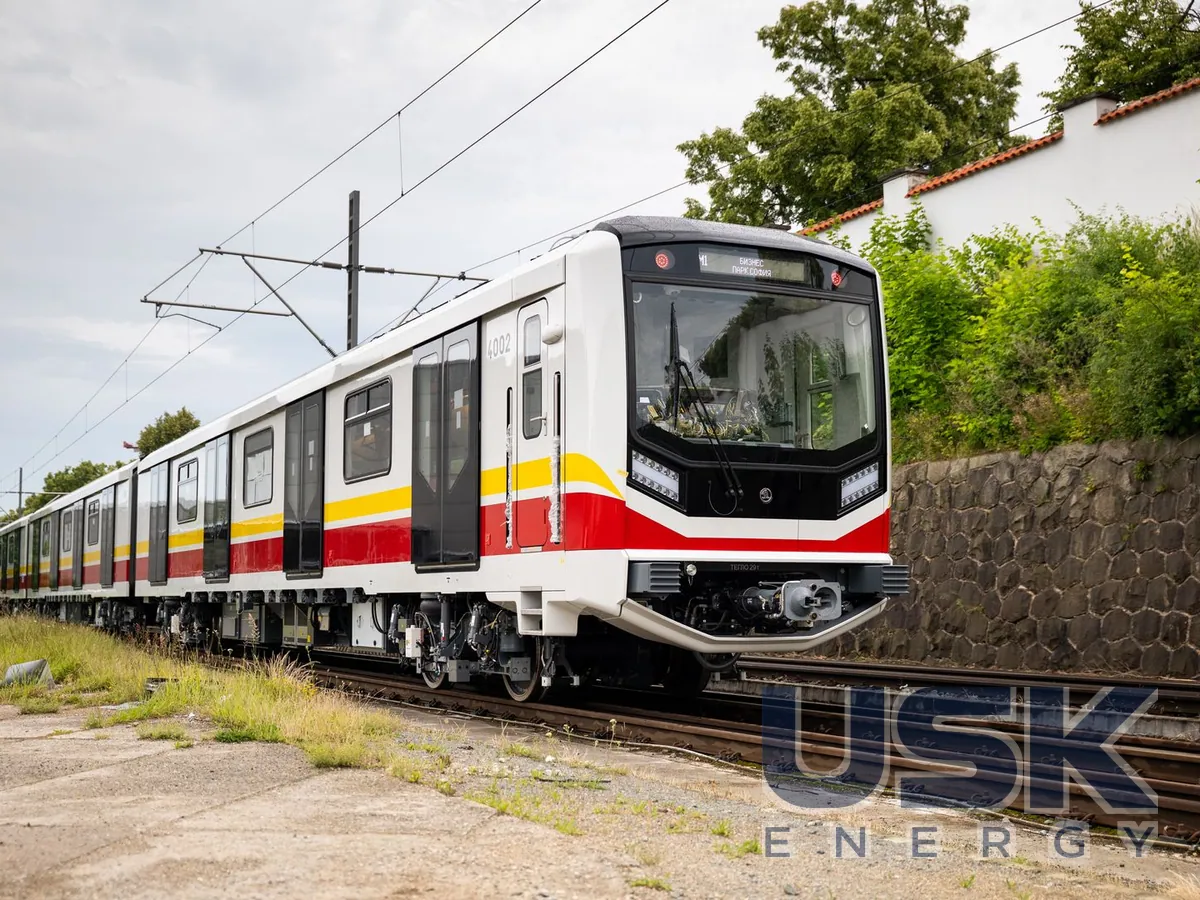
Metro cars and trainsets (750 V DC, third rail, up to 90 km/h)
The group has built metro cars since the 1990s, when it took part in the modernization of the Prague metro. The trains are supplied with 750 V DC from a third rail and have a design speed of 90 km/h. According to the company, new metro trainsets consume up to 25 % less energy.
- Supply
- 750 V DC, third rail
- Design speed
- 90 km/h
- Track gauge
- 1435 mm
- Train formation
- 4 cars (Sofia), 6 cars (Warsaw)
Price, availability and lead time on request. We help with analogue selection, customs clearance and delivery.
Description
Complete traction equipment of the group has worked in the Budapest and Kyiv metros, and it is now being supplied for Suzhou in China. The traction equipment and control systems of the new trains are made by the group itself. The bodies are welded from aluminum profiles. The brake is electrodynamic with priority given to regeneration, so braking energy is returned to the network. The trains are built to EN and UIC standards for 1435 mm track.
For Warsaw the company is building 37 six-car trains with a through gangway, with an option for 8 more, up to 270 cars in total. The bodies are made in Ostrava, and assembly and commissioning are carried out in Plzeň. The through gangway lets passengers move between cars and fill the train more evenly. The train length over couplers is 119.01 m, the width 2700 mm, the height 3660 mm and the floor height 1140 mm. The design speed is 90 km/h, the minimum curve radius 70 m, the axle load up to 125 kN and the train mass 160.4 t. Acceleration is 1.2 m/s², deceleration 1.3 m/s² and emergency deceleration 1.4 m/s². The train has 230 seats and carries up to 1680 passengers at 8 persons/m².
The metro for Sofia is being put into service in 2026 on lines 1, 2 and 4. Four-car trains 79.81 m long and 2710 mm wide will run there, with 750 V DC supply from a third rail and a speed of 90 km/h. The train has 156 seats and a total capacity of 762 passengers at 6 persons/m². The air conditioning is designed for a hot climate, and each side of a car has four double-leaf doors. Both projects are built on a common design and differ in the number of cars, the body width and the capacity.
For Ukrainian metros the modernization of the traction drive of existing cars is also relevant, and the company's traction division offers it as a separate catalog item. The group carries out testing and homologation of rolling stock in an accredited test laboratory. Welding of bodies and components is certified to EN 15085-2, and the management system complies with IRIS (ISO/TS 22163), ISO 9001, 14001 and 45001. For operation, the Datarail online monitoring, predictive diagnostics and full service are offered.
Technical specifications
| Supply | 750 V DC, third rail |
|---|---|
| Design speed | 90 km/h |
| Track gauge | 1435 mm |
| Train formation | 4 cars (Sofia), 6 cars (Warsaw) |
| Car width | 2700–2710 mm |
| Floor height | 1140–1150 mm above top of rail |
| Capacity | 762 (Sofia, 6 persons/m²); up to 1680 (Warsaw, 8 persons/m²) |
| Body | welded aluminum |
| Braking | electrodynamic with priority given to regeneration |
Request a price and lead time
Metro cars and trainsets (750 V DC, third rail, up to 90 km/h). We reply within one business day.
Or email sales@usk.ua or call 044 339-50-20.
Customs codes
| UKTZED (Ukraine) | 8603 10 00 00 |
|---|---|
| HS, 6 digits | 8603 10 |
| CN (EU) | 8603 10 00 |
| HTSUS (USA) | 8603 10 00 00 |
| China customs tariff | 8603 10 00 00 |
Codes are for reference: the final code is determined at declaration for the specific model.
Questions and answers
What network do the metro trains run on?
On 750 V DC through a third rail. The design speed of the trains for Warsaw and Sofia is 90 km/h.
What is the capacity of the metro train for Warsaw?
The six-car train has 230 seats and carries up to 1680 passengers at 8 persons/m². The length over couplers is 119.01 m and the mass 160.4 t.
What braking is used on the trains?
Electrodynamic braking with priority given to regeneration returns energy to the network. Deceleration is 1.3 m/s² and emergency deceleration 1.4 m/s².
Similar equipment from other manufacturers