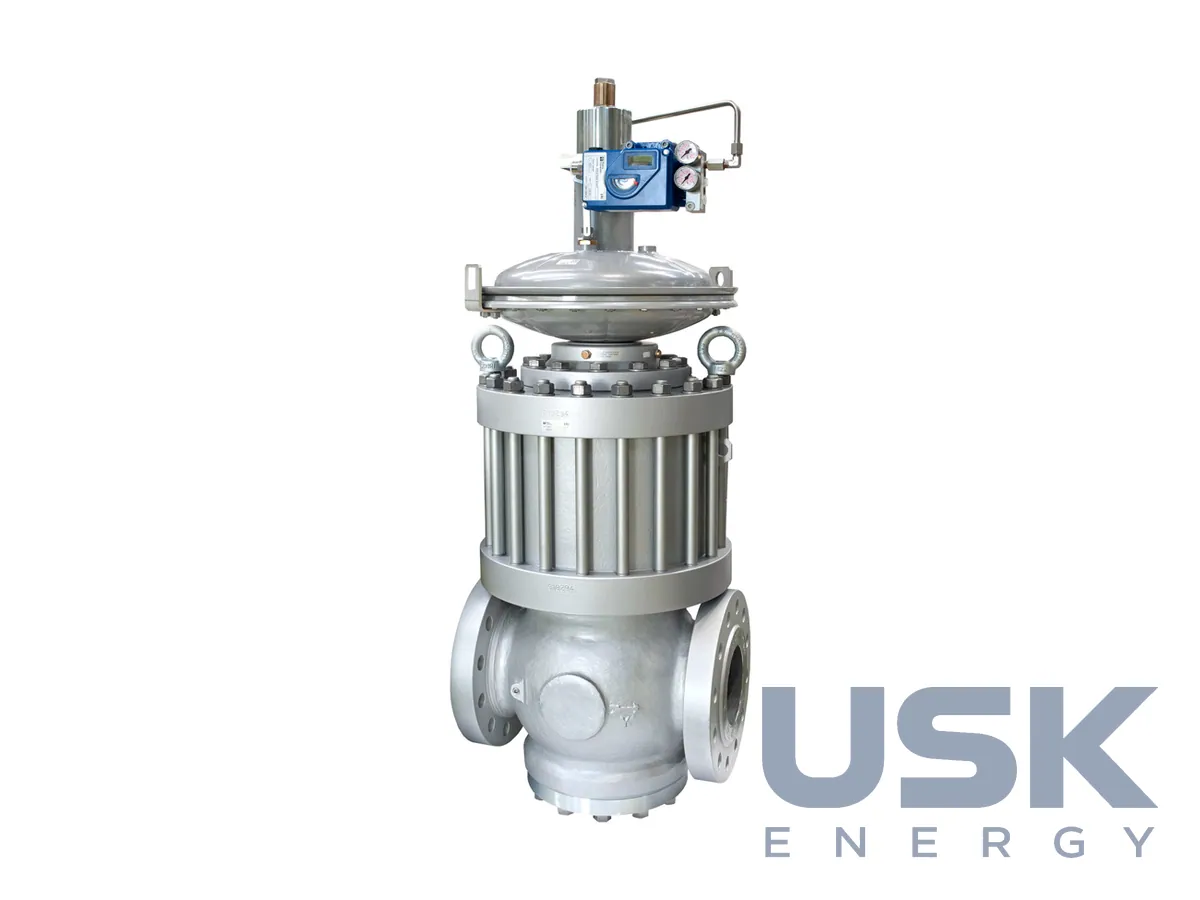
Reflux 919 — diaphragm gas control valve with positioner, up to 102 bar
Reflux 919 diaphragm gas control valve with a pneumatic or electro-pneumatic positioner. Design pressure up to 10.2 MPa (102 bar), sizes from DN 25 to DN 250. For GDS, compressor stations, storage facilities and LNG terminals.
- Type
- diaphragm control valve, direct acting (air closes) or reverse acting (air opens)
- Design pressure
- up to 10.2 MPa (102 bar)
- Inlet pressure bpu (MAOP)
- 0.1–10 MPa (1–100 bar)
- Outlet pressure in pressure control mode
- 0.05–9.5 MPa (0.5–95 bar)
Price, availability and lead time on request. We help with analogue selection, customs clearance and delivery.
Description
Reflux 919 is a diaphragm control valve for natural gas and other pre-filtered non-corrosive gases. Structurally it is close to the Reflux 819 regulator, but instead of its own pilot it is driven by an external signal through a pneumatic or electro-pneumatic positioner. For this reason the valve works in pressure or flow control loops or as part of the telemetry systems of pressure reduction stations.
Versions are direct acting (air closes) and reverse acting (air opens). Under EN 334, depending on the version, the valve responds by opening (Fail Open) or by closing (Fail Close). The main fields of application are high-pressure transmission systems and medium-pressure networks, namely GDS, compressor and booster stations, underground storage facilities, liquefaction and regasification plants, LNG terminals, power plants, heavy industry and reverse-flow units.
Design pressure is up to 10.2 MPa (102 bar), and the operating inlet pressure bpu (MAOP) is from 0.1 to 10 MPa (1–100 bar). Outlet pressure in pressure control mode is from 0.05 to 9.5 MPa (0.5–95 bar). The pneumatic control signal is 0.21–1.03 bar or 0.42–2.06 bar, and 4–20 mA for the electro-pneumatic positioner. Nominal sizes are DN 25, 50, 80, 100, 150, 200 and 250 (1″–10″). Connections are flanges of classes 150, 300 and 600 RF or RTJ per ASME B16.5 and PN 16 per ISO 7005. Temperature is from −20 to +60 °C.
For classes 300 and 600 the body is made of cast steel ASTM A352 LCC, and for class 150 and PN 16/40 of ASTM A216 WCB steel. The covers are made of forged carbon steel, the stem is AISI 416, the obturator is nickel-plated ASTM A350 LF2 steel, the seat is carbon steel with vulcanized rubber, and the diaphragm is rubberized fabric formed by hot pressing. The valve is designed to EN 334 and certified under PED 2014/68/EU, with tightness better than class VIII per ANSI/FCI 70-3.
Accessories include the DB/819 silencer, the PM/819 monitor and the SB/82 and HB/97 safety shut-off valves. The top entry design gives high accuracy and a wide control range. A hydrogen compatibility declaration has been issued for the valve.
Technical specifications
| Type | diaphragm control valve, direct acting (air closes) or reverse acting (air opens) |
|---|---|
| Design pressure | up to 10.2 MPa (102 bar) |
| Inlet pressure bpu (MAOP) | 0.1–10 MPa (1–100 bar) |
| Outlet pressure in pressure control mode | 0.05–9.5 MPa (0.5–95 bar) |
| Control signal | pneumatic 0.21–1.03 bar or 0.42–2.06 bar; electro-pneumatic positioner 4–20 mA |
| Nominal sizes | DN 25–250 (1″–10″) |
| Connections | class 150/300/600 RF/RTJ per ASME B16.5; PN 16 per ISO 7005 |
| Temperature | from −20 to +60 °C |
| Materials | body: ASTM A352 LCC or ASTM A216 WCB; obturator: nickel-plated ASTM A350 LF2; diaphragm: rubberized fabric |
| Standards | EN 334 (Fail Open or Fail Close), PED 2014/68/EU |
| Options | DB/819 silencer, PM/819 monitor, SSV SB/82 and HB/97 |
Request a price and lead time
Reflux 919 — diaphragm gas control valve with positioner, up to 102 bar. We reply within one business day.
Or email sales@usk.ua or call 044 339-50-20.
Questions and answers
Which control signals does Reflux 919 accept?
A pneumatic signal of 0.21–1.03 bar or 0.42–2.06 bar, and 4–20 mA for the electro-pneumatic positioner.
What are the inlet and outlet pressure ranges?
The operating inlet pressure bpu (MAOP) is from 0.1 to 10 MPa (1–100 bar), and the outlet pressure in pressure control mode is from 0.05 to 9.5 MPa (0.5–95 bar).
How does the valve behave under EN 334 and what is its tightness?
Depending on the version, it responds by opening (Fail Open) or by closing (Fail Close). Tightness is better than class VIII per ANSI/FCI 70-3.
Similar equipment from other manufacturers