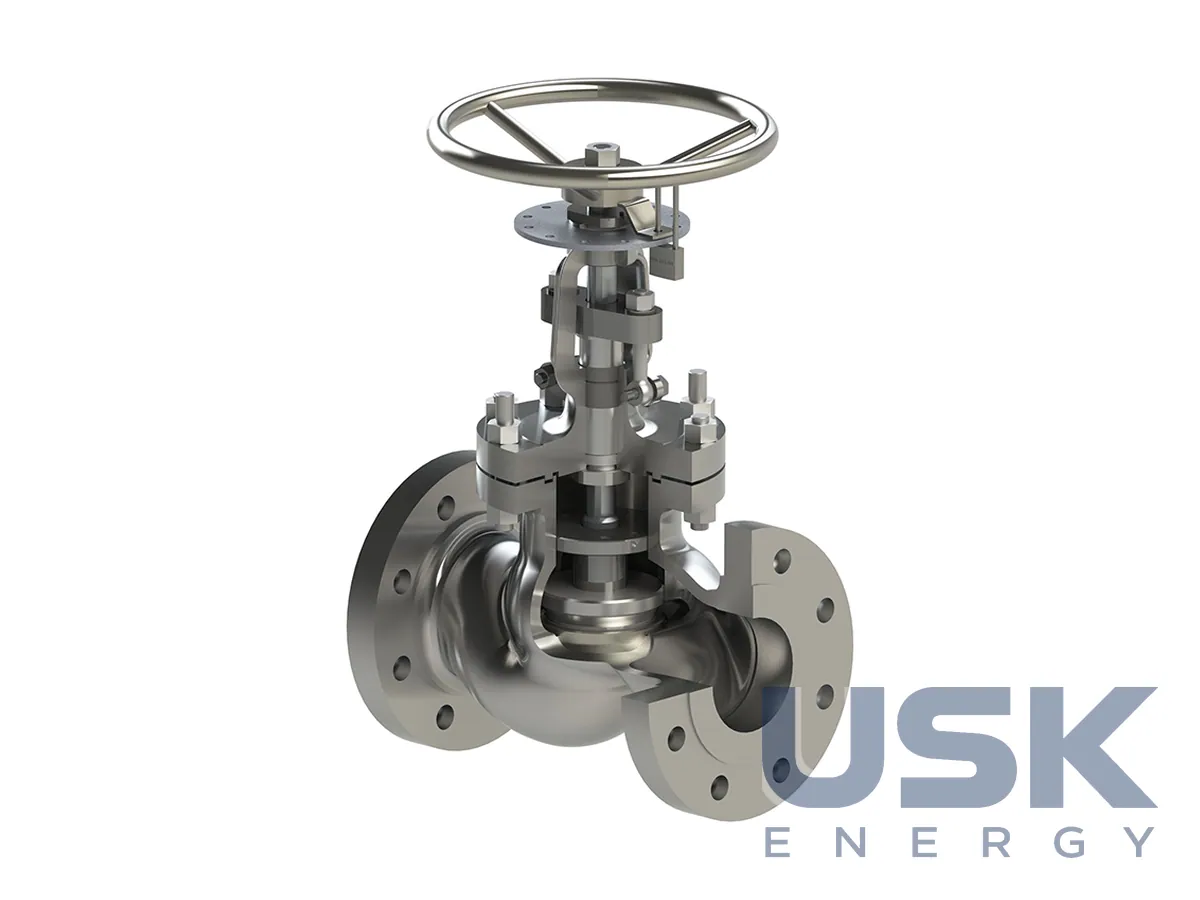
Globe — globe valves, straight, angle and Y-pattern, ANSI 150–4500
Globe valves to API 602 in straight, angle and Y-pattern versions. ANSI classes 150–4500, sizes from 2 to 30 inches. They work on natural gas, LNG, crude oil and petroleum product lines.
- Standard
- API 602 / BS 1873 (BS 1837 in the source)
- Body pattern
- straight, angle, Y-pattern
- Bonnet
- bolted or self-sealing (pressure seal)
- Classes and DN
- ANSI 150–600: 2–30 inches; 900: 2–24 inches; 1500: 2–14 inches; 2500: 2–10 inches; 4500: 2–8 inches
Price, availability and lead time on request. We help with analogue selection, customs clearance and delivery.
Description
The manufacturer has made Globe valves since the late 1950s and became an early supplier of such valves to large oil and gas projects. The valves are used on lines for natural gas, liquefied natural gas, crude oil and petroleum products; they comply with ANSI, API, ASME, BS, ISO, NACE and PED. The design standards are API 602 and the British standard for steel globe valves (designated BS 1837 in the document).
The valves suit lines for natural gas, LNG, crude oil and petroleum products in sizes up to 30 inches. The series includes three body patterns: straight pattern, angle pattern and Y-pattern with reduced hydraulic resistance. Each is offered with a bolted bonnet or a self-sealing pressure seal bonnet for high pressures. The contoured plug profile is selected for the required valve characteristic, so the valve is also suitable for rough throttling.
Range: ANSI classes 150–600 from 2 to 30 inches, 900 up to 24 inches, 1500 up to 14 inches, 2500 up to 10 inches and 4500 up to 8 inches. Class 4500 makes the series suitable for ultra-high pressures, for example on gas injection lines and in wellhead piping. Materials include low-temperature carbon or low-alloy steel with corrosion-resistant overlay, duplex, super duplex and forged nickel alloys. The plug is overlaid with stellite, and PTFE/RPTFE inserts are possible. Seals are elastomers, thermoplastics, metal or graphite.
Options include NACE construction for sour service, special bore, bypass, live loaded packing, and extended stem and bonnet. Connections are RF/RTJ flanges, compact and studded flanges, weld ends and hub. Operation is by handwheel or manual gearbox, electric multi-turn actuator or linear pneumatic actuator.
The manufacturer's range also includes cryogenic globe valves for temperatures down to −196 °C (up to 36 inches, up to ANSI class 2500) and versions for hydrofluoric acid, certified by UOP and Phillips. At gas facilities the valves are installed on drain and vent lines, in the piping of separators, filters and metering stations, and on impulse and bypass lines of large gate valves.
Technical specifications
| Standard | API 602 / BS 1873 (BS 1837 in the source) |
|---|---|
| Body pattern | straight, angle, Y-pattern |
| Bonnet | bolted or self-sealing (pressure seal) |
| Classes and DN | ANSI 150–600: 2–30 inches; 900: 2–24 inches; 1500: 2–14 inches; 2500: 2–10 inches; 4500: 2–8 inches |
| Plug | metal with stellite overlay, PTFE/RPTFE inserts; contoured plug |
| Materials | LTCS/low-alloy + CRA, duplex, super duplex, Ni alloys |
| Actuator | handwheel/gearbox, electric multi-turn, linear pneumatic |
| Media | natural gas, LNG, crude oil, petroleum products |
Request a price and lead time
Globe — globe valves, straight, angle and Y-pattern, ANSI 150–4500. We reply within one business day.
Or email sales@usk.ua or call 044 339-50-20.
Questions and answers
What body patterns are in the Globe series?
Straight, angle and Y-pattern. The Y-pattern has reduced hydraulic resistance.
What is the maximum pressure class of the valves?
Up to ANSI 4500, but then the size is limited to 8 inches. For classes 150–600 the size reaches 30 inches.
What standards are the valves designed to?
API 602 and the British standard for steel globe valves, designated BS 1837 in the document. Compliance with ANSI, API, ASME, BS, ISO, NACE and PED.
Similar equipment from other manufacturers