Short-circuit current limiting reactors 400 to 5000 A, insulation class H
Series reactors that reduce the initial short-circuit current in a power circuit. Current range 400 A to 5000 A, air-core design, insulation class H, AF cooling, installed in a vertical or horizontal arrangement.
- Current range
- 400 A to 5000 A
- Cooling
- AF
- Insulation class
- H
- Max. operating altitude
- 1000 m above sea level
Price, availability and lead time on request. We help with analogue selection, customs clearance and delivery.
Description
A short-circuit reactor is connected in series with the current path to limit the short-circuit current. Its presence raises the resulting impedance of the path, which lowers the initial short-circuit current. The required effect appears only while a short circuit lasts.
In normal operation the reactor carries the continuous line current, so some power loss and extra voltage drop occur. The current limiting comes from the reactance of the reactor. When short-circuit current flows, a large inductive voltage drop appears across it, so the voltage applied to the short-circuit loop falls considerably and the current in the loop becomes smaller.
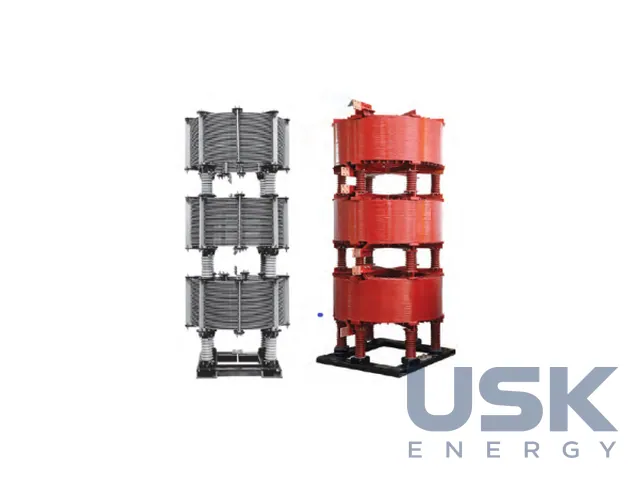
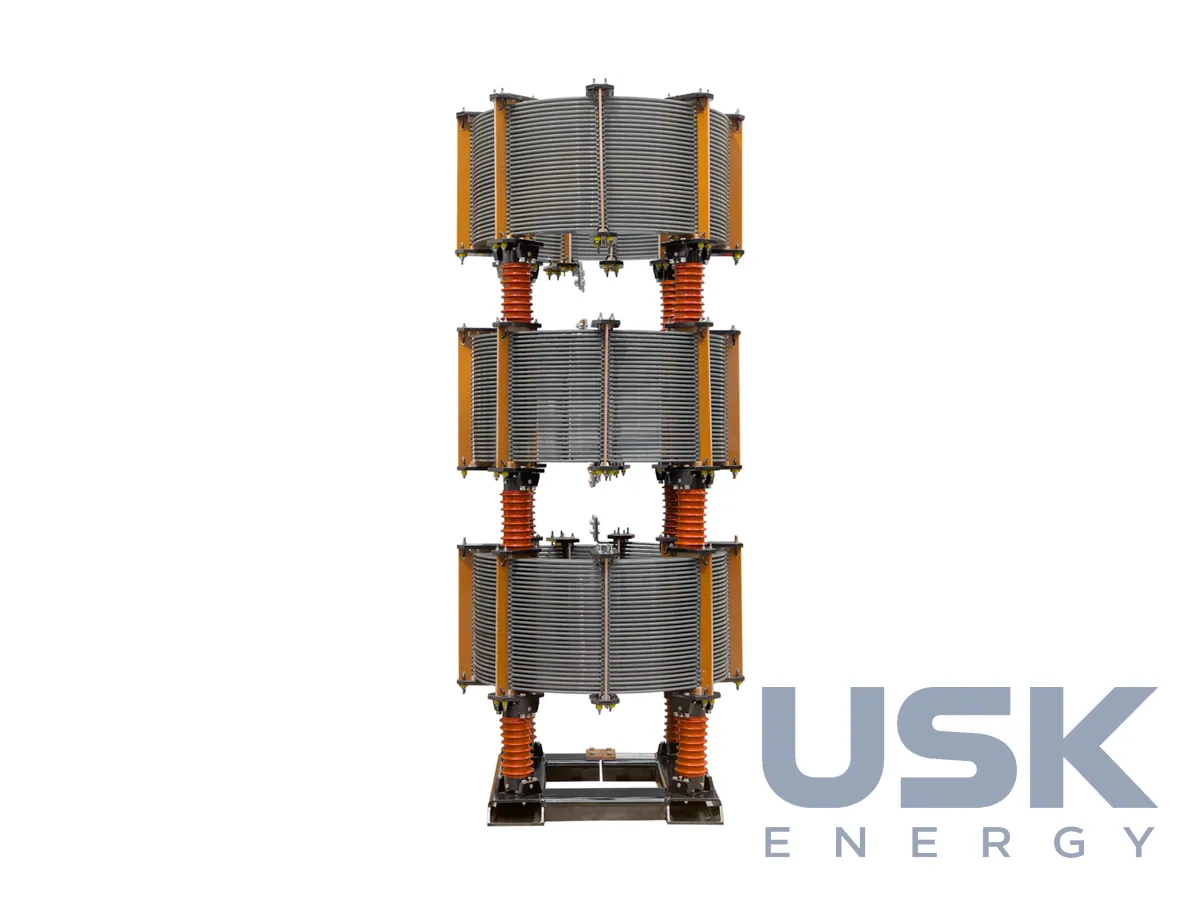
The reactors are built as air-core coils with no magnetic core. The absence of a core keeps the inductance constant whatever the value of the current flowing.
The current range is 400 A to 5000 A, with AF cooling and insulation class H. Maximum operating altitude is 1000 m above sea level, ambient temperature is from -25 to 40 °C, and rated frequency is 50 or 60 Hz. The design is coreless, insulation class H, in a vertical or horizontal arrangement.
The winding is made of rectangular-section conductor (busbar). Turns are formed from two or more flat conductors laid one above another on their flat side, so electrically they act as a single conductor with a cross-section equal to the sum of theirs. The main axis of the coil is perpendicular to the plane of the longer side of the conductor being wound.
Standard fittings are a non-magnetic steel base for fixing the reactor to the foundation, with an earthing terminal, a rating plate and composite or porcelain insulators. Design, tests and tolerances follow EN 60076-6, and units with other parameters are made by individual agreement.
Technical specifications
| Current range | 400 A to 5000 A |
|---|---|
| Cooling | AF |
| Insulation class | H |
| Max. operating altitude | 1000 m above sea level |
| Ambient temperature range | -25 to 40 °C |
| Rated frequency | 50 or 60 Hz |
| Design | air-core, vertical or horizontal arrangement |
| Winding | rectangular-section conductor (busbar) made of flat conductors |
| Base | non-magnetic steel with earthing terminal |
| Insulators | composite or porcelain |
| Standard | EN 60076-6 |
How it compares with similar models
| Parameter | Short-circuit current limiting reactors 400 to 5000 A, insulation class H | Dry-type earthing transformers 150 kVA to 4 MVA, up to 36 kV, ZNyn11 | TDSAZ dry short-circuit limiting reactor, 200 to 5000 A | TDOK C Oil-Filled Shunt Compensation Reactor with Cooler, 10–25 MVAr, up to 36 kV |
|---|---|---|---|---|
| Cooling | AF | AN | AN, AF | OFAF or KFAF |
| Insulation class | H | F or H | H | according to N-EN 60085 |
Request a price and lead time
Short-circuit current limiting reactors 400 to 5000 A, insulation class H. We reply within one business day.
Or email sales@usk.ua or call 044 339-50-20.
Questions and answers
Why does the reactor have no core?
Without a magnetic core the inductance stays constant whatever the value of the current flowing.
How does the reactor limit short-circuit current?
It raises the impedance of the circuit. During a short circuit a large inductive voltage drop appears across it and the current in the short-circuit loop falls.
In what arrangement can it be installed?
Vertical or horizontal. A non-magnetic steel base fixes the reactor to the foundation.
Similar equipment from other manufacturers