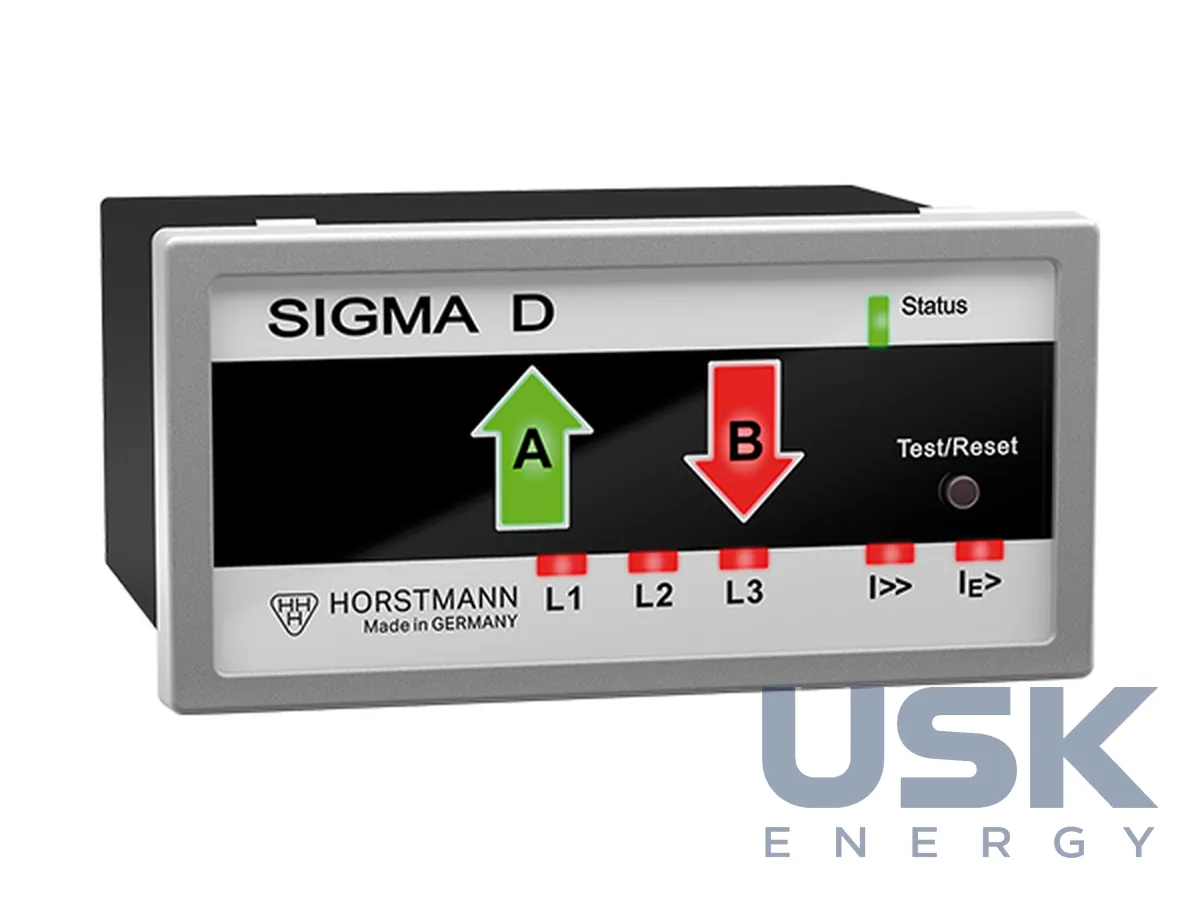
Sigma D / D+ / D++ / DM+ — directional short-circuit and earth fault indicators for MV cable networks
Sigma D, D+, D++ and DM+ detect a short circuit and an earth fault in medium-voltage cable distribution networks and show the fault direction. The short-circuit setting is adjustable within 50–2000 A, earth fault 10–1000 A. The DM+ model additionally transmits measured values via Modbus RTU.
- SC setting I>>
- DIP 200–2000 A, self-adjustment 200–2000 A; software 50–2000 A
- Earth fault setting
- DIP 20–160 A; software 10–1000 A
- Earth fault methods
- Sigma D — earth short circuit; D+/D++/DM+ — up to 5 methods (steady-state fault, earth short circuit, cos φ, sin φ, pulse, wiper)
- Current accuracy
- 3 % (0–630 A), 5 % (630–1500 A), 10 % (1500–2000 A)
Price, availability and lead time on request. We help with analogue selection, customs clearance and delivery.
Description
The devices show the fault direction relative to the installation point with red and green LED arrows. In ring and branched MV cable networks, these arrows immediately reveal the faulted section. The indication is per phase, a short circuit is marked by a red LED and an earth fault by a yellow one. Current is measured by three phase current sensors, and the voltage for determining direction is taken from built-in Wega voltage indication systems, HR/LRM interfaces or capacitive sensors. Voltage calibration is automatic.
The short-circuit setting is set by DIP switches at 200, 300, 400, 600, 800 or 2000 A, or self-adjustment within 200–2000 A is enabled. By software the range 50–2000 A with a step of 1 A is available. The earth fault setting is 20–160 A via DIP, and by software it is set in a wider range, with delays of 40 ms–60 s. Current measurement accuracy is 3 % up to 630 A, 5 % in the range 630–1500 A and 10 % above, up to 2000 A.
Sigma D works with the earth short-circuit method and is also suitable for networks with an isolated neutral. Sigma D+ and D++ are rated for all neutral modes and combine earth fault methods, including steady-state fault, earth short circuit, cos φ, sin φ, pulse and transient methods. The difference between them lies in the implementation of the transient method. D+ does without auxiliary power but needs a summation current sensor. D++ works with three phase sensors, but it requires auxiliary power of 24–230 V.
Sigma DM+ transmits measured currents, voltages, P, Q, S, cos φ, frequency and messages via RS-485/Modbus RTU. It has two freely configurable inputs, and the power supply is buffered for 1 min after the auxiliary voltage disappears. The other models output signals through four programmable relays with a load capacity of 230 V AC/1 A.
The devices are powered from current transformers, have a lithium cell with a service life of at least 20 years and an event memory. Parameters are set by DIP switches or through the front USB port in the Sigma Explorer software. The indication can be reset by a button, remotely, by time, or after current or voltage is restored. The polycarbonate housing has protection degree IP40 and works at −30…+70 °C. The delivery includes an indication unit, a voltage signal and three phase current sensors.
Technical specifications
| SC setting I>> | DIP 200–2000 A, self-adjustment 200–2000 A; software 50–2000 A |
|---|---|
| Earth fault setting | DIP 20–160 A; software 10–1000 A |
| Earth fault methods | Sigma D — earth short circuit; D+/D++/DM+ — up to 5 methods (steady-state fault, earth short circuit, cos φ, sin φ, pulse, wiper) |
| Current accuracy | 3 % (0–630 A), 5 % (630–1500 A), 10 % (1500–2000 A) |
| Signalling | 4 programmable relays (D, D+, D++); RS-485 Modbus RTU (DM+) |
| Power supply | from current transformers; lithium cell ≥ 20 years; aux. 24–230 V AC/DC (D++, DM+) |
| Voltage | from Wega VDIS, HR/LRM interfaces or capacitive sensors |
| Housing | polycarbonate IP40, −30…+70 °C |
Request a price and lead time
Sigma D / D+ / D++ / DM+ — directional short-circuit and earth fault indicators for MV cable networks. We reply within one business day.
Or email sales@usk.ua or call 044 339-50-20.
Customs codes
| UKTZED (Ukraine) | 9030 39 00 00 |
|---|---|
| HS, 6 digits | 9030 39 |
| CN (EU) | 9030 39 00 |
| HTSUS (USA) | 9030 39 01 00 |
| China customs tariff | 9030 39 00 00 |
Codes are for reference: the final code is determined at declaration for the specific model.
Questions and answers
How do Sigma D+ and Sigma D++ differ?
Both work with all neutral modes. D+ does not need auxiliary power, but for the transient method it needs a summation current sensor; D++ does with three phase sensors and a 24–230 V supply.
What is the current measurement accuracy?
The error is 3 % up to 630 A, 5 % in the range 630–1500 A and 10 % in the range 1500–2000 A.
Can the indicator data be transmitted to a telecontrol system?
Sigma DM+ transmits currents, voltages, powers, cos φ and frequency via RS-485/Modbus RTU. Models D, D+ and D++ output signals through four programmable relays.
Similar equipment from other manufacturers