WDG 1200 and 1210 Insitu probe oxygen analysers for flue gas, zirconium oxide sensor
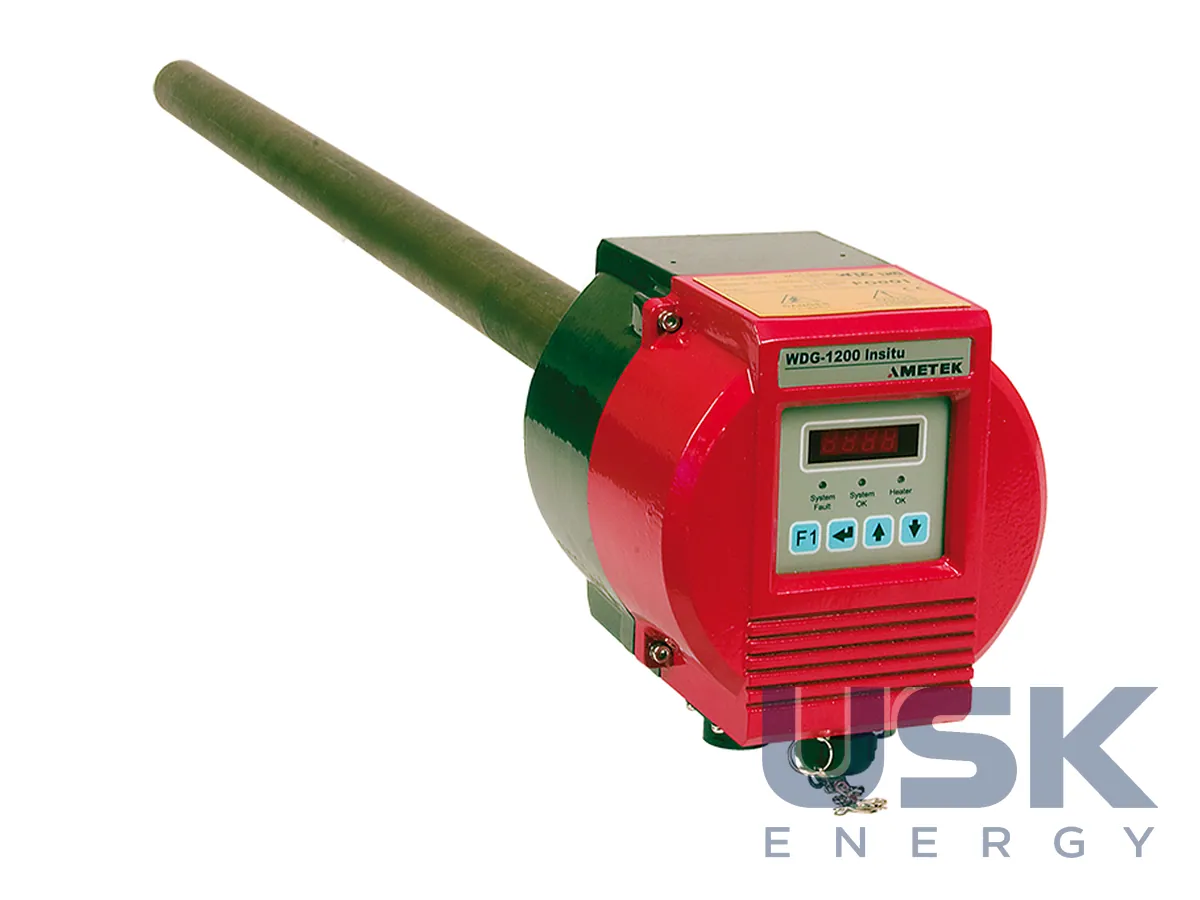
The WDG 1200 Insitu and WDG 1210 Insitu measure residual oxygen directly in the stack with a zirconium oxide sensor. The WDG 1200 has its electronics in the probe head, while the WDG 1210 uses a remote controller. The sensor and heater can be withdrawn without removing the outer protection tube from the process.
- Measuring principle
- zirconium oxide sensor
- Range
- 0-1% to 0-25% O2 by volume, selectable
- Error
- ±1% of reading
- Repeatability
- ± 0.5% of scale on the analogue outputs
Price, availability and lead time on request. We help with analogue selection, customs clearance and delivery.
Description
These analysers monitor combustion efficiency and excess air in boilers fired by gas, fuel oil, coal and biofuel, including package and marine boilers. They also serve power and combined cycle plants, petrochemicals, pharmaceuticals, waste incinerators, NOx reduction systems, burner safety systems and emissions monitoring.
The probe is fitted directly into the flue through a flange. Oxygen is measured by a zirconium oxide sensor heated to 750 °C ± 3 °C. The controller holds the sensor temperature accurately, provides built-in diagnostics and protects against overheating. The outer probe tube is 310 stainless steel, so in most applications no abrasion shield is needed. The sensor assembly with its heater can be pulled out while the outer tube stays in the process, so sensor work is done in place, without removing the instrument from the process flange or sending it to the factory.
The WDG 1200 Insitu has its electronics mounted on the probe head. The WDG 1210 Insitu has remote electronics and works with a separate controller in a 152 x 153 x 130 mm housing weighing 2.7 kg. Probes are supplied in lengths of 0.457 m (18 inches), 0.9144 m (36 inches), 1.828 m (72 inches) and 2.743 m (108 inches).
The measuring range is selected between 0-1% and 0-25% O2 by volume, with an error of ±1% of reading. The 90% of scale response takes 5 seconds on calibration gas, and warm-up takes no more than 20 minutes. As standard there is an isolated 4-20 mA current output with loads up to 500 ohms, an RS485 Modbus interface and an alarm relay rated 2 A at 30 V. The four-digit LED display shows the O2 concentration, cell temperature and fault messages.
Process temperatures run from 20 to 800 °C at a pressure of ±2 psig (±13.8 kPa). The controller works from -20 to 70 °C and from 10% to 90% relative humidity without condensation, in a NEMA 4X/IP65 housing. Connections range from a 2-inch NPT thread to a 6-inch flange. For calibration, a zero gas of 1% O2 in nitrogen and a span gas at 20.9% O2 are recommended, with a nominal flow of 1.4 L/min.
Technical specifications
| Measuring principle | zirconium oxide sensor |
|---|---|
| Range | 0-1% to 0-25% O2 by volume, selectable |
| Error | ±1% of reading |
| Repeatability | ± 0.5% of scale on the analogue outputs |
| Response time | 90% of scale in 5 s |
| Warm-up | no more than 20 minutes |
| Flue gas temperature | 20 to 800 °C |
| Process pressure | ± 2 psig (± 13.8 kPa) |
| Sensor heater temperature | 750 °C ± 3 °C |
| Probe outer tube | 310 stainless steel |
| Probe lengths | 0.457 m, 0.9144 m, 1.828 m, 2.743 m |
| Connection | 2-inch NPT to 6-inch flange |
| Analogue output | isolated 4-20 mA, up to 500 ohms |
| Digital interface | RS485 Modbus |
| Alarm relay | changeover contact 2 A, 30 V AC/DC |
| Power | 250 VA, 48-62 Hz |
| Controller temperature | -20 to 70 °C |
| Enclosure | NEMA 4X/IP65 |
Part numbers
Show all part numbers (2)
WDG 1200/INSITU, WDG 1210/INSITU
Request a price and lead time
WDG 1200 and 1210 Insitu probe oxygen analysers for flue gas, zirconium oxide sensor. We reply within one business day.
Or email sales@usk.ua or call 044 339-50-20.
Questions and answers
How do the WDG 1200 and WDG 1210 differ?
The WDG 1200 Insitu has its electronics in the probe head, while the WDG 1210 Insitu has remote electronics with a separate controller.
Does the probe have to be removed to replace the sensor?
No. The sensor assembly and heater are withdrawn, while the outer protection tube stays in the process.
What is the maximum flue gas temperature?
The probe works with flue gas from 20 to 800 °C at a pressure of ±2 psig.
Similar equipment from other manufacturers