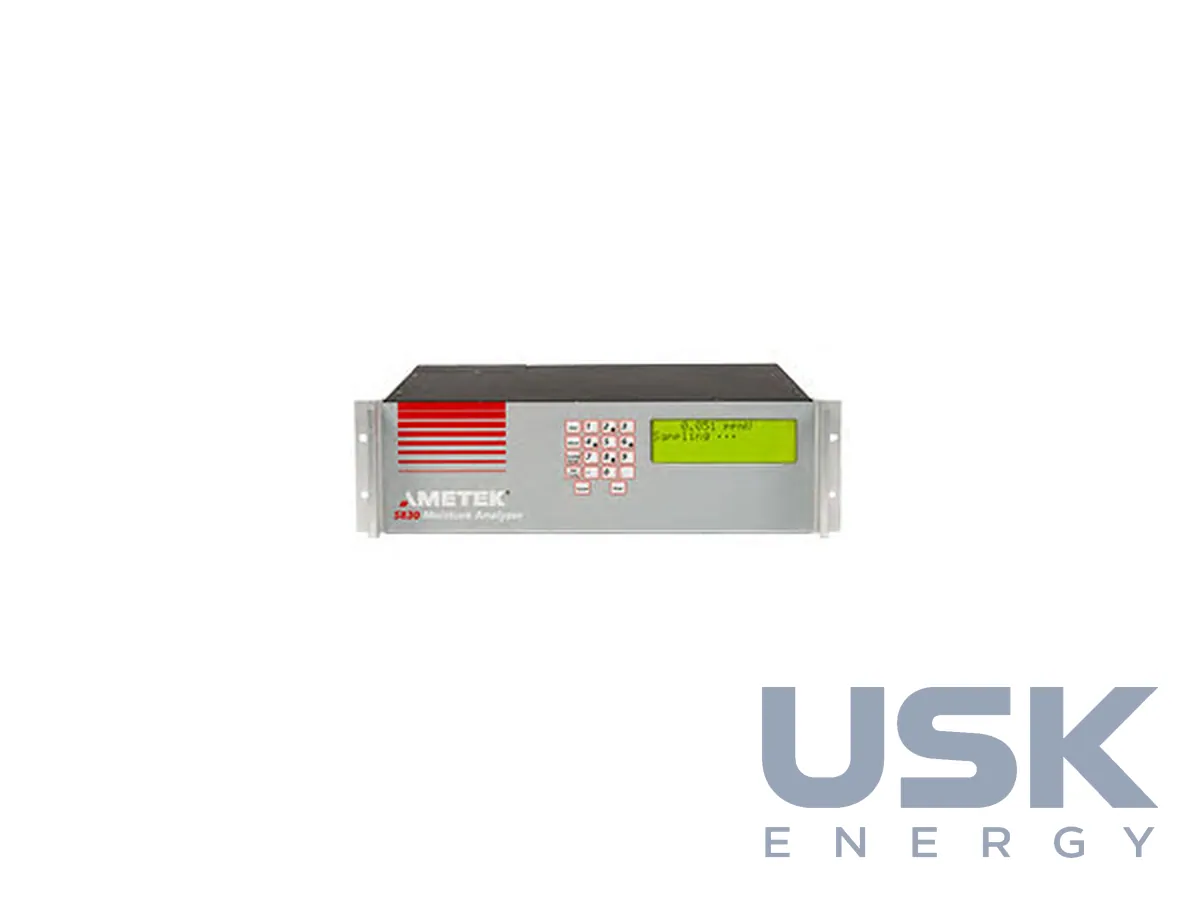
5830 Moisture Analyser for Gases, QCM Sensor, 0–100 ppmv, Detection Limit 20 ppbv
The 5830 measures trace moisture in pure and ultra-pure gases using a quartz crystal microbalance (QCM). It covers 0–100 ppmv with trend indication to 1000 ppmv and a detection limit of 20 ppbv, and is supplied for a 19-inch rack or as a benchtop unit.
- Measurement method
- quartz crystal microbalance (QCM)
- Range
- 0–100 ppmv, trend up to 1000 ppmv
- Detection limit
- 20 ppbv
- Accuracy
- ±20 ppbv or ±10% of reading, whichever is greater
Price, availability and lead time on request. We help with analogue selection, customs clearance and delivery.
Description
The 5830 analyser is used to monitor moisture in the production of high-purity and industrial gases, in semiconductor manufacturing and for quality assurance. Its sensor works on the quartz crystal microbalance principle. Measurement is non-equilibrium: the sensor is flushed alternately with moist test gas and dry gas, so the analyser does not wait for equilibrium and reacts quickly to both rising and falling moisture. The response to 63% of a step change in either direction takes less than 5 minutes.
The analyser is compatible with most non-corrosive gases, including inert gases such as helium, argon, neon, xenon and krypton, along with oxygen, hydrogen, nitrogen, air and specialty gases such as sulphur hexafluoride. A special measuring cell is needed for CO2. The gas type is selected from the menu, with no manual adjustments required.
The calibrated range is 0–100 ppmv, and the trend indication runs up to 1000 ppmv so that the nature of a process upset can be seen. The detection limit is 20 ppbv, and accuracy is ±20 ppbv or ±10% of reading, whichever is greater. The display shows moisture in ppmv or ppbv, or as dew point temperature, which requires a pressure input. An internal dryer for the reference gas is rated for over a million ppmv-hours, which at 20 ppmv of inlet moisture means more than five years.
An on-line check system feeds zero gas or a moisture reference traceable to NIST standards to the sensor, and checks zero stability and response to real moisture. Checks can run on a schedule or manually, and a failed check operates the alarm contact.
Inlet pressure is 138–345 kPa (20–50 psig), with a low-pressure version at 34.5–138 kPa, and exhaust is vented to atmosphere. Sample flow is about 150 sccm in saver mode and about 1 slpm with the bypass open. Sample temperature is 0–100 °C, with 60 ± 5 °C recommended. Outputs are a four-line LCD, a programmable 4–20 mA analogue output and RS485/RS232 serial communication, plus three dry contacts rated 32 V DC, 1 A for moisture, data validity and system alarm. Power is 85–265 V, 47–63 Hz, 185 W. The unit is for a 19-inch rack or bench top, measures 483 x 133 x 419 mm and weighs 12.7 kg. Installation is permitted in Class I Division 2, Groups A, B, C, D areas or in non-hazardous locations.
Technical specifications
| Measurement method | quartz crystal microbalance (QCM) |
|---|---|
| Range | 0–100 ppmv, trend up to 1000 ppmv |
| Detection limit | 20 ppbv |
| Accuracy | ±20 ppbv or ±10% of reading, whichever is greater |
| Response time | 63% of a step change in under 5 minutes |
| Gases | He, Ar, Ne, Xe, Kr, O2, H2, N2, air, SF6 |
| Inlet pressure | 138–345 kPa (20–50 psig) |
| Outlet pressure | atmospheric |
| Sample flow | about 150 sccm (saver mode), about 1 slpm (bypass) |
| Sample temperature | 0–100 °C |
| Analogue output | 4–20 mA, programmable |
| Interface | RS485/RS232 |
| Alarms | three dry contacts, 32 V DC, 1 A |
| Display | LCD, 4 lines x 20 characters |
| Power supply | 85–265 V, 47–63 Hz, 185 W |
| Mounting | 19-inch rack or bench top |
| Dimensions | 483 x 133 x 419 mm |
| Weight | 12.7 kg |
| Classification | Class I Division 2, Groups A, B, C, D |
Part numbers
Show all part numbers (1)
5830
Request a price and lead time
5830 Moisture Analyser for Gases, QCM Sensor, 0–100 ppmv, Detection Limit 20 ppbv. We reply within one business day.
Or email sales@usk.ua or call 044 339-50-20.
Questions and answers
Which gases can be analysed?
Inert gases He, Ar, Ne, Xe and Kr, plus O2, H2, N2, air and SF6. CO2 needs a special measuring cell.
How can readings be checked on line?
The built-in system feeds zero gas or a moisture reference traceable to NIST to the sensor, on a schedule or manually, and a failed check operates the alarm contact.
What inlet pressure is required?
The standard range is 138–345 kPa (20–50 psig), and the low-pressure version takes 34.5–138 kPa, with exhaust to atmosphere.
Similar equipment from other manufacturers