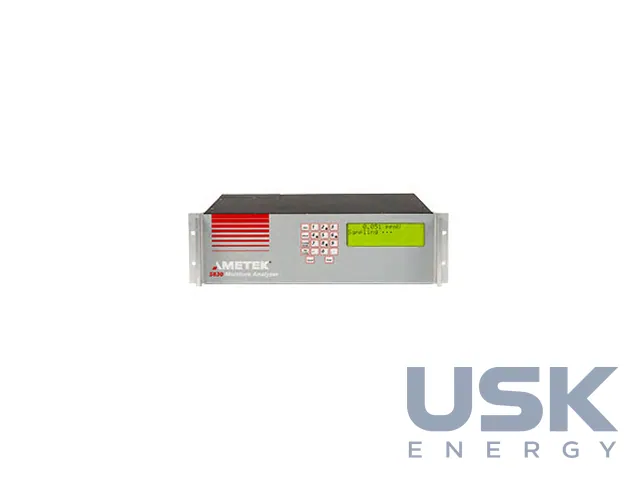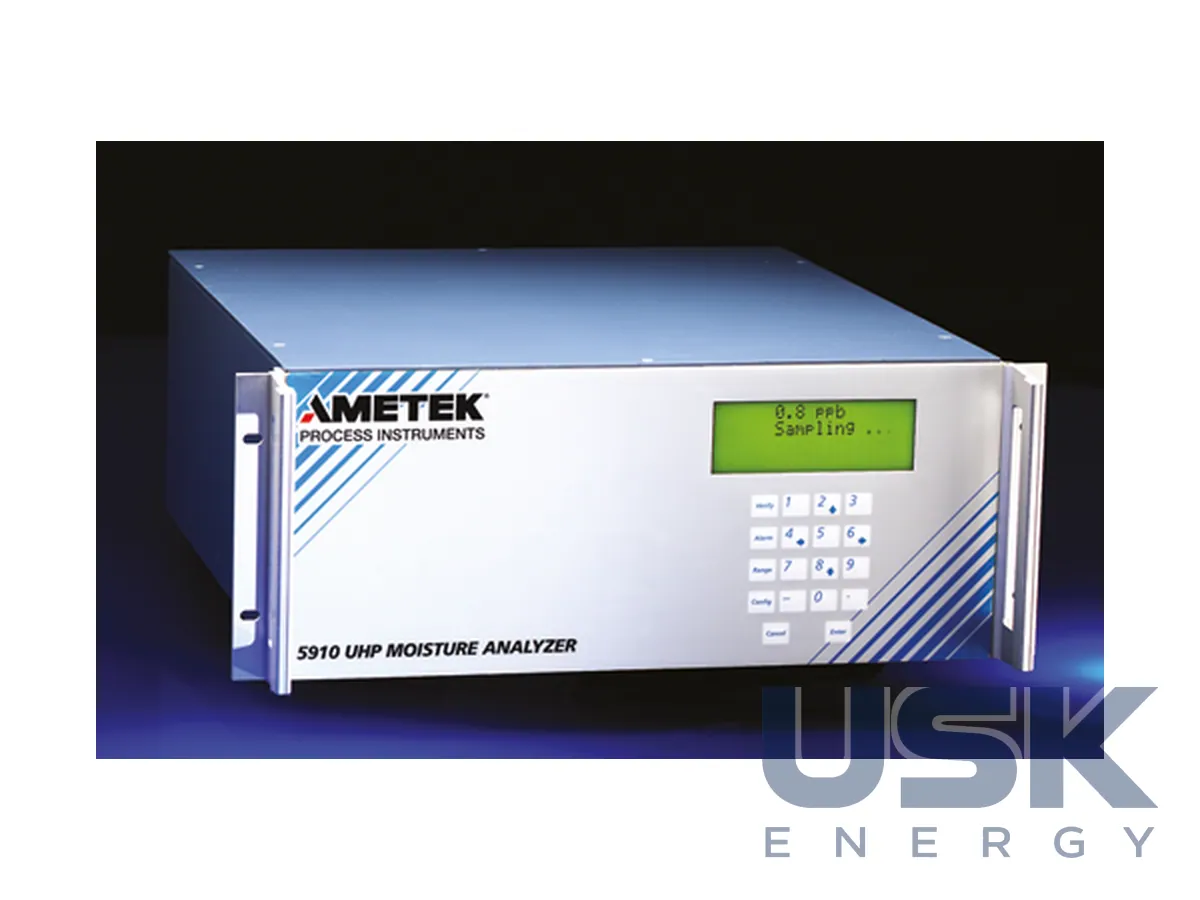
5910 UHP Sub-ppb Moisture Analyser for Ultra-High Purity Gases, ±100 pptv Accuracy
The 5910 monitors moisture in ultra-high purity gases at ppbv levels and responds to changes in concentration below 500 pptv. It uses a quartz crystal microbalance sensor with an accuracy of ±100 pptv or ±10% of reading, an internal dryer for zero checks and a rack-mount build for analytical carts.
- Measured component
- H2O
- Principle
- quartz crystal microbalance (QCM)
- Range
- 0–150 ppbv, trend up to 1000 ppbv
- Detection limit
- 150 pptv
Price, availability and lead time on request. We help with analogue selection, customs clearance and delivery.
Description
The 5910 is designed for continuous monitoring of ultra-high purity gases and for mounting in analytical carts. Its main markets are semiconductor and LCD/OLED display manufacturing, and air separation plants. It analyses air, oxygen, hydrogen, helium, argon, neon, nitrogen and xenon.
Moisture is measured by a quartz crystal microbalance (QCM) sensor. The sensor does not depend on the carrier gas, and because the QCM has no recombination errors, hydrogen and oxygen flows are monitored as easily as inert gases. The gas type is selected in the program menu, and no flow or pressure regulators need tuning.
The calibrated range is 0–150 ppbv, and above that the instrument shows a trend up to 1000 ppbv. The nominal detection limit is 150 pptv, RMS noise is 50 pptv, and accuracy is ±100 pptv or ±10% of reading, whichever is greater. The sample path is carefully laid out and heated, so the response to a moisture change takes minutes rather than hours: typically 80% of a 25 ppbv step in either direction is reached in 10 minutes or less.
For baseline checks, an internal dryer produces zero gas from the sample stream itself, so the analyser confirms zero without an external cylinder of dry gas.
The sample is supplied at 138–345 kPa (20–50 psig) and vented to atmosphere, with a flow below 1 L/min. Running consumption is about 200 SCCM and bypass about 1 SLPM, and the gas inlet temperature is 0–100 °C. The unit is a 19-inch rack instrument measuring 480 x 177 x 509 mm and weighing 15.9 kg, with a 4-line LCD and an 18-button keypad. Its 4–20 mA output is fully configurable and can be self-powered or externally powered. Serial communication is RS-232 or RS-485, with three alarm contacts for data validity, concentration and system. It runs on 100–132 V AC or 230 V AC ±10%, 47–63 Hz, 185 W, at 10–30 °C and up to 90% humidity without condensation, up to 2000 m altitude. It may be installed in Class I, Division 2, Groups A–D, T4 areas and meets EN 61326-1 and EN 61010-1.
Technical specifications
| Measured component | H2O |
|---|---|
| Principle | quartz crystal microbalance (QCM) |
| Range | 0–150 ppbv, trend up to 1000 ppbv |
| Detection limit | 150 pptv |
| Accuracy | ±100 pptv or ±10% of reading, whichever is greater |
| RMS noise | 50 pptv |
| Response time | 80% of a 25 ppbv step in 10 minutes or less |
| Inlet pressure | 138–345 kPa (20–50 psig) |
| Sample flow | less than 1 L/min; operating about 200 SCCM, bypass about 1 SLPM |
| Inlet gas temperature | 0–100 °C |
| Analogue output | 4–20 mA, self-powered or externally powered |
| Digital interface | RS-232 or RS-485 |
| Alarms | data validity, concentration, system |
| Power supply | 100–132 V AC or 230 V AC ±10%, 47–63 Hz, 185 W |
| Ambient temperature | 10–30 °C |
| Housing | 19-inch rack, 480 x 177 x 509 mm |
| Weight | 15.9 kg |
| Installation area | Class I, Division 2, Groups A–D, T4 |
Request a price and lead time
5910 UHP Sub-ppb Moisture Analyser for Ultra-High Purity Gases, ±100 pptv Accuracy. We reply within one business day.
Or email sales@usk.ua or call 044 339-50-20.
Questions and answers
What sensitivity does the 5910 offer at ppb levels?
It has a detection limit of 150 pptv, noise of 50 pptv and an accuracy of ±100 pptv, and it detects moisture changes below 500 pptv.
Can hydrogen and oxygen be analysed?
Yes. The QCM sensor has no recombination errors and does not depend on the carrier gas, and the gas type is selected in the menu.
How can zero be checked without a cylinder of dry gas?
The internal dryer produces zero gas from the sample, and the analyser checks the baseline during operation.
Similar equipment from other manufacturers