Syringe Heaters for Warming Injectable Solutions and Contrast Agents, up to 85 °C
The syringe heater keeps a solution at temperature during medical injections, reducing swings in temperature and viscosity. It comes as a polycarbonate laminate version with a foil element or a silicone version with a wire element, with an operating limit of 85 °C and a built-in controller accurate to ±3 °C.
- Type
- syringe heater for fluid delivery
- Versions
- polycarbonate with foil element; silicone with wire element
- Material (polycarbonate version)
- clear polycarbonate laminate
- Maximum operating temperature
- 85 °C (185 °F)
Price, availability and lead time on request. We help with analogue selection, customs clearance and delivery.
Description
The heater is made for medical injections where the solution or drug has to be given warm. Solutions at body temperature are easier to inject and have a lower viscosity, and a warmed contrast agent lowers the risk for the patient, particularly one who is weakened or under stress. A steady temperature gives repeatable results from one procedure to the next, because swings in temperature and viscosity are reduced.
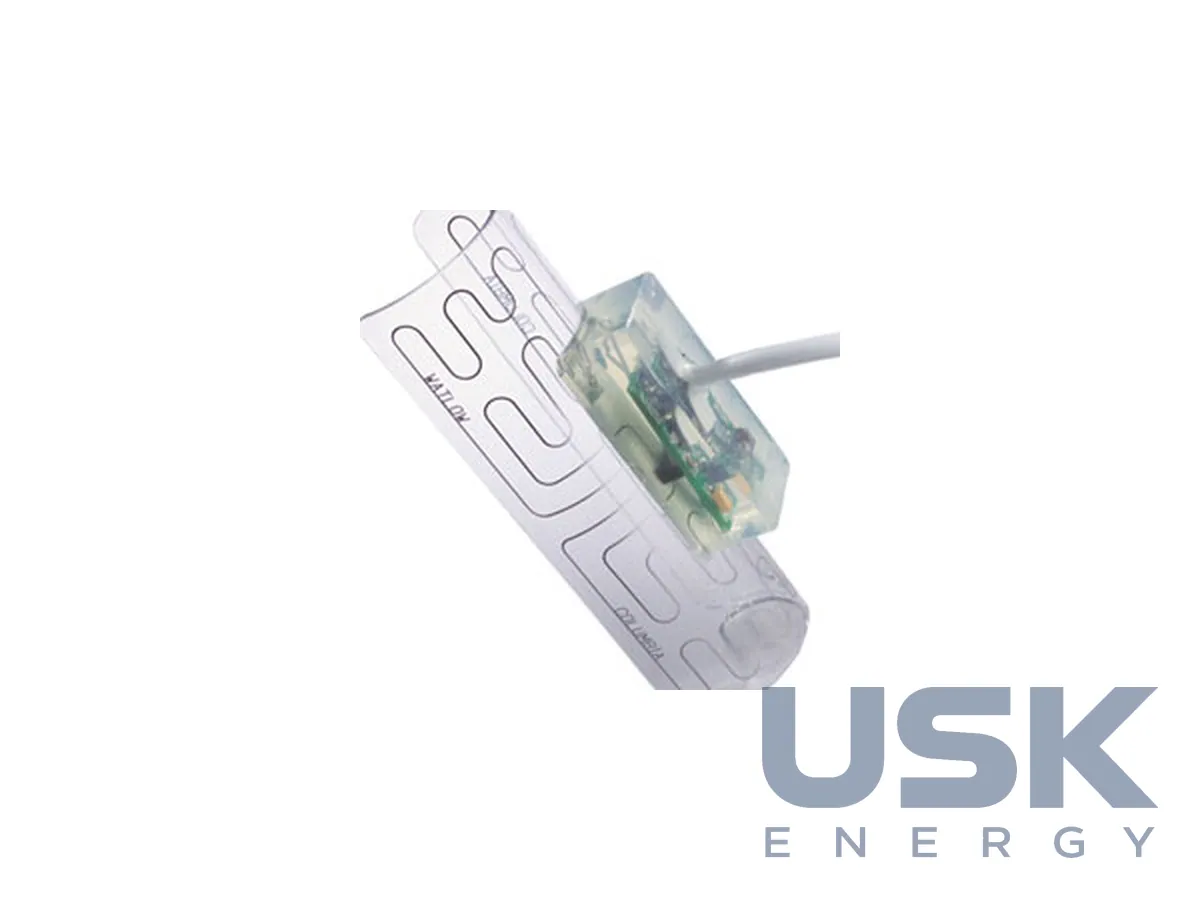
There are two versions. The silicone version with a wire heating element fits a range of syringe sizes. The version built from clear polycarbonate laminate with a foil element lets the operator see fluid levels and monitor air bubbles, and its smooth outer surfaces and radiused inside corners make cleaning easier. Both slip onto the syringe with one hand, with a snap fit, and stay firmly in place for the duration of the procedure.
Each heater is formed around a particular syringe, usually 2 to 6 in. (50 to 150 mm) across and no more than 5 in. (127 mm) long. An electronic controller and or temperature sensor is built into the formed assembly on the cable, and a backup controller can be fitted when required. Control accuracy is ±3 °C (5.4 °F), the control pod measures about 1 x 1 x 2.75 in. (25 x 25 x 70 mm), and the cable withstands a pull of up to 89 N (20 lbF).
The maximum operating temperature is 85 °C (185 °F) and the maximum watt density is 0.3 W/cm² (2 W/in²). Supply voltage depends on the application, and over 48 V, agency approvals can be affected. UL recognition is available on request for qualified designs.
Heaters of this type belong to the group of fluid delivery heaters, alongside flexible heated tubing and in-line heaters. Design, dimensions and control settings are matched to the particular syringe and medical device.
Technical specifications
| Type | syringe heater for fluid delivery |
|---|---|
| Versions | polycarbonate with foil element; silicone with wire element |
| Material (polycarbonate version) | clear polycarbonate laminate |
| Maximum operating temperature | 85 °C (185 °F) |
| Maximum watt density | 0.3 W/cm² (2 W/in²) |
| Diameter | to suit the syringe, typically 2–6 in. (50–150 mm) |
| Length | up to 5 in. (127 mm) |
| Control accuracy | ±3 °C (5.4 °F) |
| Controller unit | about 25 x 25 x 70 mm |
| Cable pull strength | up to 89 N (20 lbF) |
| Voltage | depends on application; over 48 V can affect approvals |
| Certification | UL on request for qualified designs |
Request a price and lead time
Syringe Heaters for Warming Injectable Solutions and Contrast Agents, up to 85 °C. We reply within one business day.
Or email sales@usk.ua or call 044 339-50-20.
Questions and answers
Which version lets air bubbles be seen?
The polycarbonate version with a foil element. The clear laminate shows the fluid level and air bubbles.
What accuracy does the temperature hold?
The built-in controller holds the temperature to ±3 °C, and the maximum operating temperature of the heater is 85 °C.
Which syringe sizes are supported?
The heater is formed to suit the syringe, with a typical diameter of 50–150 mm and a length up to 127 mm.
Similar equipment from other manufacturers