Polyimide Film Heaters, Working Range to 200 °C, Density to 7.75 W/cm²
Flexible polyimide heaters give precise heating in the range from -195 to 200 °C. They are thin and light, release little gas in vacuum, and resist radiation, fungus, chemicals and solvents. Power density reaches 7.75 W/cm² (50 W/in²).
- Shell material
- polyimide
- Operating temperature
- -195 to 200 °C (-319 to 392 °F)
- Maximum watt density
- 7.75 W/cm² (50 W/in²)
- Heating element
- wire or etched foil
Price, availability and lead time on request. We help with analogue selection, customs clearance and delivery.
Description
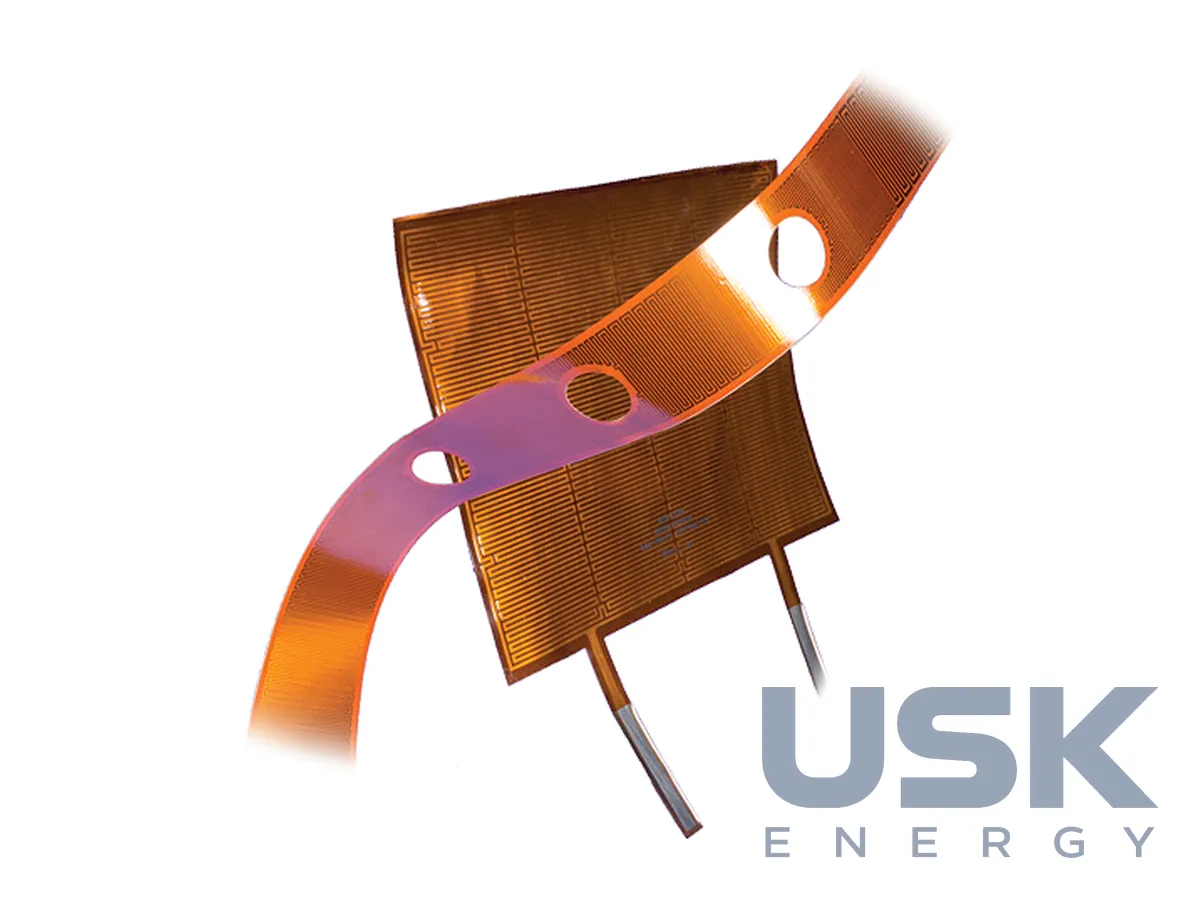
A polyimide heater has a heating element sandwiched between two layers of polyimide film insulation. Polyimide is a thin, light, transparent organic polymer with high tensile strength, tear resistance and dimensional stability. The heater is bonded or pressed directly onto the surface of the part, so heat passes through without air gaps.
The operating range runs from -195 to 200 °C (-319 to 392 °F), with a maximum power density of 7.75 W/cm² (50 W/in²). The material releases little gas in vacuum and withstands radiation, fungus, chemicals and solvents, so these heaters are placed in vacuum and clean equipment.
The heating element is made as wire or etched foil. The traces are spaced evenly and can sit as little as 0.08 mm apart, which evens out the heat distribution and shortens heat-up and cool-down times. The flat form allows holes, cut-outs and non-standard outlines, and the heater bends to follow complex part geometry. Low mass and low thermal inertia make it suitable where space or weight is limited. Many non-standard heaters can carry UR and cUR recognition.
In aircraft they keep wings, leading edges and engine housings de-iced and at temperature. In medical and laboratory equipment they handle sample preparation, reagent heating, analytical instruments, DNA sequencing and incubators. In semiconductors and electronics they serve wafer processing, chemical vapour deposition (CVD) and rapid thermal processing (RTP). In cars they warm seats, mirrors, windscreens, fuel lines and electric vehicle batteries.
They are also used in food equipment to hold temperature during processing, packaging and sterilisation, to heat the 3D printer bed, and in oil and gas to heat pipelines, flow assurance systems and instruments, preventing hydrate and wax formation. Other uses include climate chambers for testing and accelerated ageing, satellites, avionics, radar, military equipment, and consumer electronics for battery warming and display defrosting.
Technical specifications
| Shell material | polyimide |
|---|---|
| Operating temperature | -195 to 200 °C (-319 to 392 °F) |
| Maximum watt density | 7.75 W/cm² (50 W/in²) |
| Heating element | wire or etched foil |
| Trace spacing | from 0.08 mm |
| Form | flat, with holes, cut-outs and non-standard outlines |
| Properties | low outgassing in vacuum, resistant to radiation, fungus, chemicals and solvents |
| Recognition | UR and cUR (for many non-standard designs) |
| Family | flexible heaters |
Request a price and lead time
Polyimide Film Heaters, Working Range to 200 °C, Density to 7.75 W/cm². We reply within one business day.
Or email sales@usk.ua or call 044 339-50-20.
Questions and answers
What is the upper operating temperature of a polyimide heater?
The operating range runs from -195 to 200 °C. For higher temperatures, the flexible heater family includes silicone versions rated to 260 °C.
Can the heater be used in vacuum?
Yes. Polyimide releases little gas in vacuum and resists radiation, so the heater suits vacuum and semiconductor equipment.
Which heating element options are available?
A wire element or an etched foil element, with traces that can be spaced as little as 0.08 mm apart for even heating.
Similar equipment from other manufacturers