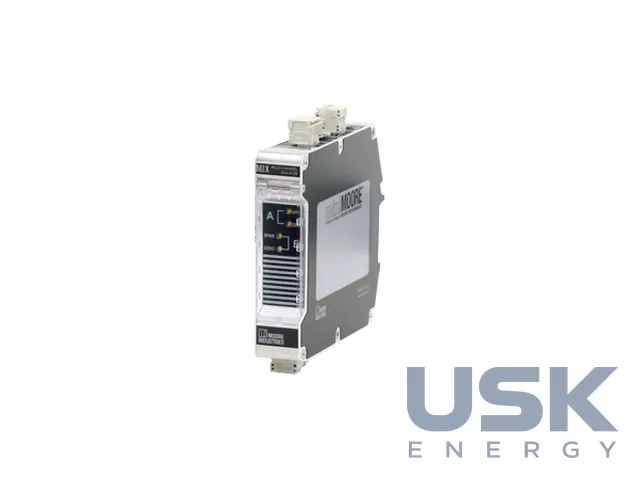
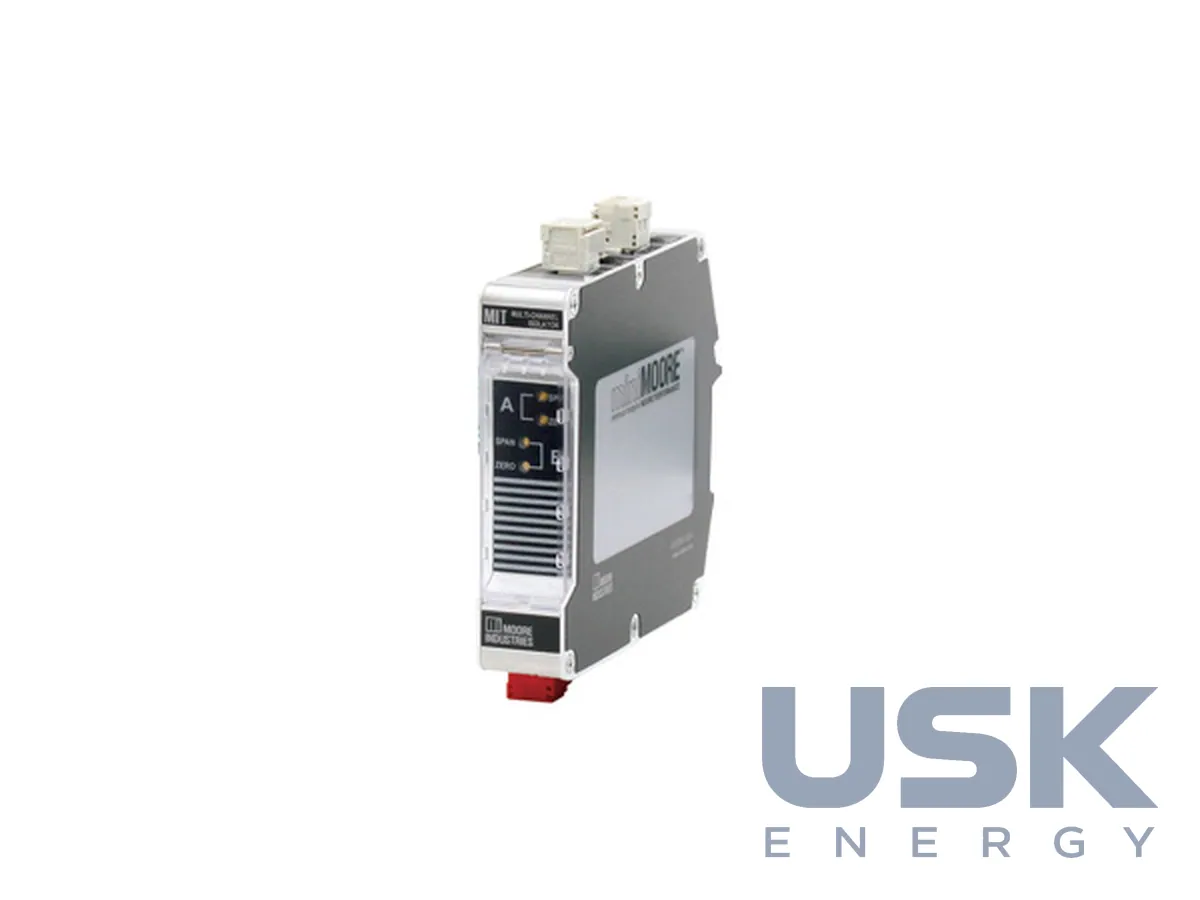
MIT 2XPRG 2-Channel 4-Wire Signal Isolator and Converter, 20-125 VDC or 90-250 VAC Supply
The MIT 2XPRG is a two-channel signal isolator in a housing 25.4 mm wide. Inputs are DIP-switch selectable per channel and both outputs are 4-20 mA. It runs from 20-125 VDC or 90-250 VAC and isolates at 1000 Vrms.
- Type
- Multi-channel signal isolator and converter, 4-wire
- Number of channels
- 2
- Input (2XPRG)
- 4-20 mA, 0-5 V, 1-5 V or 0-10 V, DIP-switch selectable per channel
- Output (2X4-20mA)
- Two 4-20 mA channels
Price, availability and lead time on request. We help with analogue selection, customs clearance and delivery.
Description
The 2XPRG version of the MIT has two independent channels in a housing 25.4 mm wide. A DIP switch for each channel selects a 4-20 mA, 0-5 V, 1-5 V or 0-10 V input. Each channel gives a 4-20 mA output ready to connect to an indicator, recorder, DCS, PLC or SCADA system.
Unlike the 2-wire MIX, the MIT is a 4-wire unit fed from the mains or a DC source. Its power input is universal, accepting any supply between 20-125 VDC and 90-250 VAC automatically, so it suits locations that have either AC or DC power.
Isolation is up to 1000 Vrms between inputs and outputs and from channel to channel, and 2500 Vrms between power and signals. It breaks ground loops and blocks motor noise and other electrical interference. The unit can also boost a signal when more instruments join a loop, split one primary signal between systems, and cure the clash when a 4-wire transmitter and a DCS both power the same loop.
The metal case screens against RFI/EMI. The DIN housing mounts on 32 mm G-type or 35 mm Top Hat rail and measures 114 x 111 x 25.4 mm. Accuracy is +/-0.1 %.
Approvals: UL, CSA for general locations, Non-Incendive Class I, Division 2, Groups A, B, C, D, CE to EN 61326 and EN 61010, and RoHS. Signal wiring should be shielded twisted pair. HART pass-through and SIS use are not provided for.
Technical specifications
| Type | Multi-channel signal isolator and converter, 4-wire |
|---|---|
| Number of channels | 2 |
| Input (2XPRG) | 4-20 mA, 0-5 V, 1-5 V or 0-10 V, DIP-switch selectable per channel |
| Output (2X4-20mA) | Two 4-20 mA channels |
| Power (U) | Universal: 20-125 VDC or 90-250 VAC |
| Isolation | Up to 1000 Vrms input to output and channel to channel; 2500 Vrms between power and signals |
| Accuracy | +/-0.1 % |
| Housing | Universal DIN-style housing, 32 mm G-type and 35 mm Top Hat rail |
| Dimensions | 114 x 111 x 25.4 mm |
| HART / SIS | HART pass-through: no; for SIS use: no |
| Approvals | UL, CSA General Location, Non-Incendive/Div. 2, CE, RoHS |
Part numbers
Show all part numbers (1)
MIT/2XPRG/2X4-20mA/U
How it compares with similar models
| Parameter | MIT 2XPRG 2-Channel 4-Wire Signal Isolator and Converter, 20-125 VDC or 90-250 VAC Supply | MIX 2XPRG 2-Channel Signal Isolator and Converter, 4-20 mA, 0-5 V, 1-5 V, 0-10 V Inputs | FCT PRG/PRG/U/-TX Field-Configurable Signal Isolator, Converter and Repeater | ECT 4-20mA/4-20mA/5.5VLP 2-Wire Input-Loop-Powered Signal Isolator and Converter |
|---|---|---|---|---|
| Type | Multi-channel signal isolator and converter, 4-wire | Multi-channel signal isolator and converter, 2-wire | Signal isolator, converter and repeater, 4-wire | Signal isolator and converter, 2-wire |
| Isolation | Up to 1000 Vrms input to output and channel to channel; 2500 Vrms between power and signals | Up to 1000 Vrms, input to output and channel to channel | 1000 Vrms between input, output and power; 500 Vac with -RF option | 500 Vrms for input-loop-powered versions |
| Accuracy | +/-0.1 % | +/-0.1 % | +/-0.1 % of span | — |
| Approvals | UL, CSA General Location, Non-Incendive/Div. 2, CE, RoHS | UL, CSA General Location, Non-Incendive/Div. 2, CE, RoHS | CSA General Location | UL, Non-Incendive/Div. 2, Zone 2, RoHS |
Request a price and lead time
MIT 2XPRG 2-Channel 4-Wire Signal Isolator and Converter, 20-125 VDC or 90-250 VAC Supply. We reply within one business day.
Or email sales@usk.ua or call 044 339-50-20.
Questions and answers
What supply does the MIT 2XPRG need?
Any supply of 20-125 VDC or 90-250 VAC; the unit detects the range automatically.
How does the MIT differ from the MIX?
The MIT is a 4-wire unit fed from the mains or a DC source, while the MIX is a 2-wire unit powered from the output loop.
What isolation is there between power and signals?
2500 Vrms between power and signals, and up to 1000 Vrms between inputs, outputs and channels.
Similar equipment from other manufacturers