
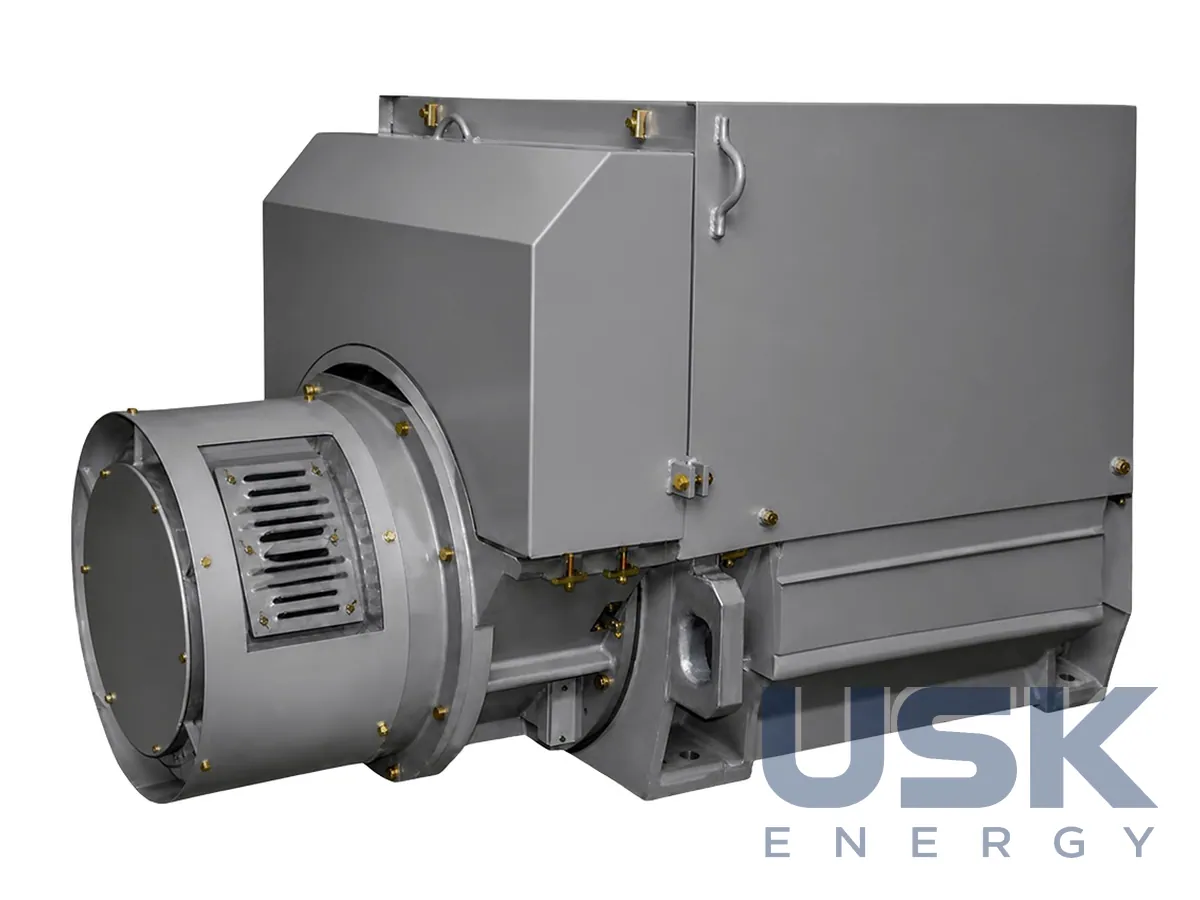
Wound-rotor induction motors 150–15 000 kW, 3–11 kV
Wound-rotor induction motors of 150–15 000 kW for voltages of 3 000, 3 300, 4 160, 6 000, 6 600, 10 000 and 11 000 V. They smoothly accelerate machines with a large moment of inertia and heavy starting conditions, such as mills, hoists and conveyors. The motor develops significant torque already when starting from standstill, with a low inrush current.
- Power
- 150–15 000 kW (100–10 000 hp per the series page)
- Voltage
- 3 000, 3 300, 4 160, 6 000, 6 600, 10 000, 11 000 V
- Rotor
- insulated winding, slip rings and carbon-composite brushes
- Starting
- external resistor bank or liquid rheostat
Price, availability and lead time on request. We help with analogue selection, customs clearance and delivery.
Description
Instead of squirrel-cage bars, the rotor has an insulated three-phase winding brought out to slip rings. The winding ends are connected to the rings on the shaft, and the brush assembly stays accessible for inspection. Carbon-composite brushes rest on the rings, and through them external resistors, a resistor bank or a liquid rheostat are connected into the rotor circuit. By changing the resistance, the mechanical characteristic of the motor is adjusted. This gives a high starting torque at a low starting current and, when needed, changes the speed.
Heat during starting is dissipated in the external resistors and not in the rotor, so the machine tolerates prolonged starts of heavy flywheel masses and lasts longer. After acceleration the resistance is taken out, and the motor runs as an ordinary induction motor. The starting current is limited, so the load on the network during acceleration is small. A liquid rheostat changes the resistance smoothly, while a resistor bank is switched in steps. Speed control through the rotor resistance makes it possible to lower the speed of fans and induced draft fans.
The power range on the series page is from 100 to 10 000 hp. According to the brochure for the cement and quarry industry, wound-rotor motors are made in the range of 150–15 000 kW, and the voltage range starts at 3 000 V and goes up to 11 000 V. The intermediate voltages of 3 300, 4 160, 6 000, 6 600 and 10 000 V cover typical industrial plant networks. The specific version is selected for the machine, the starting duty and the plant network voltage.
The motors are installed on conveyors, ball and SAG mills, mine and production hoists, chippers, fans and induced draft fans, large pumps and Banbury rubber mixers. The main industries include mining and processing, cement, pulp and paper, and chemical plants. For ball and SAG mills with a large flywheel mass, it is the starting conditions that determine the choice of motor. Hoists and long conveyors start under load, so they need high torque from the first turns. The slip ring design is familiar to operating personnel, and servicing the brush assembly is simple.
It is made by the Motors & Drives division of the company's Houston (USA) subsidiary. The products are tested in in-house laboratories accredited to ISO 9001:2015, NVLAP and UL. Service centers operate in Houston and Edmonton.
Technical specifications
| Power | 150–15 000 kW (100–10 000 hp per the series page) |
|---|---|
| Voltage | 3 000, 3 300, 4 160, 6 000, 6 600, 10 000, 11 000 V |
| Rotor | insulated winding, slip rings and carbon-composite brushes |
| Starting | external resistor bank or liquid rheostat |
| Loads | conveyors, ball and SAG mills, hoists, chippers, fans, large pumps, rubber mixers |
Request a price and lead time
Wound-rotor induction motors 150–15 000 kW, 3–11 kV. We reply within one business day.
Or email sales@usk.ua or call 044 339-50-20.
Customs codes
| UKTZED (Ukraine) | 8501 53 81 00 8501 53 94 00 8501 53 99 00 |
|---|---|
| HS, 6 digits | 8501 53 |
| CN (EU) | 8501 53 81 8501 53 94 8501 53 99 |
| HTSUS (USA) | 8501 53 40 00 8501 53 81 40 |
| China customs tariff | 8501 53 00 00 |
Codes are for reference: the final code is determined at declaration for the specific model.
Questions and answers
What power and voltage are wound-rotor motors made for?
According to the manufacturer's brochure, 150–15 000 kW at 3 000, 3 300, 4 160, 6 000, 6 600, 10 000 and 11 000 V. The series page gives a range of 100 to 10 000 hp.
How is the starting of a wound-rotor motor controlled?
An external resistor bank or a liquid rheostat is connected into the rotor circuit through slip rings and brushes. Changing the resistance gives a high starting torque at a low starting current.
What machines are these motors suitable for?
For conveyors, ball and SAG mills, hoists, chippers, fans, induced draft fans, large pumps and Banbury rubber mixers.
Similar equipment from other manufacturers
