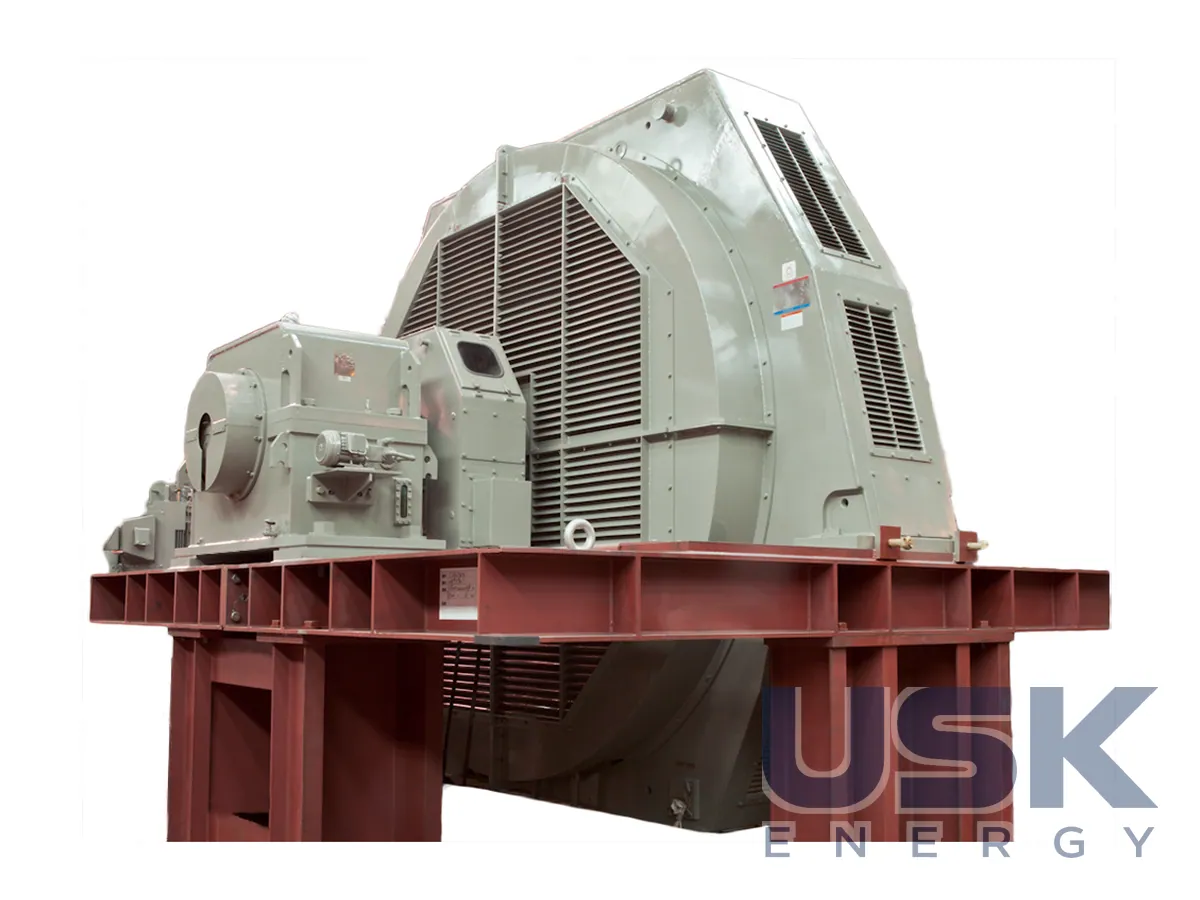
Synchronous motors for compressors, pumps, fans and mills
Synchronous motors run at a constant speed synchronous with the network frequency and drive compressors, pumps, fans, mills, high-speed blowers and DC generators. Efficiency in large industrial frame sizes reaches 95 % and above. The motors also correct the power factor and help stabilize the voltage of the supply network.
- Purpose
- constant speed drive, reactive power compensation
- Efficiency
- up to 95 % and above in large industrial frame sizes
- Voltage (catalog filter)
- 400–4 160 V
- Speed
- 720–3 600 rpm
Price, availability and lead time on request. We help with analogue selection, customs clearance and delivery.
Description
A synchronous motor holds speed precisely over the whole load range, so it is chosen for machines where the process depends on rotational speed. A synchronous machine has no slip, and the rotor turns exactly at the stator field frequency. According to the manufacturer, the efficiency of such a machine is usually higher than that of an induction motor, especially at high loads. For high-power drives that work around the clock, this difference is noticeable in the plant's energy balance.
When running overexcited, the motor supplies reactive power to the network and acts as an adjustable capacitance, and when underexcited it consumes it as an inductance. In this way it corrects the power factor, reduces losses and stabilizes the voltage in the supply network. So at industrial substations synchronous drives are often combined with the function of reactive power compensation.
The design is strong, the materials are durable and there are fewer wearing parts, so the maintenance scope is reduced. Built-in damping mechanisms and predictive maintenance programs improve operating stability. The motors are compact and lighter than designs of earlier generations, compatible with standard IEC frames, and have quick-disconnect terminals and various mounting and orientation options. Quick-disconnect terminals shorten the time to connect and replace a motor.
The synchronous motors work with the T300MV2 and MTX2 variable frequency drives, which support synchronous transfer of several motors from the drive to the line. One drive accelerates the units in turn and passes them to the line, after which it takes the next one. Starting currents and the load on the plant network are then lower than with direct starting. For direct starting and transfer, JK starters and the JK Sync-Xfer system are used. The manufacturer's catalog filter covers voltages of 400–4 160 V and speeds of 720–3 600 rpm.
Typical sites are compressor stations, water conduit pumping stations, fans and mills at cement and mining and processing plants, and drives with reactive power compensation at industrial substations. The motor for them is selected by power, speed and compensation requirements. It is made by the Motors & Drives division of the company's Houston (USA) subsidiary. The products are tested in in-house laboratories accredited to ISO 9001:2015, NVLAP and UL, and service centers operate in Houston and Edmonton.
Technical specifications
| Purpose | constant speed drive, reactive power compensation |
|---|---|
| Efficiency | up to 95 % and above in large industrial frame sizes |
| Voltage (catalog filter) | 400–4 160 V |
| Speed | 720–3 600 rpm |
| Compatibility | start and transfer from the T300MV2 drive / JK Sync-Xfer |
Request a price and lead time
Synchronous motors for compressors, pumps, fans and mills. We reply within one business day.
Or email sales@usk.ua or call 044 339-50-20.
Customs codes
| UKTZED (Ukraine) | 8501 53 81 00 8501 53 94 00 8501 53 99 00 |
|---|---|
| HS, 6 digits | 8501 53 |
| CN (EU) | 8501 53 81 8501 53 94 8501 53 99 |
| HTSUS (USA) | 8501 53 40 00 8501 53 81 40 |
| China customs tariff | 8501 53 00 00 |
Codes are for reference: the final code is determined at declaration for the specific model.
Questions and answers
What efficiency do the synchronous motors have?
Up to 95 % and above in large industrial frame sizes. At high loads the efficiency is usually higher than that of induction motors.
Can synchronous motors compensate reactive power?
Yes, when overexcited the motor acts as an adjustable capacitance, and when underexcited as an inductance. This corrects the power factor and stabilizes the network voltage.
What drives and starters do these motors work with?
With T300MV2 and MTX2 variable frequency drives with synchronous transfer to the line, as well as with JK starters and the JK Sync-Xfer system.
Similar equipment from other manufacturers