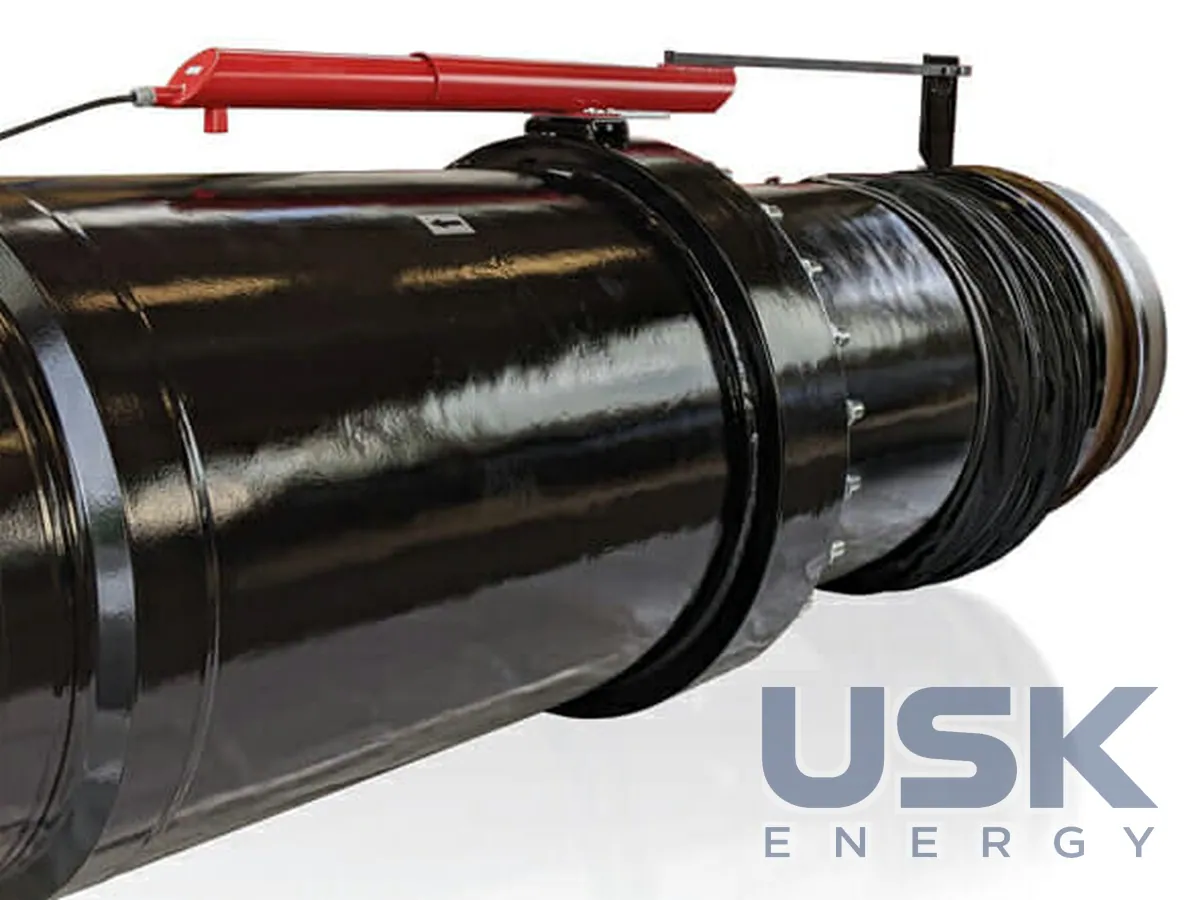
SDS / SDS-K — pipeline expansion joints, DN 80–1000, up to 100 bar
Telescopic expansion joints SDS and SDS-K for gas pipelines, oil pipelines and water mains, DN 80–1000, pressure up to 100 bar. The self-sealing design requires no maintenance and absorbs length changes of up to ±400 mm. Used in mining subsidence areas, seismically active areas and on sections with thermal expansion.
- Type
- maintenance-free self-sealing telescopic expansion joint
- Compensation
- elongation and shortening ±400 mm (standard)
- Pressure
- up to 100 bar (PN 50–100 per catalogue)
- Sizes
- DN 80–1000 (per catalogue)
Price, availability and lead time on request. We help with analogue selection, customs clearance and delivery.
Description
SDS and SDS-K are maintenance-free self-sealing telescopic expansion joints with a freely moving design that is guided and sealed both inside and outside. They absorb changes in pipeline length, elongation and shortening of up to ±400 mm in the standard version, and are used on gas pipelines, oil pipelines and water mains. The main fields of application are pipeline sections in mining subsidence areas, where the ground settles and shifts, in seismically active areas, and on above-ground sections with temperature-related length changes, for example under solar heating.
Freedom from maintenance is achieved by two self-sealing seal systems that work independently and are tested separately, by protection against ingress of contamination, and by special treatment of surfaces prone to corrosion. A combined scraper system keeps out fine particles such as dust, and the sliding surfaces have long-term lubrication. Re-tightening of the seals is not required, and during movements and bending the expansion joint absorbs large moments. Guiding and sealing are divided between two independent systems, which reduces the risk of failure. The bolts are made of steel comparable to 24CrMo5 according to AD W7, with a 3.2 certificate.
The expansion joint is supplied ready for installation, it is easy to adjust, passes cleaning pigs in one direction, can be integrated into the cathodic protection system of the pipeline, and the design is suitable for reuse. In SDS-K the coating of the sliding surface allows the expansion joint to be fully included in the cathodic protection.
Nominal pressure up to 100 bar. The SDS-K overview sheet includes a special version with pipe ends of 600 mm on both sides, as well as variants with a locking system for pressure testing and without it, when the expansion joint is in the middle position. According to the general catalogue, SDS expansion joints are made for DN 80–1000 and PN 50–100. The SDS-K version is distinguished by a compact design, and both variants are described in the general installation and operating manual. The company is certified to PED, AD2000-HP0 and W0, and welding production is certified to DIN EN ISO 3834-2. The expansion joints complement the range of pipeline connecting elements, which includes insulating joints, couplings, tees and manifolds, and are used in high- and medium-pressure gas transmission and gas distribution systems.
Technical specifications
| Type | maintenance-free self-sealing telescopic expansion joint |
|---|---|
| Compensation | elongation and shortening ±400 mm (standard) |
| Pressure | up to 100 bar (PN 50–100 per catalogue) |
| Sizes | DN 80–1000 (per catalogue) |
| Media | gas, oil, water |
| Sealing | two independent self-sealing systems with separate testing; scraper system against dust |
| Other | pig passage, reuse, integration into the cathodic protection system |
| Application | mining subsidence areas, seismic areas, thermal expansion |
Request a price and lead time
SDS / SDS-K — pipeline expansion joints, DN 80–1000, up to 100 bar. We reply within one business day.
Or email sales@usk.ua or call 044 339-50-20.
Questions and answers
What movement does the SDS expansion joint absorb?
Elongation and shortening of up to ±400 mm in the standard version. Nominal pressure up to 100 bar.
Is maintenance of the seals required?
No, the expansion joint is maintenance-free. Two self-sealing systems work independently and are tested separately, re-tightening of the seals is not required.
For which diameters and pressures is SDS made and where is it used?
According to the general catalogue for DN 80–1000 at PN 50–100. Typical places of use are mining subsidence areas, seismically active areas and above-ground sections with temperature-related length changes.
Similar equipment from other manufacturers