SPRECON-E-C-SYNC — synchro-check and parallel switching device
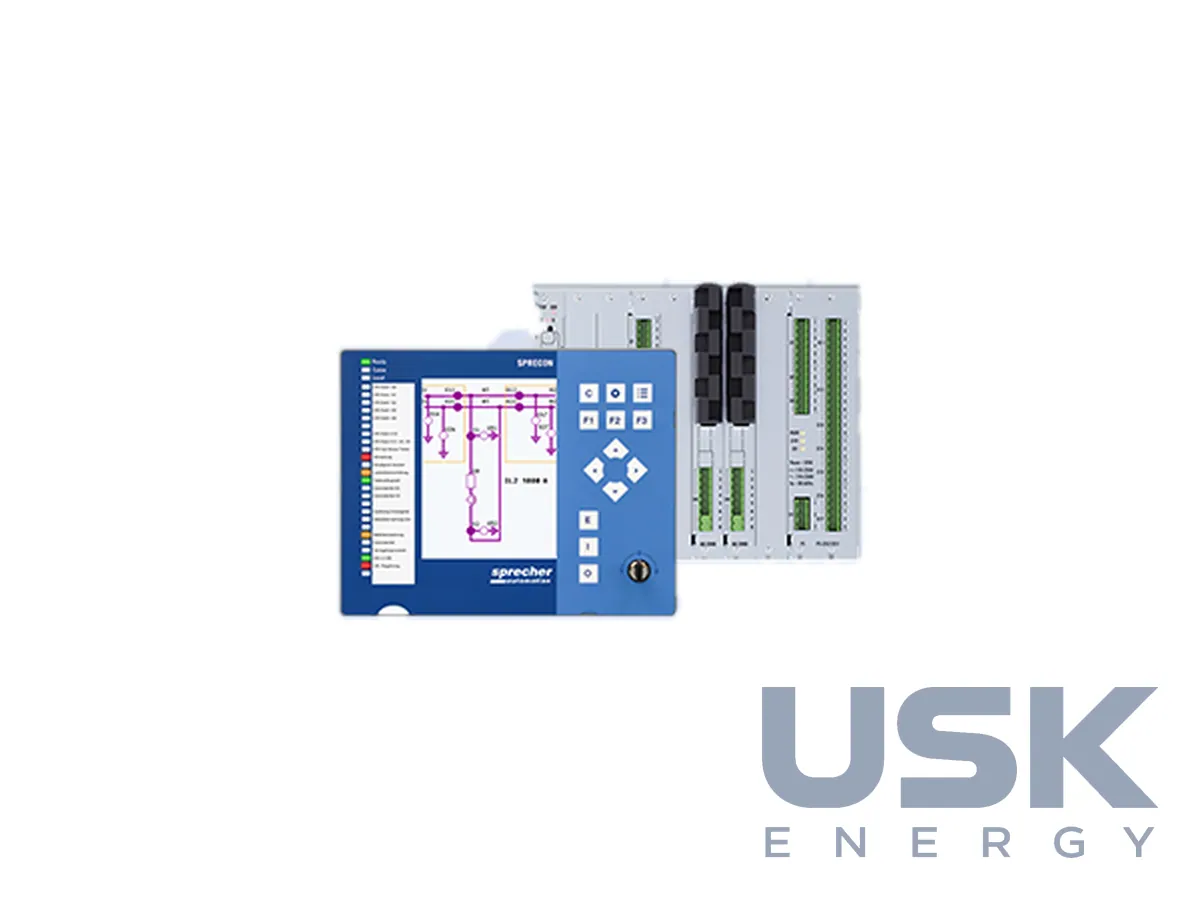
SPRECON-E-C-SYNC is a parallel switching (synchro-check) device for connecting two live parts of a network. It compares two voltages by phase difference, frequency and amplitude and releases the circuit breaker closing only when the synchronism conditions are met. The device works stand-alone or as a function in the SPRECON-E-C bay controller.
- Measurement
- two voltages: phase difference, frequency and amplitude
- Modes
- closing on demand or continuous synchronism monitoring; manual polling of the state (synchronous/asynchronous/dead)
- Parameter sets
- up to 6
- Versions
- stand-alone network device or a function in the SPRECON-E-C field device
Price, availability and lead time on request. We help with analogue selection, customs clearance and delivery.
Description
Typical installation sites are bus coupler and sectionalizing breakers of substations, connecting generators and renewable networks for parallel operation, and restoring the normal scheme after a network section has operated in island mode. The parallel switching function is located centrally or decentrally. Depending on the application, it is activated on demand or continuously monitors synchronism.
The command to the feeder circuit breaker first goes to the parallel switching function. It checks synchronism and voltage and only then releases execution of the command. The synchronism condition requires that the phase difference between the feeder voltage and the busbar voltage lies within defined limits. Voltage supervision runs in parallel with synchro-check, and different criteria for blocking the command output can be set. In this way separated parts of a network are safely connected after separation or island operation.
The state of the networks can also be polled manually. In this mode the device only shows the current state: synchronous, asynchronous or dead. Up to 6 parameter sets are available, and they are switched by commands or directly from the process. Besides the stand-alone network version, the parallel switching function is implemented in the SPRECON-E-C field device together with other bay control functions.
According to the technical document the device has up to 20 wide-range binary inputs for 24–220 V DC and 110–230 V AC 50/60 Hz, up to 8 analog inputs or 4 analog outputs 0…±20 mA. The power supply is 24–60 V DC or 110–250 V DC and 110–230 V AC 50/60 Hz. Communication runs through 2/3 Ethernet ports 10/100 Mbit/s (RJ45) or a built-in switch for an optical ring with 2 optical (BFOC) and 1 electrical RJ45 port. For 16.7 Hz networks the operating frequency range is 14.7–18.7 Hz. The front panel has 25 freely parameterizable LEDs in red, green and orange.
The device complies with EN 55022, IEC 60255, IEC 61010, IEC 60870-2, IEC 61000-4 and IEC 61000-6 and carries the CE mark. An extended temperature range from −25 to +70 °C is supplied on request. In a substation control system the device works over the standard protocols of the SPRECON-E platform alongside SPRECON-E-C FLG controllers, SPRECON-E-C-AVR regulators and SPRECON-EDIR indicators.
Technical specifications
| Measurement | two voltages: phase difference, frequency and amplitude |
|---|---|
| Modes | closing on demand or continuous synchronism monitoring; manual polling of the state (synchronous/asynchronous/dead) |
| Parameter sets | up to 6 |
| Versions | stand-alone network device or a function in the SPRECON-E-C field device |
Request a price and lead time
SPRECON-E-C-SYNC — synchro-check and parallel switching device. We reply within one business day.
Or email sales@usk.ua or call 044 339-50-20.
Customs codes
| UKTZED (Ukraine) | 8537 10 98 00 |
|---|---|
| HS, 6 digits | 8537 10 |
| CN (EU) | 8537 10 98 |
| HTSUS (USA) | 8537 10 91 70 |
| China customs tariff | 8537 10 90 90 |
Codes are for reference: the final code is determined at declaration for the specific model.
Questions and answers
Which parameters does SPRECON-E-C-SYNC compare before closing?
The device measures two voltages and compares the phase difference, frequency and amplitude. The phase difference between the feeder voltage and the busbar voltage must lie within defined limits.
How many parameter sets does the device support?
Up to 6 parameter sets, which are switched by commands or directly from the process.
Does the device work in 16.7 Hz networks?
Yes, for a frequency of 16.7 Hz the operating range is 14.7–18.7 Hz. The device power supply is 24–60 V DC or 110–250 V DC and 110–230 V AC 50/60 Hz.
Similar equipment from other manufacturers