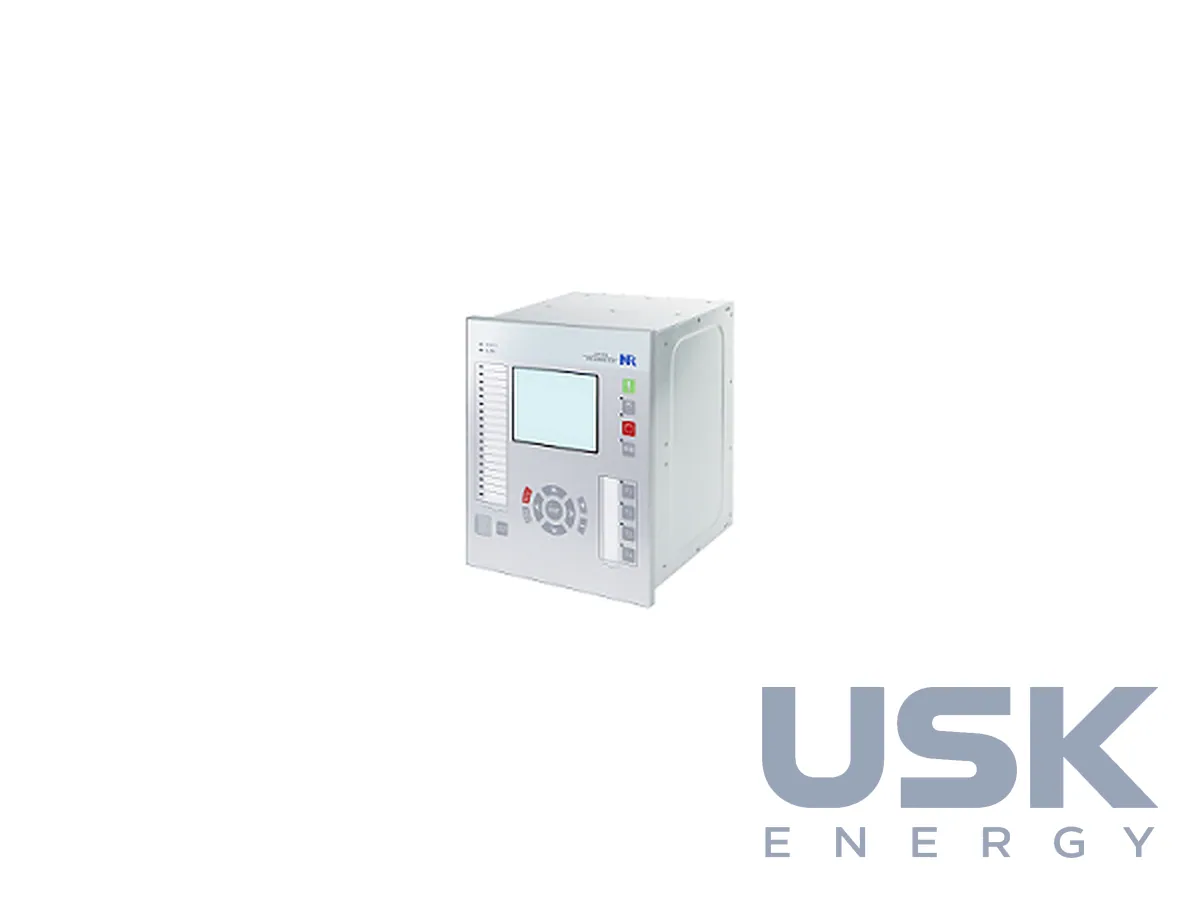
PCS-931 / PCS-931S — line differential protection terminal
NR PCS-931 and PCS-931S are line current differential protection terminals for transmission lines with a full set of main and backup functions. They are installed on overhead, cable and mixed lines of various voltage classes, including three-terminal, double-circuit, series-compensated and weak-infeed lines. The terminals are used at grid company substations, power plants and in wind and solar farm power evacuation schemes.
- Application
- main protection of overhead, cable and mixed lines, including three-terminal lines
- Main protection
- longitudinal phase current differential protection, DPFC differential protection (87L)
- Features
- adaptive restraint threshold, dynamic capacitive current compensation
- Backup protection
- distance protection with teleprotection, zero-sequence overcurrent protection, overcurrent protection, breaker failure protection, out-of-step protection
Price, availability and lead time on request. We help with analogue selection, customs clearance and delivery.
Description
The main protection (87L) compares phase currents at the line ends phase by phase. The terminals at each end exchange instantaneous current values over an optical channel, so the protection covers the whole line length without time delay. Patented developments are used here: an adaptive restraint threshold, dynamic compensation of the line charging (capacitive) current and differential protection based on power frequency fault components (DPFC). They increase sensitivity to faults through transition resistance and stability during external faults with current transformer saturation. According to the documentation, if the CTs transform the current correctly for at least 3 ms, the differential protection does not operate falsely on an external fault. The PCS-931S also has neutral current differential protection.
The two communication channels are used for redundancy or to protect a three-terminal line. Supported interfaces are G.703 and IEEE C37.94 at 64 kbit/s or 2 Mbit/s, direct dedicated fibre and multiplexed channels, single-mode and multimode links. The PCS-931S belongs to the new PCS-S platform and is configured with the PCS-Studio software.
Backup functions are built into the same enclosure. The fast distance protection with teleprotection schemes in the PCS-931S has six zones for phase-to-phase faults and six for earth faults, with a typical operating time of 12–15 ms. It is complemented by directional zero-sequence protection, stepped overcurrent protection of phase, zero-sequence and negative-sequence currents, and voltage and frequency protection. There are breaker failure protection for one or two breakers, dead zone protection, and protection against open-phase operation, conductor break and out-of-step conditions. Separate power swing blocking logic prevents false operation on external faults during power swings and quickly trips internal faults.
Single- and three-phase auto-reclosing with synchro-check works in schemes with one and two breakers, and the terminal controls the breaker, disconnectors and earthing switches. Built-in functions include a fault locator, a recorder for 1024 changes of binary inputs, up to 32 COMTRADE oscillograms, and supervision of CT/VT circuits and channels. Integration into the SCADA system uses IEC 61850-8-1 (MMS, GOOSE), IEC 61850-9-2 (SV), DNP3.0 and IEC 60870-5-103 over Ethernet and RS-485 ports; the PCS-931S also offers PRP/HSR redundancy and cybersecurity features. Time is synchronised via IRIG-B, SNTP, PPS and IEEE 1588, and the front RJ45 port simplifies commissioning and testing.
Technical specifications
| Application | main protection of overhead, cable and mixed lines, including three-terminal lines |
|---|---|
| Main protection | longitudinal phase current differential protection, DPFC differential protection (87L) |
| Features | adaptive restraint threshold, dynamic capacitive current compensation |
| Backup protection | distance protection with teleprotection, zero-sequence overcurrent protection, overcurrent protection, breaker failure protection, out-of-step protection |
| Channels | 2 optical channels (redundancy or three-terminal line), G.703 / IEEE C37.94 |
| Auto-reclosing | single- and three-phase, one or two breakers, synchro-check |
| Protocols | IEC 61850-8-1, IEC 61850-9-2, DNP3.0, IEC 60870-5-103; PRP/HSR (931S) |
| Recording | COMTRADE oscillograms, events, fault locator |
Request a price and lead time
PCS-931 / PCS-931S — line differential protection terminal. We reply within one business day.
Or email sales@usk.ua or call 044 339-50-20.
Customs codes
| UKTZED (Ukraine) | 8537 10 98 00 |
|---|---|
| HS, 6 digits | 8537 10 |
| CN (EU) | 8537 10 98 |
| HTSUS (USA) | 8537 10 91 70 |
| China customs tariff | 8537 10 90 90 |
Codes are for reference: the final code is determined at declaration for the specific model.
Questions and answers
How many communication channels does the PCS-931 have and what are they used for?
The terminal has two optical channels per G.703 or IEEE C37.94. The second channel backs up the first or connects the third end of a three-terminal line.
Which backup protections are built into the PCS-931?
Distance protection with teleprotection, zero-sequence overcurrent protection, overcurrent protection, breaker failure protection and out-of-step protection. The typical operating time of the PCS-931S distance protection is 12–15 ms.
Does the protection account for the capacitive current of long and cable lines?
Yes, the PCS-931 has dynamic compensation of the line capacitive current and an adaptive restraint threshold. This keeps the protection sensitive on long overhead and cable lines.
Similar equipment from other manufacturers