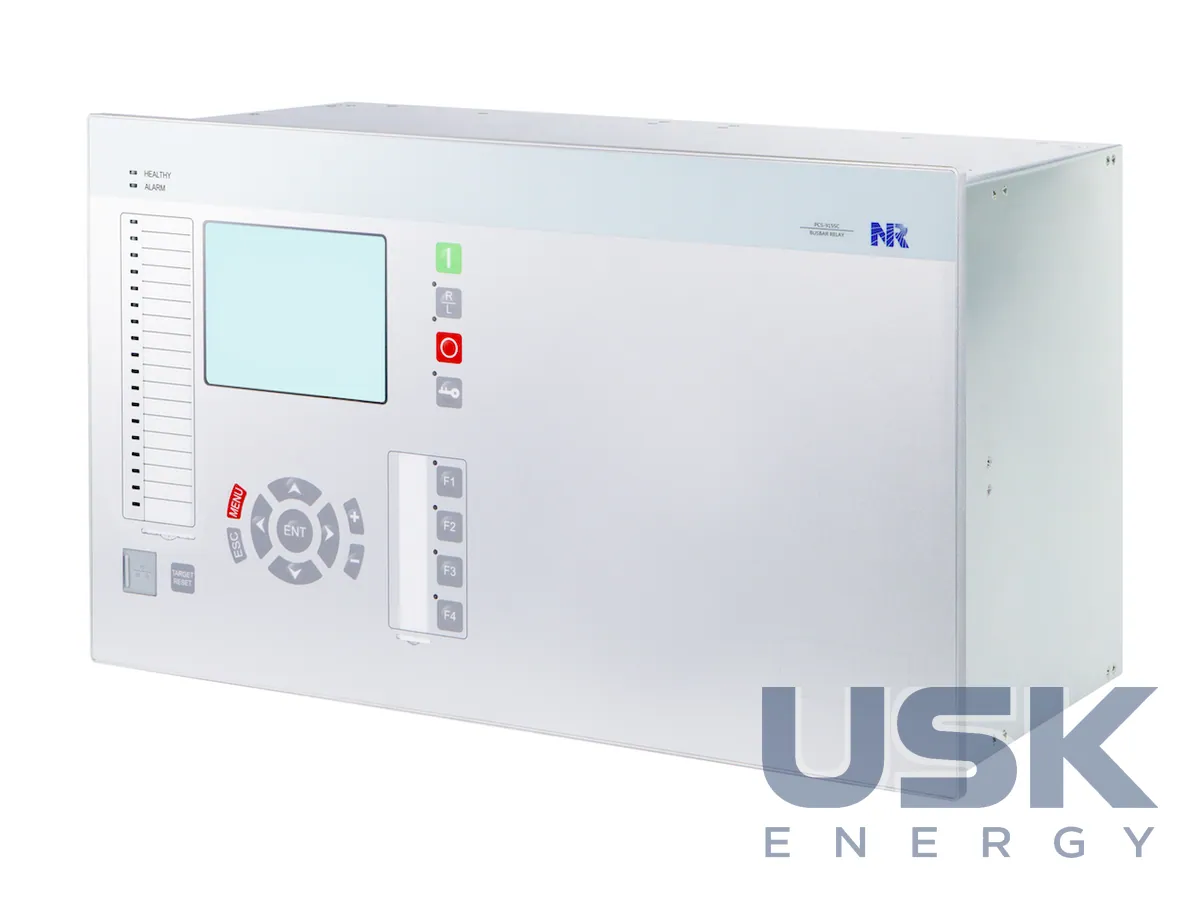
PCS-915 — busbar differential protection terminal (centralised and distributed)
NR PCS-915 is a family of microprocessor-based low-impedance busbar differential protection terminals for switchgear of all voltage classes. The centralised PCS-915IC protects up to 25 bays in one cabinet, while the distributed PCS-915ID works with up to 32 bay units over optical fibre. The terminals are used at substations and power plants.
- Versions
- PCS-915IC, PCS-915SC (centralised); PCS-915ID, PCS-915SD (distributed: central unit + bay units)
- Number of bays
- up to 25 (915IC); up to 32 bay units (915ID)
- Switchgear schemes
- single/double busbar systems with sectionalising, with bypass bus, one-and-a-half breaker, polygon
- Main protection
- low-impedance busbar differential protection (87B) with starting and selective elements, DPFC
Price, availability and lead time on request. We help with analogue selection, customs clearance and delivery.
Description
The family includes two groups of terminals. In the centralised PCS-915IC and PCS-915SC all current circuits are brought into one cabinet. In the distributed PCS-915ID and PCS-915SD the central unit is linked to the bay units by optical fibre in point-to-point mode. The central unit calculates the protection and controls the device; the bay units collect analogue and binary signals and execute trip and close commands. S models belong to the PCS-S platform and are configured with PCS-Studio. According to the PCS-915SC documentation, the busbar protection covers up to 4 busbar systems and 32 bays.
The terminals work with a single busbar system with and without sectionalising, double systems with and without a bypass bus, a one-and-a-half breaker scheme and a polygon. The topology is set in the settings, the busbar diagram follows the disconnector positions dynamically, and a mismatch of their auxiliary contacts raises an alarm.
The main function (87B) trips busbar faults faster than one power frequency cycle. The starting element (check zone) works together with the selective elements of each section, so only the faulted section is tripped and the de-energised zone is minimal. The phase-segregated differential protection combines the steady-state component and the DPFC fault component. A patented weighted CT saturation detection method and harmonic restraint prevent false operation on external faults if the CTs work correctly for at least 3 ms. The typical operating time of the DPFC protection does not exceed 15 ms in the PCS-915SC and is up to 20 ms in the PCS-915ID. Voltage-controlled starting is also provided.
Besides busbar protection, the terminals perform breaker failure protection (50BF) with a current element that resets in no more than 12 ms, dead zone protection (50DZ), bus coupler and bus section breaker protection, bay protection and protection against open-phase operation. For the bus coupler and sectional breakers, overcurrent protection, switch-onto-fault protection and dead zone differential protection with two CTs are available, and the PCS-915SC also has voltage and frequency protection. IEC 61850-8-1 and IEC 61850-9-2 are supported with up to 32 optical ports for SV and GOOSE, as well as DNP3.0, IEC 60870-5-103, Modbus, PRP/HSR redundancy, and IRIG-B, SNTP and PPS synchronisation. The recorder stores 1024 events and oscillograms in COMTRADE format, and the front RJ45 port is used for setting and testing.
Technical specifications
| Versions | PCS-915IC, PCS-915SC (centralised); PCS-915ID, PCS-915SD (distributed: central unit + bay units) |
|---|---|
| Number of bays | up to 25 (915IC); up to 32 bay units (915ID) |
| Switchgear schemes | single/double busbar systems with sectionalising, with bypass bus, one-and-a-half breaker, polygon |
| Main protection | low-impedance busbar differential protection (87B) with starting and selective elements, DPFC |
| Operating time | less than one power frequency cycle |
| Additional functions | breaker failure protection (50BF), dead zone protection (50DZ), bus coupler/sectional breaker protection, overcurrent protection, open-phase protection |
| Protocols | IEC 61850-8-1, IEC 61850-9-2 (up to 32 optical SV/GOOSE ports), DNP3.0, IEC 60870-5-103 |
| Recording | 32–1024 COMTRADE oscillograms, 1024 events |
Request a price and lead time
PCS-915 — busbar differential protection terminal (centralised and distributed). We reply within one business day.
Or email sales@usk.ua or call 044 339-50-20.
Customs codes
| UKTZED (Ukraine) | 8537 10 98 00 |
|---|---|
| HS, 6 digits | 8537 10 |
| CN (EU) | 8537 10 98 |
| HTSUS (USA) | 8537 10 91 70 |
| China customs tariff | 8537 10 90 90 |
Codes are for reference: the final code is determined at declaration for the specific model.
Questions and answers
How many bays does the PCS-915 protect?
The centralised PCS-915IC protects up to 25 bays. The distributed PCS-915ID works with up to 32 bay units connected to the central unit by optical fibre.
Which switchgear arrangements does the terminal support?
Single and double busbar systems with sectionalising, schemes with a bypass bus, the one-and-a-half breaker scheme and the polygon. The topology is set in the terminal settings.
How fast is the PCS-915 busbar differential protection?
The protection trips busbar faults faster than one power frequency cycle. The typical operating time of the PCS-915SC DPFC protection does not exceed 15 ms.
Similar equipment from other manufacturers