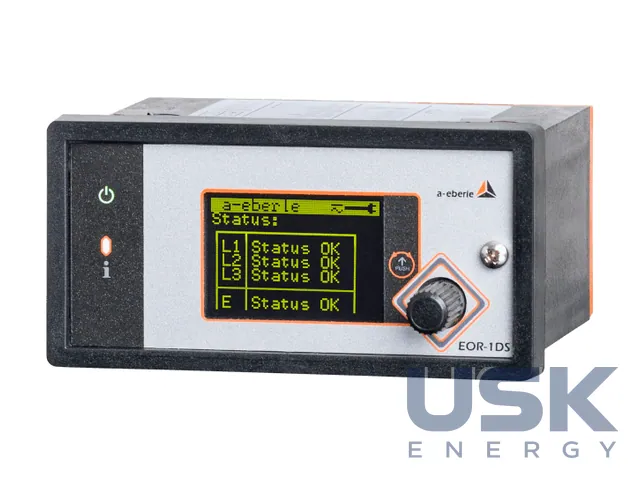
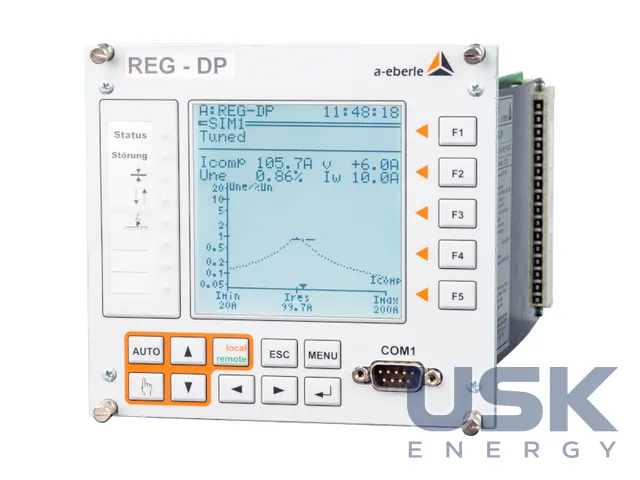
Earth Fault Locator selective detection of the feeder with an earth fault
The device determines on which feeder an earth fault has occurred in networks with resonant and other types of high-impedance neutral earthing. It works without a neutral earthing resistor and is combined with the arc suppression reactor tuning controller. One rack monitors 8 feeders.
- Feeders in the main 19″ rack
- 8
- Additional feeders
- 14 per each slave rack
- Algorithms
- initial transient; adaptive zero-sequence admittance
- Functions
- feeder indication, tripping of the faulted feeder, distance to the earth fault in loops
Price, availability and lead time on request. We help with analogue selection, customs clearance and delivery.
Description
Earth Fault Locator is intended for detecting and selectively identifying the feeder with a single-phase earth fault in networks with resonant and other types of high-impedance neutral earthing. It is combined with the automatic arc suppression reactor tuning controller (SN-NM-A1 version). The device reports on which outgoing feeder the fault has occurred, can trip it and, in loop networks, estimate the distance to the fault location.
The main advantage is high sensitivity without a neutral earthing resistor. Traditional directional protections need an active current for selectivity, which a resistor creates by increasing the fault current. The locator uses two algorithms based on the neutral voltage and the zero-sequence currents of the feeders. The initial transient algorithm analyzes the charge component (100 Hz–2 kHz), which is measured by ordinary current transformers, and instantly detects the faulted feeder in low-resistance and intermittent breakdowns. The discharge component has a frequency of 10–100 kHz and is not measured by ordinary current transformers. In the faulted feeder, the current and the neutral voltage are in antiphase (180 degrees) relative to the healthy feeders.
The adaptive zero-sequence admittance algorithm compares the admittances of the feeders before and after switching the capacitor step of the reactor. The change is observed only on the faulted feeder, so the method works at any fault resistance, does not depend on reactor detuning and eliminates CT and VT errors. It is suitable for radial and closed networks, for schemes with GFN and for backup tripping. One 19-inch rack contains monitoring of 8 feeders and the tuning controller, and each slave rack adds another 14 feeders.
The local panel shows the faulted feeder, group signals and network parameters with LEDs. All faults are recorded and downloaded with the NMTerm program, which also includes a function for calculating the distance to the fault along a loop with reference points. Communication with telemechanics is by protocol over Ethernet, modem or wired signals of 24–110 V DC. The device power supply is 90–230 V AC/DC. The cable plan provides for connecting busbar VTs, summation current transformers of the feeders (for example 200/5 A) and reactor control circuits. Together with the controller and the GFN system, the locator forms a complete earth fault protection package without increasing the fault current.
Technical specifications
| Feeders in the main 19″ rack | 8 |
|---|---|
| Additional feeders | 14 per each slave rack |
| Algorithms | initial transient; adaptive zero-sequence admittance |
| Functions | feeder indication, tripping of the faulted feeder, distance to the earth fault in loops |
| Built-in function | automatic tuning of arc suppression reactors of any type |
| Power supply | 90–230 V AC/DC |
| Current inputs | feeder 3I0 CTs (example 200/5 A) |
| Communication | Ethernet/protocol, modem, wired signals 24–110 V DC |
| Software | NMTerm |
Request a price and lead time
Earth Fault Locator selective detection of the feeder with an earth fault. We reply within one business day.
Or email sales@usk.ua or call 044 339-50-20.
Questions and answers
How many feeders does one rack monitor?
One 19-inch rack contains monitoring of 8 feeders and the tuning controller. Each slave rack adds another 14 feeders.
Is a neutral earthing resistor required?
No. High sensitivity is achieved without it, so the fault current is not increased.
Which algorithms does the locator use?
The initial transient algorithm on the charge component of 100 Hz–2 kHz and the adaptive zero-sequence admittance algorithm. The device power supply is 90–230 V AC/DC.
Similar equipment from other manufacturers