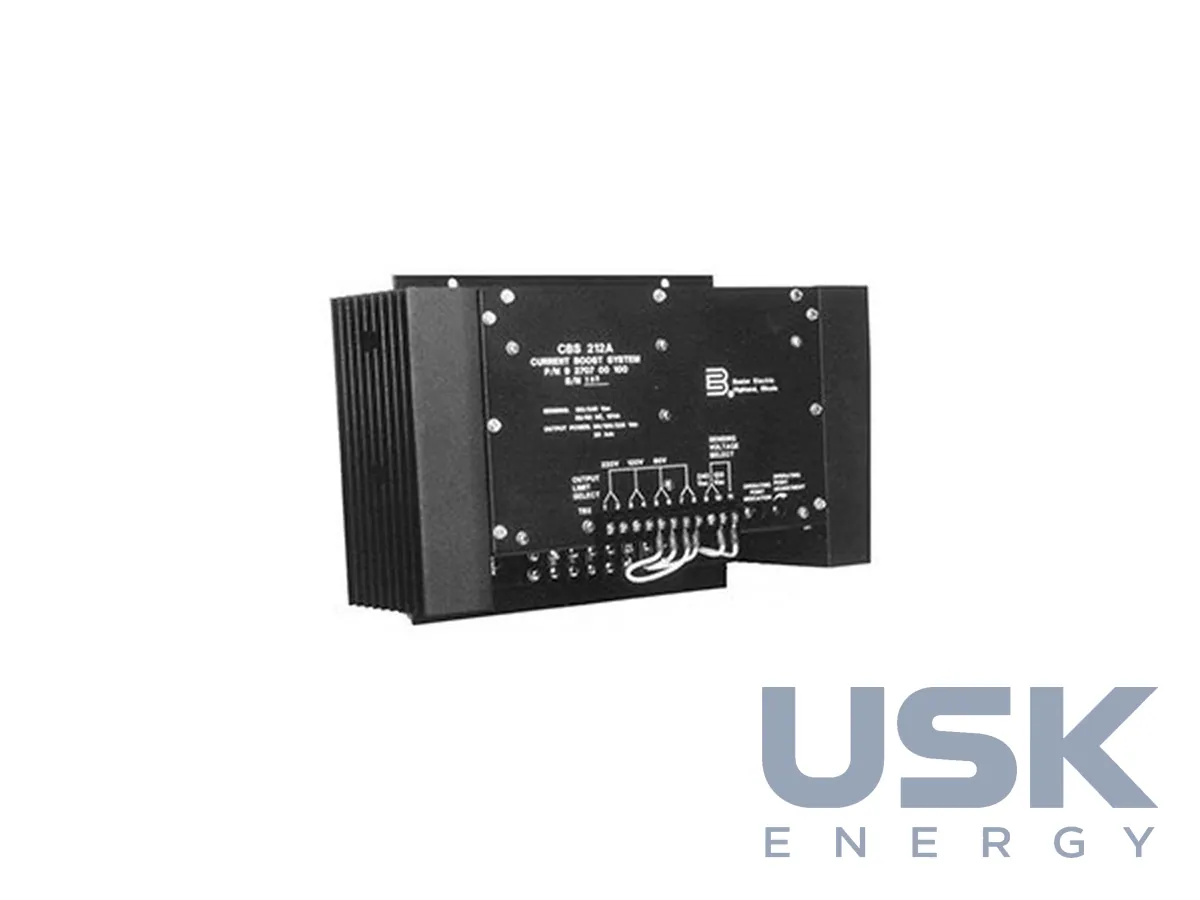
CBS-212A — generator excitation current boost system
CBS-212A maintains generator excitation during electric motor starting and short circuits on generator lines. Additional current is fed into the excitation winding by power current transformers at the generator terminals. The system responds instantly and replaces schemes with a PMG pilot exciter.
- Principle
- power current transformers at the generator terminals feed additional current into the excitation winding
- Purpose
- motor starting, short circuits on generator lines
- Response
- instantaneous
- Alternative
- replaces systems with a PMG pilot exciter
Price, availability and lead time on request. We help with analogue selection, customs clearance and delivery.
Description
The CBS-212A is a Current Boost System. It maintains generator excitation during motor starting and short circuits on generator lines. In such modes the voltage at the terminals of a self-excited generator falls, and an ordinary regulator cannot hold the required excitation current. As a result the voltage sags, motor starting becomes harder, and the short-circuit current may be insufficient for selective operation of the protection.
The principle is simple. Power current transformers are installed on the generator terminals. The load or short-circuit current is transformed and fed into the excitation winding as an additional component. This increases the stability of the power system, improves the clearing of faults by protection and supports motor starting. The system responds instantly: it applies the required excitation support and maintains overall stability.
According to the manufacturer, the CBS-212A removes the need for expensive generators with a permanent magnet pilot exciter (PMG) and other alternative systems that supply current for short-circuit clearing or motor starting. Installation and setup are simple, so commissioning is shorter. The earlier models CBS 305, 320, 344 and 377 are discontinued.
The current transformers for the system are selected according to the generator current. Ranges are 125–250 A, 250–500 A, 500–1000 A, 1000–2000 A, 2000–4000 A and 4000–8000 A AC, and there are versions for 15 kV in the same ranges. Applications cover standby and emergency generator installations, ship power plants and industrial generators with heavy motor loads. The manufacturer designs and manufactures excitation regulators, protection systems and controllers at plants in Highland, Illinois and Taylor, Texas.
Installation consists of fitting the current transformers to the generator output busbars and connecting them to the boost module. Maintenance is minimal, because the system has no moving parts and does not need a separate power supply, unlike a pilot exciter. Setup is performed once for the generator operating mode and the motor load parameters. After installation a trial motor start is carried out. Before starting, the polarity of the current transformer connections is checked.
Technical specifications
| Principle | power current transformers at the generator terminals feed additional current into the excitation winding |
|---|---|
| Purpose | motor starting, short circuits on generator lines |
| Response | instantaneous |
| Alternative | replaces systems with a PMG pilot exciter |
Request a price and lead time
CBS-212A — generator excitation current boost system. We reply within one business day.
Or email sales@usk.ua or call 044 339-50-20.
Questions and answers
Which modes is the CBS-212A system intended for?
For motor starting and for short circuits on generator lines. In these modes the voltage at the terminals of a self-excited generator falls.
How does the current boost system work?
Power current transformers at the generator terminals convert the load or short-circuit current and feed it into the excitation winding as an additional component. The response is instantaneous.
Which current transformers are used with the CBS-212A?
Ranges from 125–250 A to 4000–8000 A AC, and versions for 15 kV in the same ranges.
Similar equipment from other manufacturers