TGA-S Portable Partial Discharge Monitor for Turbine Generators
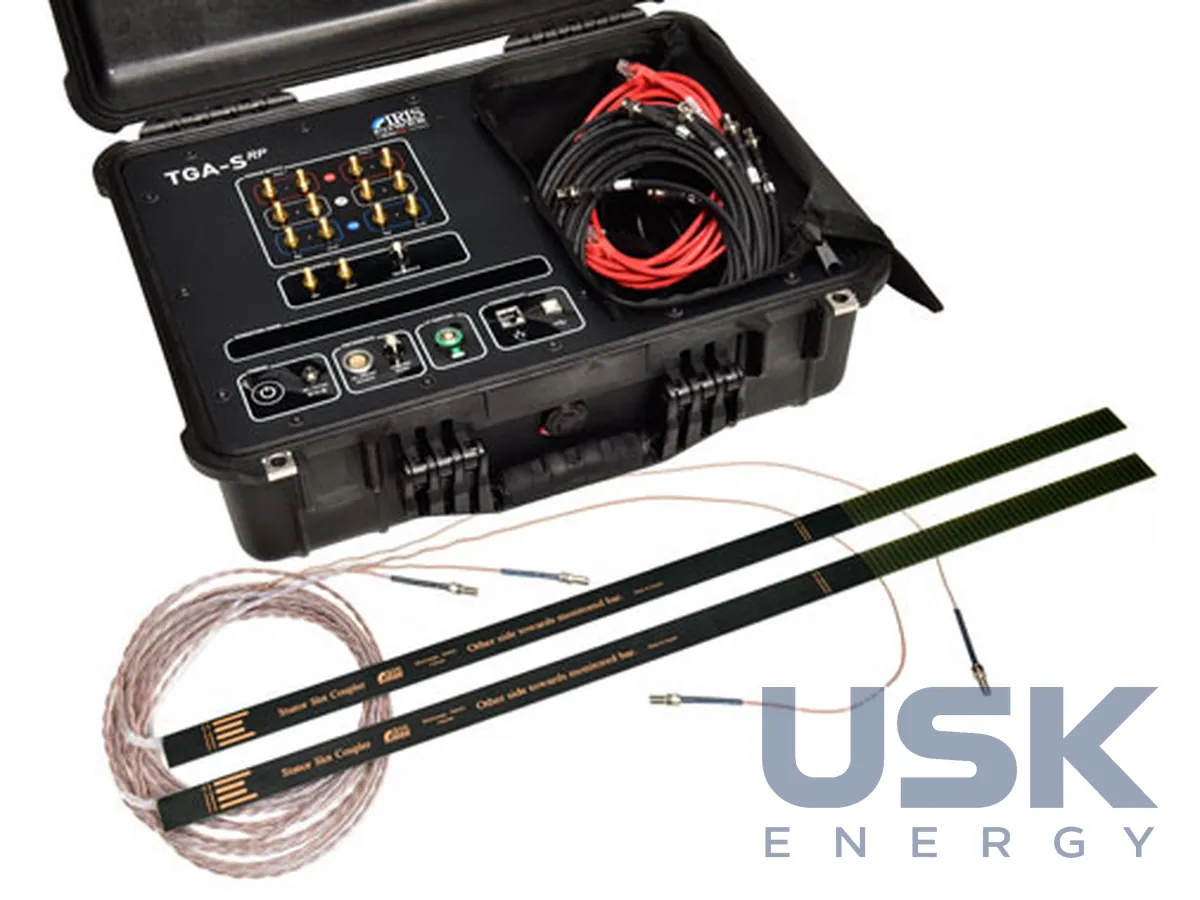
The TGA-S measures partial discharges in the stator winding of turbine generators while the machine runs, using permanently installed stator slot couplers (SSC). It covers large generators with up to 6 couplers, across 0.1 MHz to 350 MHz, and up to 800 MHz with SSC.
- Purpose
- Online partial discharge monitoring of the stator winding
- Number of sensors
- Up to 6 SSC
- Compatible sensors
- 80 pF EMC (6.9kV - 35 kV) and/or SSC
- Frequency range
- 0.1 MHz - 350 MHz
Price, availability and lead time on request. We help with analogue selection, customs clearance and delivery.
Description
Partial discharges accompany most ageing processes in stator winding insulation. The TGA-S picks out windings with loose bars, contamination, overheating or poor impregnation, which helps to judge the risk of a stator winding failure. Measurement takes place online, so the machine does not have to be stopped. The test method is non-destructive and is covered by IEEE Std. 1434-2000, IEEE Std.1129 and IEC 60034-27-2.
The instrument connects to permanently installed stator slot couplers, up to six for larger turbogenerators. 80 pF EMC capacitors rated 6.9kV to 35 kV are also compatible. The test frequency depends on the sensor: 40 MHz to 350 MHz with EMCs, 2 MHz to 350 MHz with capacitive couplers, and up to 800 MHz with SSCs. The high measurement frequency gives a good signal-to-noise ratio, so discharges are separated from interference and recorded automatically.
Pulse amplitudes run from 2 mV to 34,000 mV, with 10 sensitivity settings. The phase window is divided into 100 windows per cycle, and data collection takes 1 s or 5 s per amplitude window. The shortest pulse width is under 2.5 ns at the 3 dB cut-off point.
Control and data display run from a computer, and station staff can carry out measurements and interpret results after a short training. The range also includes stationary systems for continuous monitoring. The unit works between -15°C and 45°C at relative humidity up to 95% without condensation, measures 41 x 31 x 21 cm and weighs 10 kg, so it can be carried between machines on site.
Technical specifications
| Purpose | Online partial discharge monitoring of the stator winding |
|---|---|
| Number of sensors | Up to 6 SSC |
| Compatible sensors | 80 pF EMC (6.9kV - 35 kV) and/or SSC |
| Frequency range | 0.1 MHz - 350 MHz |
| Frequency with EMC | 40 MHz to 350 MHz |
| Frequency with capacitive couplers | 2 MHz to 350 MHz |
| Frequency with SSC | Up to 800 MHz |
| Pulse amplitude range | 2 mV - 34000 mV |
| Sensitivity settings | 10 |
| Phase resolution | 100 phase windows per cycle |
| Acquisition time | 1 s or 5 s per amplitude window |
| Minimum pulse width | Below 2.5 ns at 3 dB |
| Operating temperature | -15°C to 45°C |
| Relative humidity | Up to 95%, non-condensing |
| Dimensions | 41 x 31 x 21 cm |
| Weight | 10 kg |
| Standards | IEEE Std. 1434-2000, IEEE Std.1129, IEC 60034-27-2 |
Request a price and lead time
TGA-S Portable Partial Discharge Monitor for Turbine Generators. We reply within one business day.
Or email sales@usk.ua or call 044 339-50-20.
Questions and answers
Does the generator need to be shut down for a TGA-S test?
No. Measurements are taken online on a machine in service, through the permanently installed couplers.
How many couplers can be connected to the TGA-S?
Up to 6 stator slot couplers, and 80 pF EMC capacitors are also compatible.
Which stator faults does the instrument detect?
Loose windings, contamination, overheating and poor impregnation of the stator winding.
Similar equipment from other manufacturers