SSC Slot Couplers for Turbogenerator Partial Discharge Detection
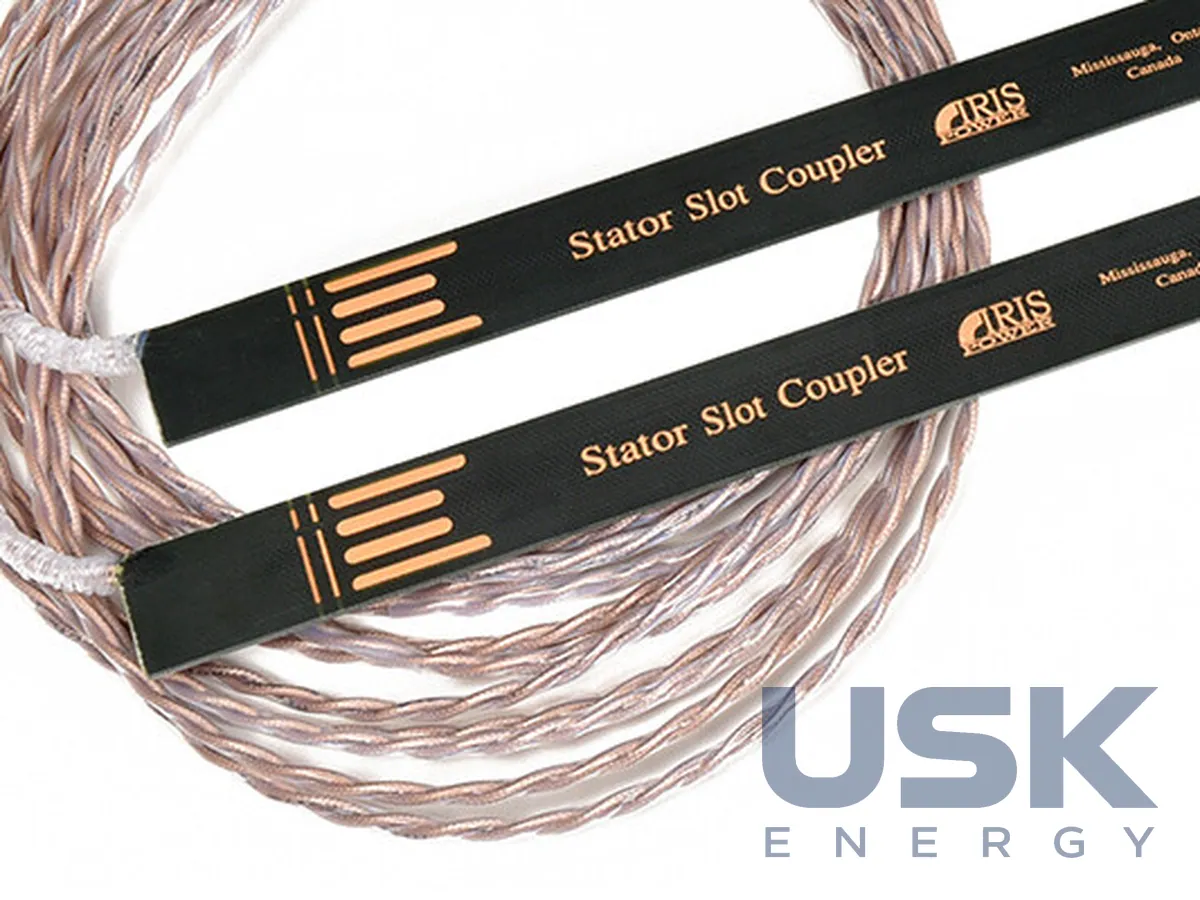
Sensors that fit into the stator slots of gas- and steam-cooled turbogenerators to detect partial discharges in the winding during operation. The dual output separates discharges occurring in the slot from those in the end winding.
- Purpose
- detection of partial discharges in the turbogenerator stator winding
- Material
- NEMA FR4 glass-epoxy laminate (class F)
- Available on order
- NEMA FR5 (class H), ATEX version
- Bandwidth
- 10 to 1000 MHz (3 dB)
Price, availability and lead time on request. We help with analogue selection, customs clearance and delivery.
Description
The couplers work with a portable partial discharge measuring instrument or with a continuous monitoring platform from the same supplier. They are fixed permanently beneath the slot wedges at the line end of the stator winding in machines in service, or placed between the upper and lower bars in new or rewound machines. The couplers are not connected to the high-voltage winding and are not exposed to high electrical stress. Turbogenerators up to 600 MVA usually need six couplers, and larger machines may need more.
Each coupler is built on NEMA FR4 glass-epoxy laminate rated class F, with FR5 class H available to order, or supplied in an ATEX version. Its bandwidth is 10 to 1000 MHz at the 3 dB level, and the characteristic impedance is 50 ohm. The coupler measures 2.0 mm in thickness, is cut in width to suit the stator slot, and its length can be trimmed down to 53 cm. The double output separates signals from partial discharges in the slot from those in the end winding.
For hydrogen-cooled machines, hermetic penetration kits are supplied for six, nine or twelve couplers. A combined penetration needs only one opening in the generator casing and includes a terminal box assembly as standard, or a terminal box with extension cables. Each penetration is tested with nitrogen at 2750 kPa (400 psi). Measurements also need a 50/60 Hz reference voltage, which comes either from an enclosed isolating transformer connected to a voltage transformer, or from an epoxy-mica capacitor.
The S0500 kit for air-cooled machines contains seven FR4 couplers, six pairs of RG316 cables for the extension runs, a glass-reinforced polyester terminal box and an AC reference source. The S0510 has the same content but with ten couplers and nine cable pairs. The S0600 for hydrogen-cooled machines holds seven couplers, six pairs of internal RG316 cables, a sealed penetration, a terminal box and a reference source, while the S0611 is equipped the same way with ten couplers and nine cable pairs. The ZAXS0601 ATEX version for hazardous areas holds seven couplers and six pairs of internal cables, plus a sealed penetration and a stainless steel box with a weatherproof seal and a hinged lid.
Technical specifications
| Purpose | detection of partial discharges in the turbogenerator stator winding |
|---|---|
| Material | NEMA FR4 glass-epoxy laminate (class F) |
| Available on order | NEMA FR5 (class H), ATEX version |
| Bandwidth | 10 to 1000 MHz (3 dB) |
| Characteristic impedance | 50 ohm |
| Outputs | dual, slot and end winding |
| Thickness | 2.0 mm |
| Width | cut to suit the stator slot |
| Length | trimmable to 53 cm |
| Couplers per machine up to 600 MVA | 6 |
| Cables | RG316 |
| Hydrogen penetrations | for 6, 9 or 12 couplers, one opening in the casing |
| Penetration test | nitrogen, 2750 kPa (400 psi) |
| Reference signal | 50/60 Hz |
Part numbers
Show all part numbers (5)
S0500, S0510, S0600, S0611, ZAXS0601
Request a price and lead time
SSC Slot Couplers for Turbogenerator Partial Discharge Detection. We reply within one business day.
Or email sales@usk.ua or call 044 339-50-20.
Questions and answers
How many couplers does a turbogenerator need?
Machines up to 600 MVA usually need six couplers, and larger machines may need more. The S0500 and S0600 kits contain seven couplers each, while the S0510 and S0611 contain ten.
Are the couplers suitable for hydrogen-cooled generators?
Yes. The S0600, S0611 and ZAXS0601 kits are designed for them, with a hermetically sealed penetration tested with nitrogen at 2750 kPa.
Where does the 50/60 Hz reference signal come from?
It comes from an enclosed isolating transformer connected to a voltage transformer, or from an epoxy-mica capacitor. A reference source is included in every kit.
Similar equipment from other manufacturers