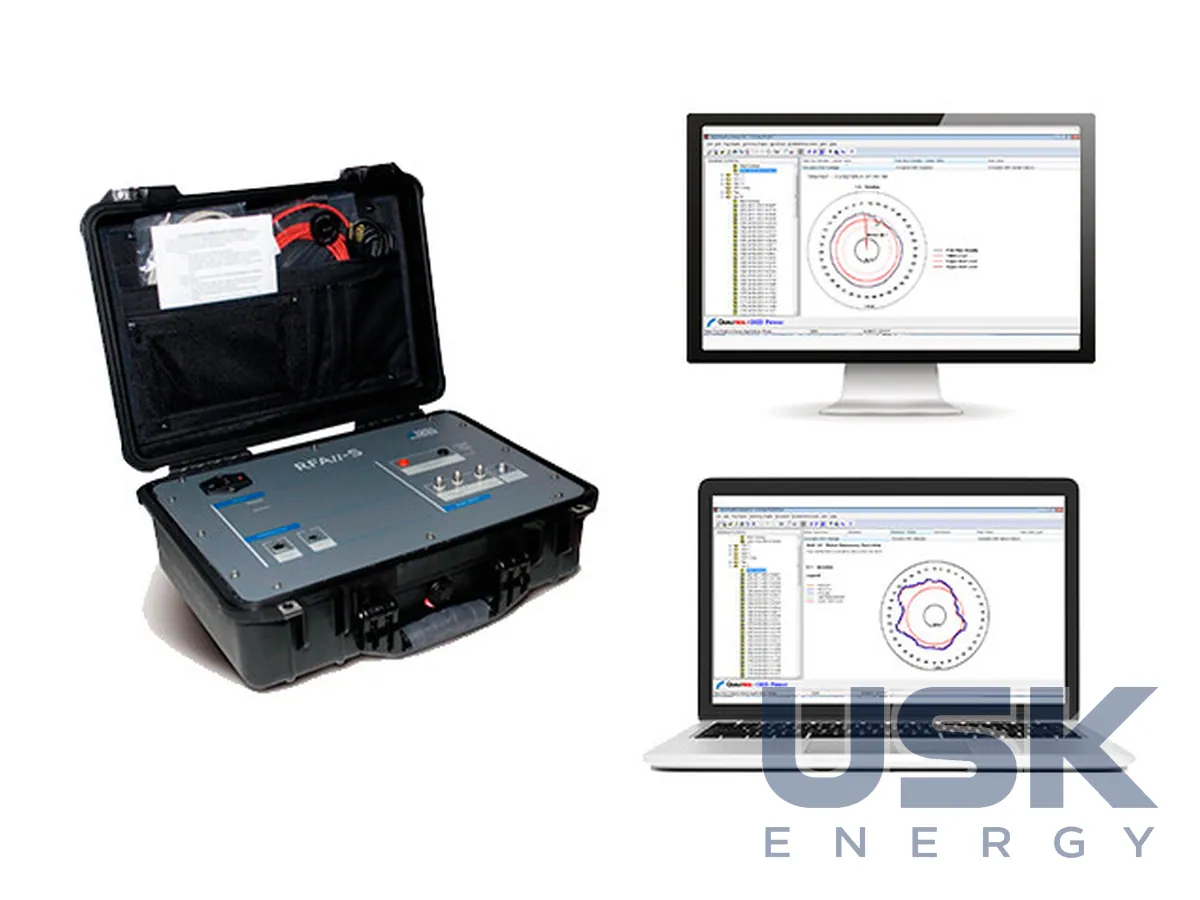
RFAII-S Portable Rotor Flux Analyser for Salient Pole Machines, 4 to 128 Poles
The RFAII-S detects shorted rotor turns and mechanical faults in salient pole motors and hydrogenerators from the signal of a flux probe while the machine runs. The instrument is carried between machines fitted with flux probes and used for periodic online measurements.
- Model
- RFAII-S
- Machine type
- Salient pole motors and generators
- Rotor poles
- 4–128
- Measurement time
- 30 s
Price, availability and lead time on request. We help with analogue selection, customs clearance and delivery.
Description
Measurement takes 30 seconds per run, and the RFAII-S accepts flux signals from 0.3 to 48 V through an input with 10 kΩ impedance. The shaft sync input takes 1 to 24 V peak, and external sync from the mains accepts 50 to 237 V AC. The instrument works with rotors from 4 to 128 poles and connects to a computer over USB or Ethernet.
Ageing of inter-turn insulation in generator and synchronous motor rotors eventually causes shorted turns. These seldom bring a machine down on their own, but they can limit reactive power, and a rising count of shorts over time points to ageing of the rotor body insulation. Online monitoring of rotor flux gives data for deciding when to plan winding repair, based on the machine's actual condition.
The unit works with TFProbe and FFProbe probes as well as with older-type flux probes, including those from other suppliers. It detects shorted turns, pole misalignment and air gap unevenness without stopping the machine. Synchronisation comes from the mains frequency signal or, preferably, from an external shaft sync sensor that identifies a particular pole.
The data acquisition system offers very high resolution, switchable attenuation on the board, high speed and large memory. Once set up, the instrument can collect data on its own without a connected computer and store it in internal memory. A fast collection mode produces a results table for each coil at each load point, together with waveforms. Processing, analysis and trend display are handled by RotorFluxPro, which also reads files from other makers' portable instruments.
The unit runs on 115 or 230 V, 50/60 Hz, drawing under 100 W. Operating temperature runs from 0 to 40 °C, storage from -20 to 50 °C, with relative humidity below 90 % non-condensing. It is supplied in a transport case measuring 47 × 36 × 18 cm and weighing 7.5 kg. For permanent remote monitoring, fixed FluxTracII systems are available, with SCADA integration over Modbus.
Technical specifications
| Model | RFAII-S |
|---|---|
| Machine type | Salient pole motors and generators |
| Rotor poles | 4–128 |
| Measurement time | 30 s |
| Flux signal range | 0.3–48 V |
| Flux input impedance | 10 kΩ |
| Sync sensor input | 1–24 V peak |
| External sync from mains | 50–237 V AC |
| Interfaces | USB, Ethernet |
| Power supply | 115/230 V, 50/60 Hz |
| Power consumption | Under 100 W |
| Operating / storage temperature | 0…40 °C / -20…50 °C |
| Relative humidity | Below 90% non-condensing |
| Case | 47 × 36 × 18 cm, 7.5 kg |
| Compatible probes | TFProbe, FFProbe, older-type flux probes |
Part numbers
Show all part numbers (4)
M1310, M1300, M1320, C0010
Request a price and lead time
RFAII-S Portable Rotor Flux Analyser for Salient Pole Machines, 4 to 128 Poles. We reply within one business day.
Or email sales@usk.ua or call 044 339-50-20.
Questions and answers
Does the machine need to be stopped for measurement?
No. Measurements are taken while the machine runs, using installed flux probes, and each run takes 30 seconds.
Which flux probes does the instrument work with?
TFProbe and FFProbe, as well as older-type flux probes, including those from other suppliers.
Which rotors is the RFAII-S designed for?
Salient pole rotors from 4 to 128 poles. The RFAII-R covers non-salient pole rotors, and the RFAII-RS covers both types.
Similar equipment from other manufacturers