MDSP3 Portable Current Signature Analyser for Induction Motor Rotors
The MDSP3 detects broken rotor bars, cracked shorting rings, die-cast faults and unequal air gaps in squirrel-cage induction motors by analysing stator current. A test runs online in under 75 seconds, and a single clamp-on current probe is enough to take the measurement.
- Purpose
- Diagnosis of rotor cage and eccentricity in induction motors
- Method
- Current signature analysis (CSA)
- Motor power
- 50hp (37.5kW) and above
- Signal-to-noise ratio
- >100 dB
Price, availability and lead time on request. We help with analogue selection, customs clearance and delivery.
Description
Broken rotor bars and air-gap eccentricity have long been recognised as common causes of induction motor failure. A broken bar is particularly likely in motors with heavy inertial loads, such as fans, and where starts are frequent. The broken bar overheats the rotor core locally, causes torque and speed oscillations that damage bearings, and can work loose from its slot and damage the stator winding. Eccentricity develops from inaccurate rotor alignment or worn bearings.
The MDSP3 uses current signature analysis (CSA). Rotor or driven-equipment faults alter the magnetic field pattern of the rotor, and the resulting rotating fields induce characteristic components in the stator current, which the instrument isolates and identifies. Its algorithms calculate slip accurately from the measured current, including at different loads. The signal-to-noise ratio exceeds 100 dB, so the instrument separates interference from genuine bar defects and reduces false conclusions.
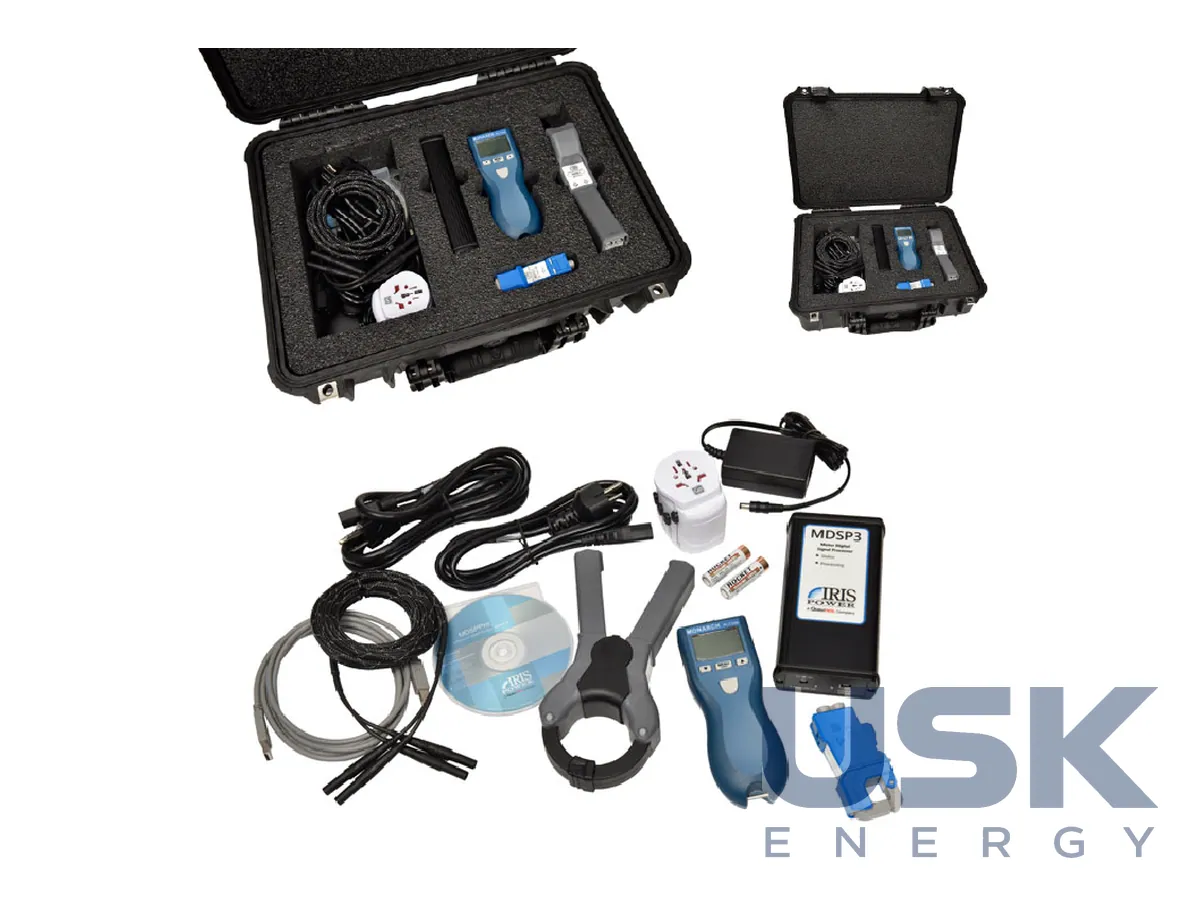
One clamp-on current probe on one phase of the motor, or on the secondary circuit of a 50 or 60 Hz current transformer in the motor control cabinet or at the breaker, is enough for a measurement. Two probes come in the kit and together cover 5A to 1000A. A test runs online in under 75 seconds, before the fault can do further damage to the motor.
The unit is intended for motors of 50hp (37.5kW) and above, with load between 35% and 110% of nameplate. Minimum full-load slip is 0.8%, the maximum rotor slot passing frequency is 3000Hz, and sampling exceeds 6500 readings per second. It runs from USB or a 100 to 200 V, 50/60 Hz supply. The processor measures 16.51cm x 9.52 cm x 3.175 cm and weighs 0.4 kg. The method follows the condition-based maintenance approach recommended by ISO 20958:2013 for electrical signature analysis of three-phase induction motors.
Technical specifications
| Purpose | Diagnosis of rotor cage and eccentricity in induction motors |
|---|---|
| Method | Current signature analysis (CSA) |
| Motor power | 50hp (37.5kW) and above |
| Signal-to-noise ratio | >100 dB |
| Sampling rate | >6500/sec |
| Load current | 35% ... 110% of nameplate |
| Maximum rotor slot passing frequency | 3000Hz |
| Minimum full-load slip | 0.8% |
| Current probe range | 5A ... 1000A (two probes) |
| Test duration | Under 75 seconds |
| Power supply | USB or 100 to 200 V 50/60 Hz |
| Dimensions | 16.51cm x 9.52 cm x 3.175 cm |
| Weight | 0.4 kg |
| Standard | ISO 20958:2013 |
Part numbers
Show all part numbers (1)
MDSP3
Request a price and lead time
MDSP3 Portable Current Signature Analyser for Induction Motor Rotors. We reply within one business day.
Or email sales@usk.ua or call 044 339-50-20.
Questions and answers
Does the motor have to be stopped for an MDSP3 test?
No. The test runs online on a motor in operation, in under 75 seconds.
Where is the current probe fitted?
The clamp-on probe goes on one phase of the motor, or on the secondary circuit of a 50 or 60 Hz current transformer in the control cabinet or at the breaker.
Which motors is the instrument suited to?
Squirrel-cage induction motors of 50hp (37.5kW) and above, with load between 35% and 110% of nameplate.
Similar equipment from other manufacturers