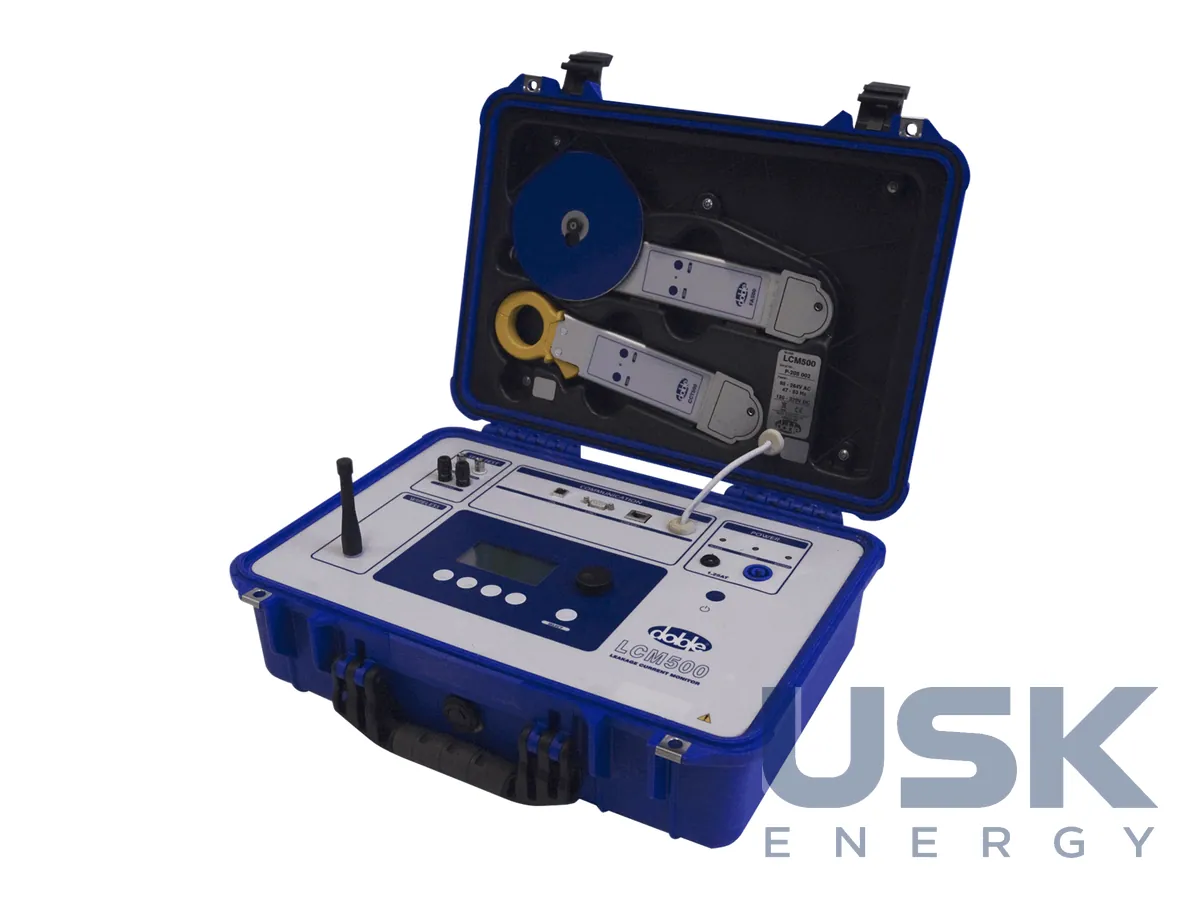
LCM500 leakage current monitor for in-service surge arresters
The LCM500 assesses metal oxide surge arresters (MOSA) while they stay in service, measuring leakage current and the quality of their metal oxide blocks. A single arrester can be checked on site in under 15 minutes.
- Purpose
- in-service assessment of MOSA arresters
- Total leakage current
- 200 – 16000 µA
- Resistive current
- 0 – 9000 µA
- Frequency
- 47 – 63 Hz (50 or 60 Hz system)
Price, availability and lead time on request. We help with analogue selection, customs clearance and delivery.
Description
A surge arrester is inexpensive but protects a power transformer, so its condition is checked regularly. The LCM500 is used for periodic assessment of arresters at substations and on lines, and also for short-term monitoring of a single arrester to track how its leakage current changes over time.
The method analyses the compensated third harmonic of the leakage current, and IEC 60099-5 recognises it for field monitoring of metal oxide arresters. Results are corrected automatically to a reference temperature of +20 °C and to the operating voltage recorded during measurement. The arrester stays in service, and measurements are taken safely from ground level.
The instrument is portable and battery-powered. Each arrester has its own identifier, and the memory holds 1000 identifiers together with the field measurements. Separate arrester types can be set up with their operating parameters. The LCM Viewer program on a computer opens and edits survey files, merges several files, prints reports and evaluates groups of arresters by type or region.
The total leakage current range is 200 to 16000 µA, with a resistive component of 0 to 9000 µA. Network frequency is 47 to 63 Hz for 50 Hz or 60 Hz systems, and accuracy is ±5% or ±5 µA. Current signals come from a wireless sensor with a 9 V 500 mAh battery over a 434.075–434.525 MHz radio link, and the field voltage probe covers 0 to 5 VAC.
The enclosure measures 47 by 35.7 by 17.6 cm and weighs 7.5 kg. It is rated IP67 when closed and IP51 with the lid open. It runs from 12 to 15 VDC or 85 to 264 VAC at 47 to 63 Hz, and has a built-in 9.6 V 2600 mAh battery that lasts 8 hours and recharges in 1.5 hours. Operating temperature is -10 to +50 °C, and storage is -20 to +70 °C.
Technical specifications
| Purpose | in-service assessment of MOSA arresters |
|---|---|
| Total leakage current | 200 – 16000 µA |
| Resistive current | 0 – 9000 µA |
| Frequency | 47 – 63 Hz (50 or 60 Hz system) |
| Accuracy | ±5% or ±5 µA |
| Field voltage probe | 0-5 VAC |
| Wireless current sensor | 9 V 500 mAh battery |
| Radio link | 434.075–434.525 MHz |
| Memory | 1000 arrester identifiers with measurements |
| Power supply | 12–15 VDC or 85–264 VAC 47–63 Hz; battery 9.6 V 2600 mAh |
| Battery runtime | 8 hours, recharge 1.5 hours |
| Protection rating | IP67 (closed), IP51 (lid open) |
| Operating temperature | -10 °C … +50 °C |
| Storage temperature | -20 °C … +70 °C |
| Dimensions | 47 by 35.7 by 17.6 cm |
| Weight | 7.5 kg |
| Standard | IEC 60099-5 |
Part numbers
Show all part numbers (2)
TN-25000, TN-25156
Request a price and lead time
LCM500 leakage current monitor for in-service surge arresters. We reply within one business day.
Or email sales@usk.ua or call 044 339-50-20.
Questions and answers
Does the arrester have to be disconnected for measurement?
No. Measurements are taken on the arrester under operating voltage, and a single arrester can be checked on site in under 15 minutes.
Which assessment method does the LCM500 use?
It analyses the compensated third harmonic of the leakage current, a method recognised by IEC 60099-5 for field monitoring of metal oxide arresters. Results are corrected to +20 °C and to the operating voltage.
How long does the instrument run on its battery?
The 9.6 V 2600 mAh battery is rated for 8 hours of operation and recharges in 1.5 hours. The instrument can also run from 12 to 15 VDC or 85 to 264 VAC.
Similar equipment from other manufacturers