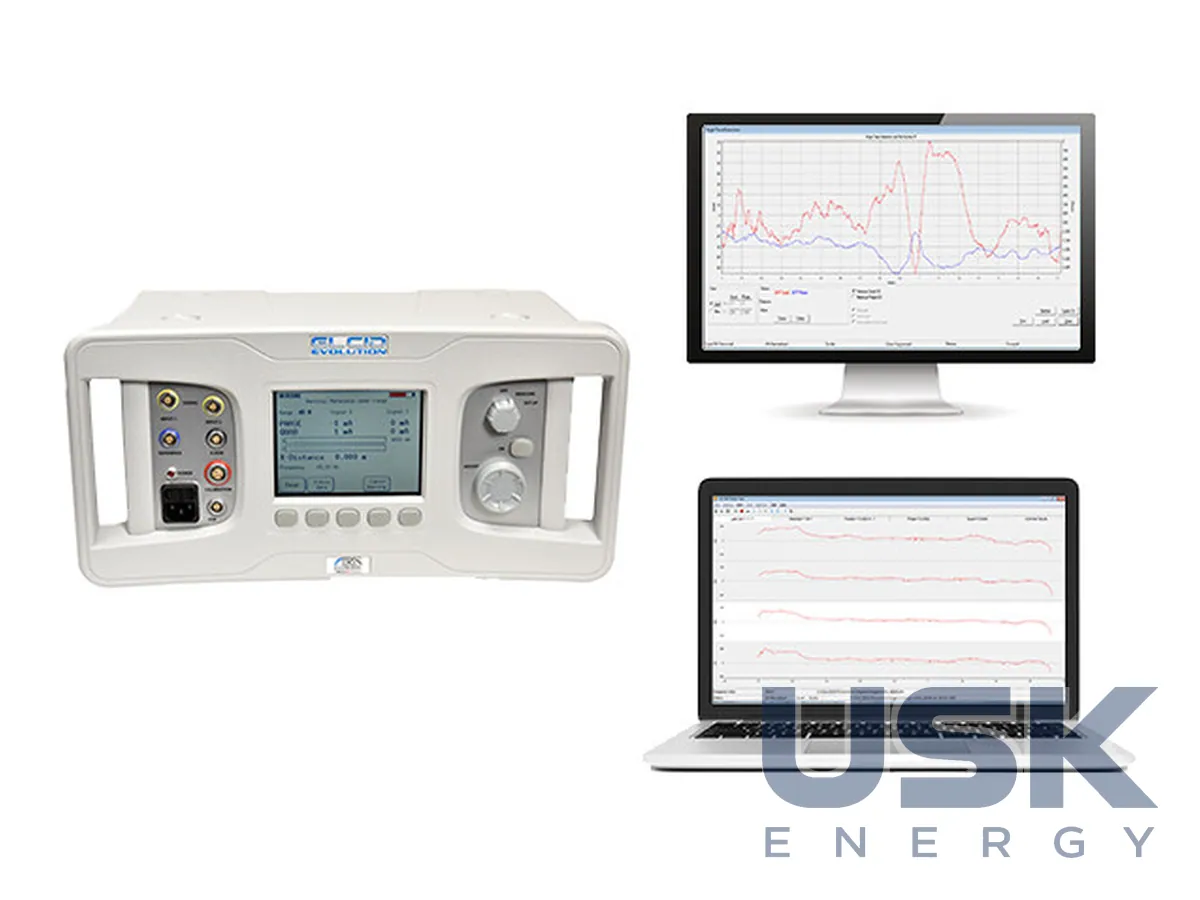
EL CID Evolution portable stator core tester using the low flux method
The EL CID Evolution is a portable system for detecting interlaminar insulation faults in the stator cores of turbo and hydro generators of small, medium and large power rating. The test runs on a machine taken out of service at low excitation, without fully magnetising the core.
- Type
- portable stator core tester, low flux
- Applications
- turbogenerators, hydrogenerators, large motors
- Software
- ELAN V6
- Records per slot for comparison
- up to 26
Price, availability and lead time on request. We help with analogue selection, customs clearance and delivery.
Description
The kit includes the EL CID Evolution tester, Chattock sensors in lengths of 10, 20, 25 and 30 cm, a switched turbo excitation system with a 30 m cable and 6 turns, and two wheeled transit cases. Options include different sensor configurations to suit core geometry, battery power for remote sites, and accessories for excitation and signal processing.
A stator core is built from thin sheets of electrical steel insulated from one another to stop axial currents. If a short forms between laminations, local heating can burn through the stator winding insulation and even melt the core. The tester finds such faults during planned maintenance, at commissioning and during acceptance testing, and it also helps judge the condition of ageing interlaminar insulation.
The low flux method runs at a small excitation current, so it is safe for staff and needs no high-power supply. The alternative, the full flux ring test, needs a large single-phase supply, thermal imaging inspection and considerable labour. For a major turbogenerator, labour falls from 150–200 man-hours to 8–10, and a check often finishes within one work shift, whereas a ring test usually takes 3 work shifts. One technician can run the test.
The EL CID Evolution is the third generation of this method and is used on turbogenerators, hydrogenerators and large electric motors. Digital signal processing separates the quadrature and phase components of the fault current, and results are displayed and stored in real time. The tester works with an RIV-800 robotic inspection carriage. The ELAN V6 program controls the test from a remote PC, combines testing and analysis, and calculates excitation parameters from turns per phase, winding and core geometry.
Up to 26 records per slot can be compared, main and stepped package traces can be combined on one graph, and the core can be viewed in three dimensions. Results export to several formats, reports are produced as text or PDF, and the software is available in several languages with built-in help.
Technical specifications
| Type | portable stator core tester, low flux |
|---|---|
| Applications | turbogenerators, hydrogenerators, large motors |
| Software | ELAN V6 |
| Records per slot for comparison | up to 26 |
| Chattock sensors | 10, 20, 25 and 30 cm |
| Excitation system | switched, for turbogenerators, 30 m, 6 turns |
| Transport | two wheeled cases |
| Turbogenerator test duration | often under one shift |
| Labour for a major turbogenerator | 8–10 man-hours instead of 150–200 |
| Personnel | one technician |
| Compatibility | RIV-800 robotic carriage |
| Power supply | optional battery |
Request a price and lead time
EL CID Evolution portable stator core tester using the low flux method. We reply within one business day.
Or email sales@usk.ua or call 044 339-50-20.
Questions and answers
Does the test need a high-power supply?
No, the method works at low excitation, unlike the ring test, which needs a large single-phase supply.
How many people are needed to run the test?
One technician, who controls the test from a remote PC using ELAN V6 software.
Which sensors come in the kit?
Chattock sensors of 10, 20, 25 and 30 cm, plus a switched excitation system with a 30 m cable and 6 turns.
Similar equipment from other manufacturers