DTM (DM Series) — bushing and partial discharge monitor for power transformers
DTM (Diagnostic Transformer Monitor, DM series) is an online monitoring system for power transformer bushings and electrical partial discharge. It detects faults in bushings, windings, the de-energised tap changer, the OLTC and the connected busduct, including the phase-isolated busduct. Diagnostics run under operating voltage, without taking the transformer out of service.
- Basic systems
- DTM-V (3 voltage inputs + 3 current) or DTM-I (6 current inputs)
- Expansion modules
- up to 4, of which up to 2 bushing modules and up to 2 PD modules
- Bushing module
- 6 sensor inputs, 1 or 2 sets of three-phase bushings
- PD module
- 15 channels with simultaneous data acquisition
Price, availability and lead time on request. We help with analogue selection, customs clearance and delivery.
Description
Many types of transformer defects are easier to detect online, at operating voltage and temperature, than during tests at 10 kV at ambient temperature. In addition, many defects develop faster than the offline test cycle. PD monitoring complements bushing monitoring and the dissolved gas analyser, because it shows which phase and winding the defect is in, and it reacts faster than DGA. The status is shown by red, yellow and green indicators, and the archive and detailed diagnostics show the location, type and rate of development of the defect.
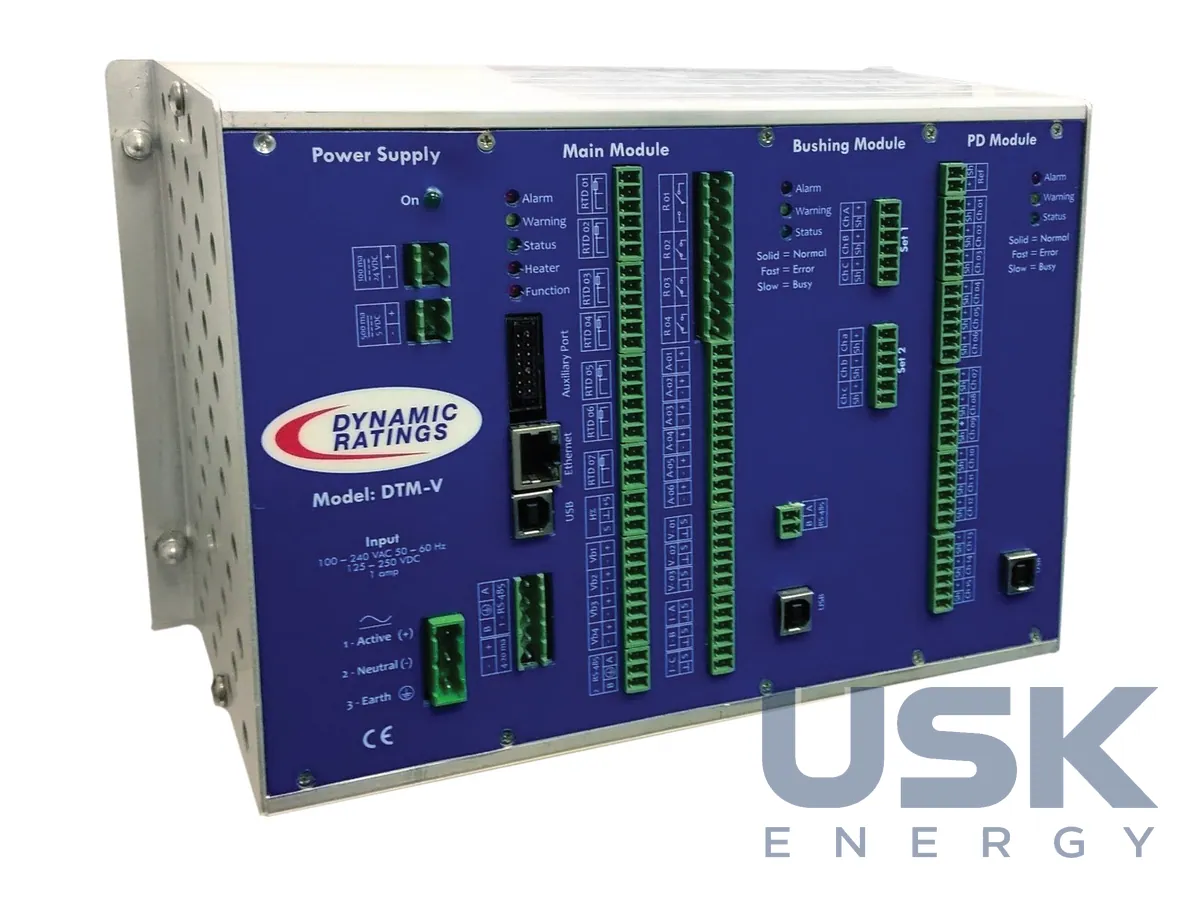
There are two basic systems. The DTM-V has three voltage inputs and three current inputs, the DTM-I has six current inputs. Each includes a main module, a universal power supply and up to four expansion modules, of which no more than two are bushing modules and no more than two are PD modules, and at least one module is required. The main module has an Ethernet 10/100 port for Modbus or DNP over TCP/IP, USB, RS-485, seven RTD inputs, a moisture input, relays and six analogue 4–20 mA inputs. Power supply 100–240 V AC or 125–250 V DC, internal memory 8 MB. The device works from −40 to 70 °C without additional heating or cooling.
The bushing module accepts six sensor signals, that is, it serves one or two sets of three-phase bushings, and determines the loss tangent and capacitance of each bushing. The main bushing analytics are built on the value and trend of the current unbalance. The magnitude of the unbalance shows how serious the problem is, and its vector shows which bushing is deteriorating and whether the loss tangent or the capacitance is changing. The condition is compared with oil temperature, load current and moisture, so the warning arrives earlier.
The PD module has 15 configurable channels with simultaneous data acquisition. It records pulse amplitude in mV or pC, the number of pulses per second and the discharge intensity (PDI), builds phase-resolved patterns to determine the discharge type, stores up to two years of data and suppresses external interference. Alarms are triggered by amplitude and PDI setpoints and by trends, and discharges are correlated with load, oil temperature and OLTC position. BAU+ bushing sensors, Rogowski coils, coupling capacitors, RFCT high-frequency current transformers and GPCS sensors in the earthing circuit can be connected to the monitor.
Versions are standalone, on a mounting panel with all circuits brought out to terminals, with shorting blocks for bushing sensors and a fuse at the power input, or in a steel NEMA 4 cabinet. The system can be ordered with a built-in PD module or prepared for periodic measurements with a portable instrument. Data can also be transmitted over the existing wires via iBridge, without new cable or fibre.
Technical specifications
| Basic systems | DTM-V (3 voltage inputs + 3 current) or DTM-I (6 current inputs) |
|---|---|
| Expansion modules | up to 4, of which up to 2 bushing modules and up to 2 PD modules |
| Bushing module | 6 sensor inputs, 1 or 2 sets of three-phase bushings |
| PD module | 15 channels with simultaneous data acquisition |
| PD data storage | up to 2 years |
| Main module inputs | 7 × RTD, moisture input, 6 × 4–20 mA |
| Power supply | 100–240 V AC (50–60 Hz), 125–250 V DC |
| Operating temperature | from −40 to 70 °C |
| Internal memory | 8 MB |
| Communication | Ethernet 10/100 (Modbus or DNP over TCP/IP), USB, RS-485 |
| Versions | standalone, panel-mounted, NEMA 4 cabinet |
Request a price and lead time
DTM (DM Series) — bushing and partial discharge monitor for power transformers. We reply within one business day.
Or email sales@usk.ua or call 044 339-50-20.
Questions and answers
How do the DTM-V and DTM-I basic systems differ?
The DTM-V has 3 voltage inputs and 3 current inputs, the DTM-I has 6 current inputs. Both come with a main module, a power supply and up to 4 expansion modules.
How many bushing and PD modules can be fitted to a DTM?
No more than 2 bushing modules and no more than 2 PD modules, up to 4 in total, with at least one module required. A bushing module serves 1 or 2 sets of three-phase bushings, and the PD module has 15 channels.
In what conditions does the DTM monitor operate?
From −40 to 70 °C without additional heating or cooling, with power supply 100–240 V AC or 125–250 V DC. It is available as standalone, panel-mounted or in a NEMA 4 cabinet.
Similar equipment from other manufacturers