DCR 60-2 Stator Insulation Test Unit, Linear DC Ramp up to 60 kV
The DCR 60-2 checks the ground wall insulation of generator and motor stator windings with a linearly rising DC voltage up to 60 kV. Unlike a pass or fail high-potential test, the method yields diagnostic information, and the test can be stopped before breakdown.
- Model
- DCR 60-2 (DCR-60)
- Method
- Linear DC ramp, stepped tests in manual mode
- Output voltage
- 0–60 kV DC, negative polarity
- Ramp rate
- 0–2.5 kV/min, smooth adjustment
Price, availability and lead time on request. We help with analogue selection, customs clearance and delivery.
Description
The unit is used for offline diagnosis of the ground wall insulation in hydrogenerators, turbogenerators and large AC motors. Its purpose is to reveal insulation defects before an unexpected failure in service. The risk of breaking down sound insulation during this test is lower than with a standard high-voltage withstand test.
Voltage is applied to the winding and raised at a steady rate from zero to the set level. Compared with stepped testing, the linear rise lets the polarisation and capacitive components of the current be separated from the leakage current, so small defects show on the current-voltage curve. The operator watches the curve during the test and can stop it before breakdown. The method has been used on machines with asphalt, polyester and epoxy-mica insulation.
The test follows IEEE Standard 95-2002. In manual mode the unit also runs stepped DC tests, with equal or increasing time intervals to the same standard. The polarisation index (PI) is calculated automatically. After the test, the winding is discharged through a built-in safe discharge circuit.
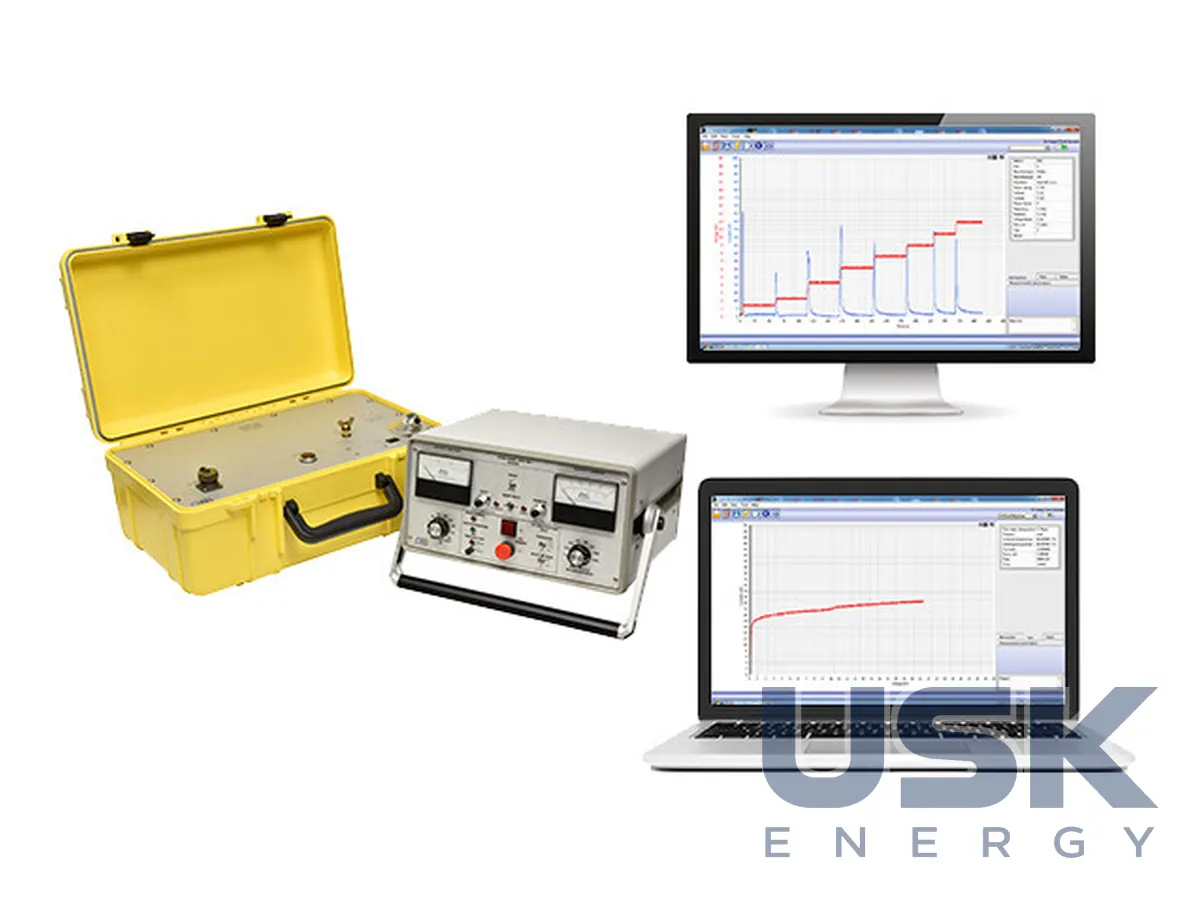
The output is 0–60 kV DC with negative polarity, the ramp rate is 0–2.5 kV/min with smooth adjustment, and the output current reaches up to 1.0 mA. Current measurement ranges run from 1 to 250 μA. Over USB the PC shows results while the test runs, stores curves with their parameters, and displays curves side by side for comparison with similar machines or earlier readings.
The kit comprises a control unit measuring 42 × 40 × 19.5 cm and weighing 9.5 kg, and a high-voltage module measuring 55 × 38 × 24 cm and weighing 15 kg. It runs on 85 to 264 V AC, 2 A, 50/60 Hz, with an operating temperature from 0 to +40 °C and storage from -25 to +60 °C. One phase usually takes less than an hour and can be run by one person. Electromagnetic compatibility is to EN61326.
Technical specifications
| Model | DCR 60-2 (DCR-60) |
|---|---|
| Method | Linear DC ramp, stepped tests in manual mode |
| Output voltage | 0–60 kV DC, negative polarity |
| Ramp rate | 0–2.5 kV/min, smooth adjustment |
| Output current | 1.0 mA maximum |
| Current measurement ranges | 0-1/2.5/5/10/25/50/100/250 μA |
| Power supply | 85–264 V AC, 2 A, 50/60 Hz |
| PC connection | USB |
| Operating temperature | 0…+40 °C |
| Storage temperature | -25…+60 °C |
| Control unit | 42 × 40 × 19.5 cm, 9.5 kg |
| High-voltage module | 55 × 38 × 24 cm, 15 kg |
| Standards | IEEE Standard 95-2002, EN61326 (EMC) |
Part numbers
Show all part numbers (1)
DCR-60
Request a price and lead time
DCR 60-2 Stator Insulation Test Unit, Linear DC Ramp up to 60 kV. We reply within one business day.
Or email sales@usk.ua or call 044 339-50-20.
Questions and answers
How does the method differ from a standard high-voltage withstand test?
A linear voltage rise separates the polarisation and capacitive currents from the leakage current, so defects show on the curve and the test can be stopped before breakdown.
How long does the test take?
One phase usually takes less than an hour and can be carried out by one person.
What is the maximum output?
Up to 60 kV DC with negative polarity, at an output current of up to 1.0 mA.
Similar equipment from other manufacturers