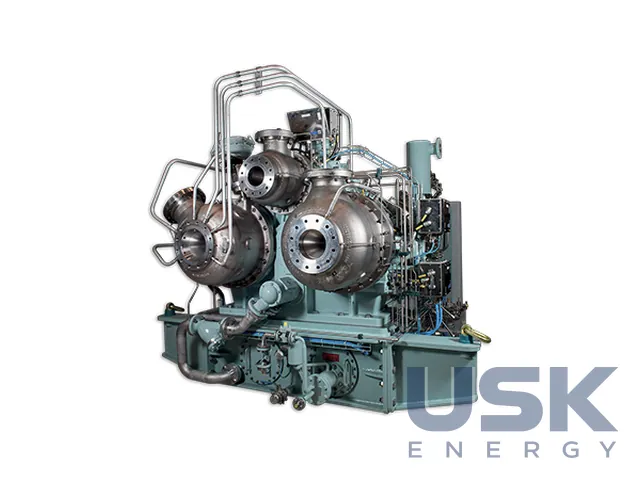
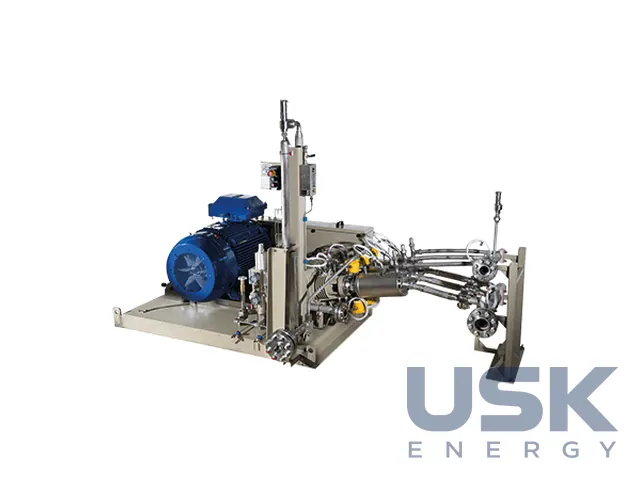
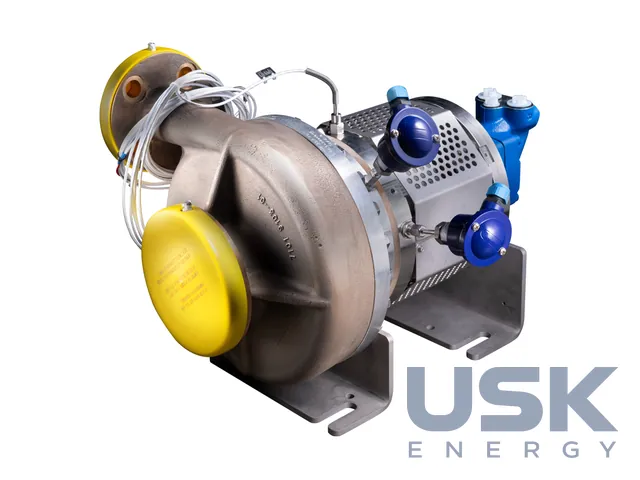
TKH hydraulically driven dry-running piston compressors for hydrogen and inert gases, up to 10,000 bar
TKH series hydraulically driven piston compressors for hydrogen, helium, argon, nitrogen, CO2 and ethylene, final pressure up to 10,000 bar. Dry-running piston, compression without lubrication. Compression ratio up to 5 per stage, capacity controlled within 5–100%.
- Drive
- hydraulic (including explosion-proof)
- Final pressure
- up to 10,000 bar (about 4200 bar / 61,000 psi in the brochure applications section; up to 1000 bar for H2 refuelling)
- Lubrication
- dry-running piston, oil-free compression
- Control
- by changing the number of strokes, 5–100%
Price, availability and lead time on request. We help with analogue selection, customs clearance and delivery.
Description
Hydraulically driven piston compressors of the TKH series are used mainly in special industries. Without lubrication they compress gases that contain no solid particles: hydrogen, helium, argon, nitrogen, carbon dioxide and ethylene. All compressors are made in Germany, where the manufacturer has a long tradition of piston machines, the first of which were developed by the founder of the company.
In the TKH, the reciprocating motion of the piston is produced by a hydraulic cylinder instead of a crank mechanism. The piston runs dry, with no lubricant in the compression zone, so the gas stays clean. Capacity is controlled simply by changing the number of double strokes in the range from 5 to 100%. The compression ratio per stage is up to 5, any number of stages can be used, and they are easily arranged one above another, so the compressor takes up little space. Leakage is monitored continuously, which simplifies operation.
The main operating advantage is simplicity: the piston seal is replaced in 10–30 minutes. The hydraulic drive can be made in an explosion-proof version to ATEX 2014/34/EU. Mass balancing allows the machine to be installed without a foundation, low piston speeds give low wear and quiet running, and water cooling provides heat removal and a low noise level. The design complies with the Machinery Directive 2006/42/EG and the standards DIN EN 1012-1, DIN EN 12100-1, DIN EN 60204-1.
The manufacturer states a final pressure of up to 10,000 bar. In another section of the same brochure, the maximum discharge pressure of the TKH is given as about 61,000 psi (4200 bar). A typical application example is hot isostatic pressing (HIP), where metal parts are densified by sintering under argon pressure of up to 4200 bar.
For small flows, for example at hydrogen refuelling stations (HRS), the TKH is suitable as a compressor with 100% oil-free hydrogen compression up to 1000 bar for passenger cars, up to 500 bar for fuel cell buses and trucks, and up to 550 bar for rail transport. The compressors undergo load tests with documented operating parameters. Individual machines or complete compressor packages are supplied, and service is provided worldwide.
Technical specifications
| Drive | hydraulic (including explosion-proof) |
|---|---|
| Final pressure | up to 10,000 bar (about 4200 bar / 61,000 psi in the brochure applications section; up to 1000 bar for H2 refuelling) |
| Lubrication | dry-running piston, oil-free compression |
| Control | by changing the number of strokes, 5–100% |
| Compression ratio | up to 5 per stage; any number of stages (stages one above another) |
| Maintenance | piston seal replacement in 10–30 min |
| Monitoring | continuous leakage monitoring |
| Media | hydrogen, helium, argon, nitrogen, CO2, ethylene (free of solid particles) |
Request a price and lead time
TKH hydraulically driven dry-running piston compressors for hydrogen and inert gases, up to 10,000 bar. We reply within one business day.
Or email sales@usk.ua or call 044 339-50-20.
Questions and answers
What pressure do TKH series compressors have?
The manufacturer states a final pressure of up to 10,000 bar, while the applications section of the brochure gives about 4200 bar (61,000 psi). The exact value for a specific model is clarified on request.
How quickly can the piston seal be replaced?
Replacing the piston seal takes 10–30 minutes. Leakage is monitored continuously, and capacity is controlled by the number of double strokes from 5 to 100%.
Is the TKH suitable for hydrogen refuelling stations?
Yes, hydrogen compression is fully oil-free, up to 1000 bar for passenger cars, up to 500 bar for buses and trucks and up to 550 bar for rail.
Similar equipment from other manufacturers