StarLite LNG — small-scale natural gas and biogas liquefaction plants 20–200 t/day with a compander
Small-scale liquefaction plants for natural gas and biomethane with a capacity from 20 to 200 tonnes per day. They run on a closed reverse Brayton cycle with nitrogen around a single compander. They are intended for satellite stations, filling stations, associated and coal gas, and bio-LNG.
- Capacity
- 20 … 200 t/day (17–124 thousand gallons/day)
- Process
- reverse Brayton cycle with nitrogen, single- or two-stage (with a JT valve)
- Models
- XS 28 t/day (1.1 kWh/kg), S 50 (1.0), M 88 (0.8), L 125 (0.7), XL 200 t/day (0.6 kWh/kg)
- Site
- 20×15 m (S–XL), 30×15 m (XS) without air coolers
Price, availability and lead time on request. We help with analogue selection, customs clearance and delivery.
Description
StarLite LNG is a family of small-scale plants for liquefaction of natural gas and biomethane with a capacity from 20 to 200 tonnes per day. The plants are based on the experience of BOG reliquefaction systems on LNG carriers, including 2×14 Ecorel units on the largest Q-Max tankers of 266 000 m³ since 2008. They belong to the StarLNG family of liquefiers, which covers small and mid-scale plants from 21 to 900 t/day.
The process is built on a closed reverse Brayton cycle with nitrogen, single-stage or two-stage with an additional Joule–Thomson valve. No flammable or toxic refrigerants are stored, which simplifies permitting and speeds up the start of LNG production. The control is built around a single turbomachine, the compander, with automatic load adjustment as air temperature, composition, and gas pressure and temperature change. Capacity can be reduced to 30 %, for example to avoid peak electricity tariffs.
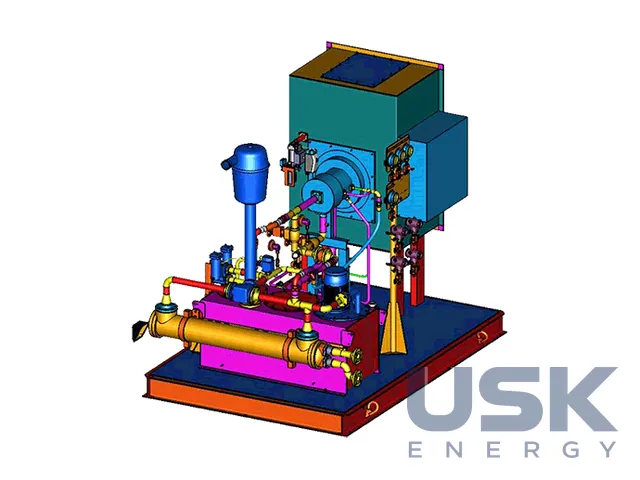
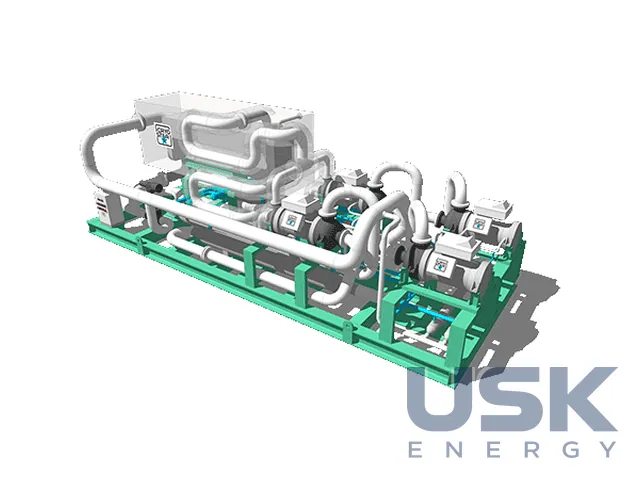
Models: XS at 28 t/day with a specific energy consumption of 1.1 kWh/kg, two skids and a 30×15 m site. S at 50 t/day, 1.0 kWh/kg. M at 88 t/day, 0.8 kWh/kg. L at 125 t/day, 0.7 kWh/kg. XL at 200 t/day, 0.6 kWh/kg. Models S–XL have one refrigeration unit and a 20×15 m site. The plant is modular, on skids; gas treatment units and plant-wide systems are supplied together with partners. The documentation package includes input data, process flow diagrams, P&ID, safety and winterization concepts, a general layout, a 3D model, equipment lists and HAZID.
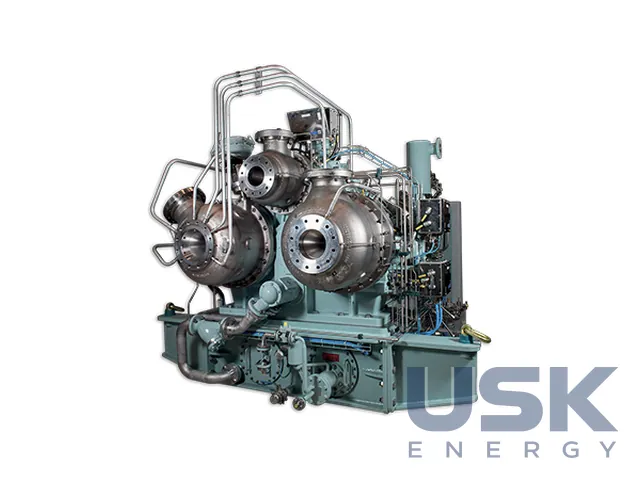
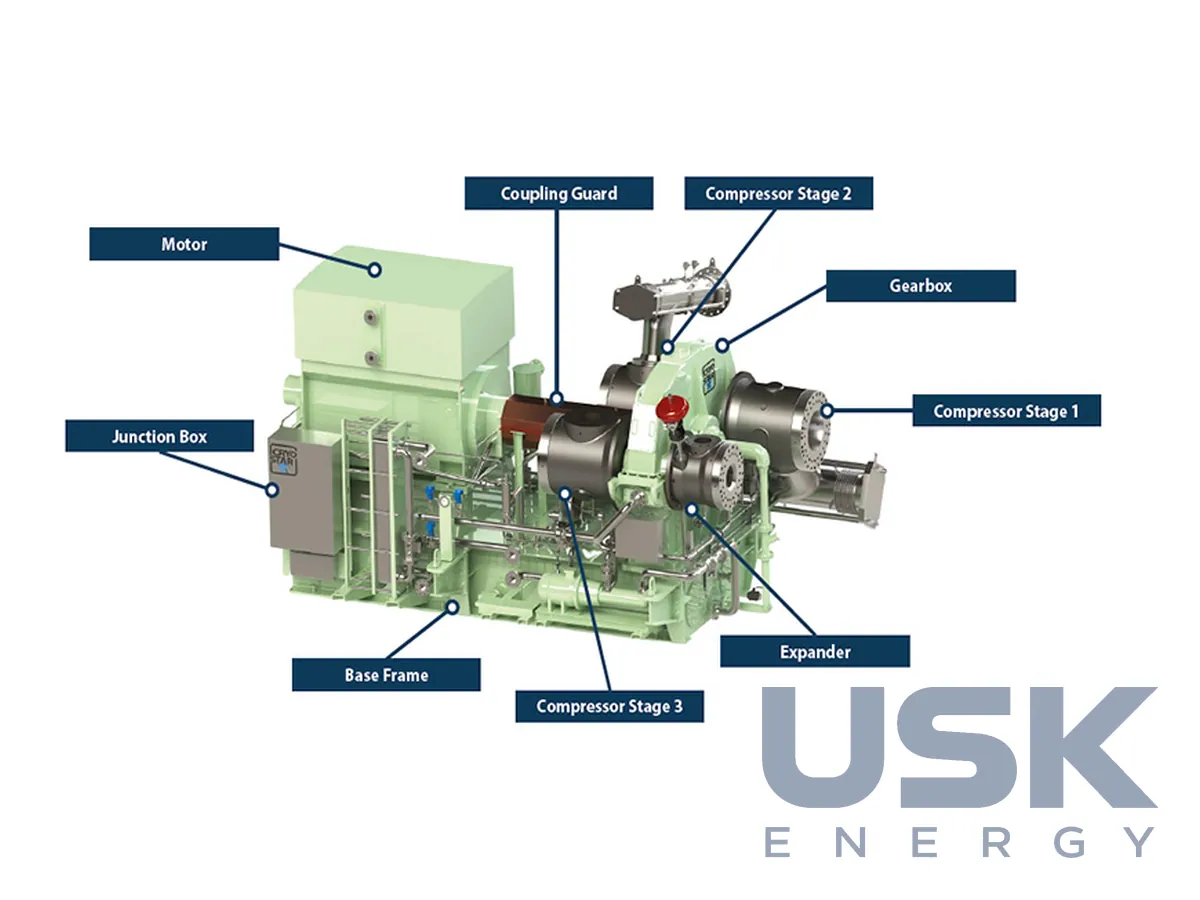
The compander is a multi-shaft turbomachine with three compression stages and one expansion stage on a common multiplier, driven by a medium-voltage electric motor. The expansion energy is returned to the cycle. The first compander of this manufacturer was built in 1996. It is supplied on a frame with an oil system and a seal gas system, with a nitrogen consumption of 25–45 Nm³/h. Scheduled maintenance takes two days a year and 14 days every 35 000 hours.
Feedstock is pipeline, associated and coal gas and biogas. The plants are used for satellite stations and filling stations, bio-LNG production and peak shaving. Each machine undergoes factory mechanical and cryogenic tests.
Technical specifications
| Capacity | 20 … 200 t/day (17–124 thousand gallons/day) |
|---|---|
| Process | reverse Brayton cycle with nitrogen, single- or two-stage (with a JT valve) |
| Models | XS 28 t/day (1.1 kWh/kg), S 50 (1.0), M 88 (0.8), L 125 (0.7), XL 200 t/day (0.6 kWh/kg) |
| Site | 20×15 m (S–XL), 30×15 m (XS) without air coolers |
| Compander | 3 compression stages + 1 expansion stage on a common gearbox, MV motor, seal N₂ consumption 25–45 Nm³/h |
| Turndown | load reduction to 30 % |
| Compander maintenance | 2 days a year, 14 days every 35 000 h |
| Feedstock | pipeline gas, associated gas, coalbed methane, biogas |
Request a price and lead time
StarLite LNG — small-scale natural gas and biogas liquefaction plants 20–200 t/day with a compander. We reply within one business day.
Or email sales@usk.ua or call 044 339-50-20.
Questions and answers
What is the capacity of the StarLite LNG plants and how is it controlled?
The range covers from 20 to 200 tonnes per day, with models XS 28, S 50, M 88, L 125 and XL 200 t/day. The load can be reduced to 30 %.
What is the specific energy consumption of the StarLite LNG models?
For the XS it is 1.1 kWh/kg, for the S 1.0, for the M 0.8, for the L 0.7 and for the XL 0.6 kWh/kg. The site of models S–XL is 20×15 m, and the XS needs 30×15 m.
How often is the compander serviced?
Scheduled maintenance takes two days a year and 14 days every 35 000 hours. Seal nitrogen consumption is 25–45 Nm³/h.
Similar equipment from other manufacturers