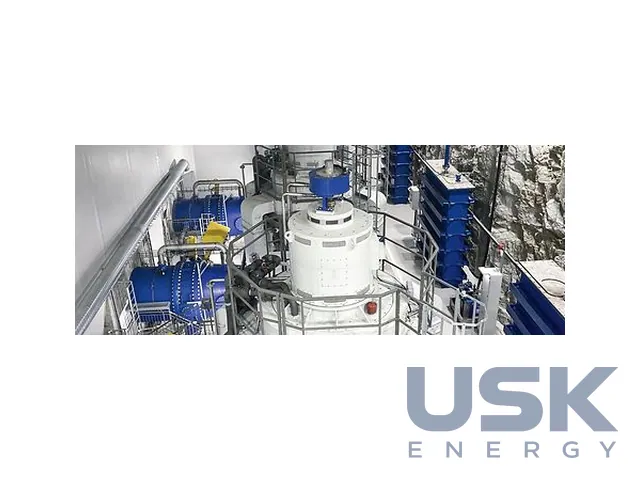
Synchronous generators for ORC turbines 4.6–45 MVA, 4.16–13.8 kV (2 and 4 poles)
Synchronous generators rated 4.6–45 MVA at 4.16–13.8 kV for organic Rankine cycle (ORC) turbines. Four-pole versions with a gearbox and two-pole versions directly coupled to the turbine are available. They are used in biomass plants, heat recovery and geothermal power.
- Power
- 4600–45,000 kVA
- Voltage
- 4160–13,800 V
- Weight
- 17,500–76,000 kg
- Design
- 4-pole (through a gearbox) and 2-pole with direct coupling
Price, availability and lead time on request. We help with analogue selection, customs clearance and delivery.
Description
The manufacturer has created a complete range of synchronous generators designed specifically for organic Rankine cycle (ORC) turbines. They are installed in biomass power plants, in heat recovery and in geothermal power. There are two variants, the traditional four-pole (with a gearbox) and the two-pole directly coupled to the turbine, and both help to maximize energy production.
The two-pole machines have a laminated rotor and are coupled to the ORC turbine directly, without a gearbox. This reduces losses, operating and maintenance costs, shortens the unit, reduces the footprint and increases the MTBF, lowering the life-cycle cost. This design appeared at the request of an OEM that needed a more compact and efficient system without a gearbox. An ORC turbine works like a steam one, but it evaporates an organic fluid instead of water, so it extracts energy from lower-temperature sources. One of the completed projects is waste heat recovery at a glass plant in Bulgaria. Later a complete range of generators for ORC plants was created for the same OEM, supplied to the Turkish market.
The rating is 4600–45,000 kVA, the voltage 4160–13,800 V and the weight 17.5–76 t. The rotor is cylindrical or salient-pole depending on requirements, with speed up to 3000 rpm. Excitation is brushless, with an auxiliary generator (exciter) on the shaft and a rotating diode bridge. Cooling is through an air-water or air-air heat exchanger, or open ventilation.
The bearings are designed for 100,000 hours of continuous operation, and the mechanical and electrical design based on a 3D model aims at minimum operating costs and draws on more than forty years of experience in supplying generators for power plants. The insulation is the proprietary MICASYSTEM® VPI system based on mica tape and a solvent-free epoxy resin mixture. According to the documentation, in case of a fault it allows the machine to be repaired on site, without taking it to a service shop. The manufacturer supports OEMs and plant owners from the feasibility study to the end of the life cycle. Applications include ORC plants on biomass, recovery of waste heat from industrial processes and gas engines, and geothermal plants.
Technical specifications
| Power | 4600–45,000 kVA |
|---|---|
| Voltage | 4160–13,800 V |
| Weight | 17,500–76,000 kg |
| Design | 4-pole (through a gearbox) and 2-pole with direct coupling |
| Rotor | cylindrical (laminated) or salient-pole; up to 3000 rpm |
| Excitation | brushless (exciter on the shaft + rotating diode bridge) |
| Cooling | air-water, air-air or open ventilation |
| Bearings | design life 100,000 h |
| Insulation | MICASYSTEM® VPI |
Request a price and lead time
Synchronous generators for ORC turbines 4.6–45 MVA, 4.16–13.8 kV (2 and 4 poles). We reply within one business day.
Or email sales@usk.ua or call 044 339-50-20.
Questions and answers
How do two-pole and four-pole generators differ?
Four-pole machines work through a gearbox, while two-pole machines with a laminated rotor are coupled to the turbine directly. Without a gearbox there are lower losses, footprint and maintenance costs.
What are the rating and voltage of the range?
The rating is 4600–45,000 kVA, the voltage 4160–13,800 V and the weight 17.5–76 t.
What excitation and cooling do these generators have?
Brushless excitation with a rotating diode bridge. Cooling is air-water, air-air or open ventilation.
Similar equipment from other manufacturers