TFS 2100E line fault locator using travelling waves, accuracy within ±50 m
The TFS 2100E finds the location of faults on power lines by travelling waves, with an accuracy within ±50 m. It consists of TDU-100E recorders at substations with GPS synchronisation and the TAS-2100E master station software.
- Type
- travelling wave fault location system
- Components
- TDU-100E recorders, TAS-2100E master station software
- Location accuracy
- within ±50 m
- Resolution
- ±5 m
Price, availability and lead time on request. We help with analogue selection, customs clearance and delivery.
Description
A fault on a line sends a travelling wave along it in both directions. Each recorder captures the moment the wave front arrives, using a timestamp from its built-in GPS module with an accuracy of 100 ns, and the master station compares the stamps from different substations. Methods of type D (double-ended), A (single-ended), E and W (based on data from the whole network) are available. The result does not depend on fault resistance, the error stays within ±50 m, which is less than one span between poles, and the resolution is ±5 m. The calculation takes only a few milliseconds.
The TFS 2100E is built from two or more TDU-100E recorders installed at substations at the ends of the monitored lines, together with the TAS-2100E master station software. That software gathers the records, works out the distance to the fault and shows the result on a network map. The system works on AC and DC lines, and the number of monitored lines is not limited.
The recorder connects to the master station over the internet, through a modem or a point-to-point link, and offers two Ethernet RJ45 ports at 100 Mbit/s plus an RS232 port. Substation integration uses IEC 61850-8, and IEC 60870-5-104, IEC 60870-5-103 and DNP3.0 are supported as well. Installation requires no intervention in primary circuits.
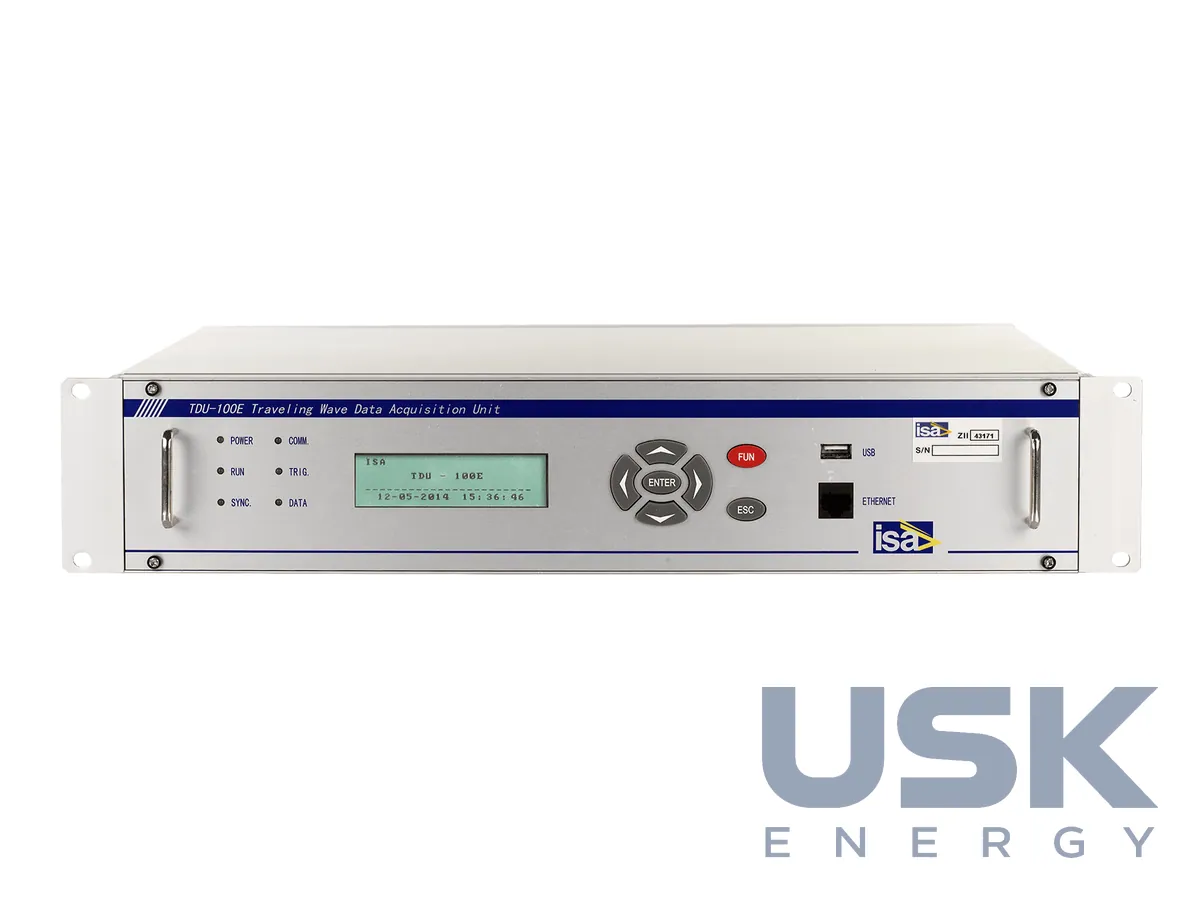
The TDU-100E recorder comes in a 2U housing for a 19-inch rack, sampling each wire at up to 36 MHz with 12-bit resolution. It records for up to 20 ms, the trigger threshold ranges from 4 to 20%, and the internal memory holds 8 GB. Analogue modules provide up to 24 channels for eight lines. Module AD connects to the secondary circuits of protective current transformers rated 1 A or 5 A, module AI works with split-core current transformers (250T for 1 A, 1250T for 5 A) or with an external CT of 200:1, and module AV measures phase voltage of 57, 63.5 or 69 V.
The base module runs from 85 to 264 V AC at 50/60 Hz or from 90 to 260 V DC, and optional supplies cover 35 to 140 V DC and 100 to 300 V DC. Digital inputs take five double dry contacts, wet contacts at 35 to 140 V, or eight inputs at 125 V or 250 V. External time sync comes via IRIG-B or 1PPS, over an electrical cable up to 90 m or with unlimited distance over optical fibre, with 1 µs accuracy. A TSG-10 pulse generator allows the recorder to be checked.
Technical specifications
| Type | travelling wave fault location system |
|---|---|
| Components | TDU-100E recorders, TAS-2100E master station software |
| Location accuracy | within ±50 m |
| Resolution | ±5 m |
| Sampling rate | up to 36 MHz per wire |
| Bit depth | 12 bit |
| Recording length | up to 20 ms |
| Analogue inputs | up to 24 channels for 8 lines |
| Time synchronisation | built-in GPS, 100 ns; external, 1 µs |
| Supply | 85–264 V 50/60 Hz AC, or 90–260 V DC; options 35–140 V DC and 100–300 V DC |
| Power consumption | < 10 W |
| Memory | 8 GB |
| Ports | 2 × Ethernet RJ45 100 Mbit/s, RS232, USB |
| Protocols | IEC 60870-5-104, IEC 61850-8, IEC 60870-5-103, DNP3.0 |
| Operating temperature | −10 to 55 °C |
| Humidity | 0 to 90% without condensation |
| Dimensions | 2U, 19-inch rack, 483 × 323 × 83 mm |
| Weight | < 4 kg without modules, < 6 kg with modules |
Part numbers
Show all part numbers (4)
TFS-2100E, TDU-100E, TAS-2100E, TSG-10
Request a price and lead time
TFS 2100E line fault locator using travelling waves, accuracy within ±50 m. We reply within one business day.
Or email sales@usk.ua or call 044 339-50-20.
Questions and answers
How many recorders does the system need?
Two or more TDU-100E recorders are installed at the substations at the ends of the lines, and there is no limit on the number of monitored lines.
Can the system be used on DC lines?
Yes, the TFS 2100E is used on AC and DC lines, including HVDC.
How is the recorder connected to measuring circuits?
Module AD connects to secondary circuits of 1 A or 5 A current transformers, modules AI take split-core or external CTs of 200:1, and module AV connects to a voltage transformer with a 57, 63.5 or 69 V output. Primary circuits are not touched.
Similar equipment from other manufacturers