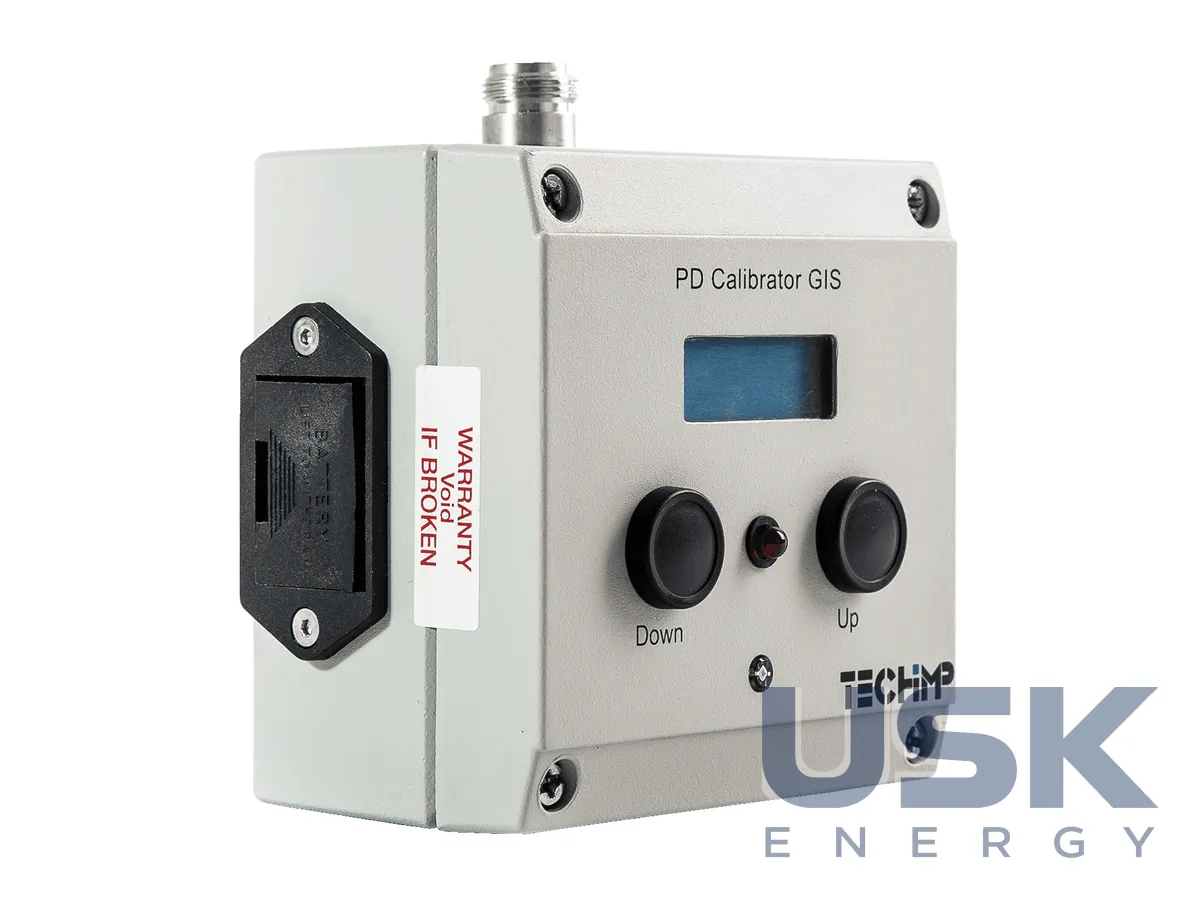
PDCAL partial discharge calibrator, 1–100 pC, 50–800 pC and UHF 0.2–50 V versions
The PDCAL is a portable reference pulse source for calibrating partial discharge measuring circuits. It runs from an internal battery and is offered as PDCAL, PDCAL PLUS and PDCAL UHF.
- Type
- partial discharge calibrator with microprocessor controlled pulse generator
- PDCAL range
- 1 pC, 2 pC, 5 pC, 10 pC, 20 pC, 30 pC, 40 pC, 50 pC, 70 pC and 100 pC
- PDCAL PLUS range
- 50 pC and 80 pC, then 100 to 800 pC in steps of 100 pC
- PDCAL UHF range
- 0.2 V, 0.5 V, 1.0 V, 2.0 V, 5.0 V, 10 V, 20 V, 30 V, 40 V and 50 V
Price, availability and lead time on request. We help with analogue selection, customs clearance and delivery.
Description
Engineers use the PDCAL to set up and verify partial discharge (PD) measuring chains. Connected to the test object before a measurement, it injects a known charge pulse so that the scale factor of the circuit can be established. Typical targets include medium and high voltage AC cables, HVDC cables, rotating machines, PWM drives, GIS, GIL and GIB, switchboards, bushings, power transformers and instrument transformers.
At its core is a microprocessor controlled pulse generator, and the operator steps through the output level with up and down keys. The pulse shape stays stable, and the calibration factors are held in flash memory. An on-board photo coupler synchronises the output pulse with the mains frequency by sensing light from surrounding lighting systems, so no separate synchronisation cable is needed. The internal 9 V battery allows the unit to run in the field.
The base PDCAL version delivers 1 pC, 2 pC, 5 pC, 10 pC, 20 pC, 30 pC, 40 pC, 50 pC, 70 pC and 100 pC, and its pulse accuracy complies with IEC 60270. The repetition rate is adjustable at 0.5, 1, 2 or 4 pulses per cycle, the output uses a BNC connector, and the injection capacitance is below 20 pF.
The PDCAL PLUS extends the range with 50 pC and 80 pC, then steps of 100 pC from 100 to 800 pC. Its injection capacitance is below 200 pF, which makes it the choice for test objects with large capacitance and higher discharge levels.
For GIS work, the PDCAL UHF produces pulses from 0.2 to 50 V with an accuracy of 1%. Rise time is below 200 ps and pulse width is 1 ns. Repetition rates are 0.5, 1 or 2 pulses per cycle, the output is an N type connector, and the injection capacitance is below 10 pF.
Technical specifications
| Type | partial discharge calibrator with microprocessor controlled pulse generator |
|---|---|
| PDCAL range | 1 pC, 2 pC, 5 pC, 10 pC, 20 pC, 30 pC, 40 pC, 50 pC, 70 pC and 100 pC |
| PDCAL PLUS range | 50 pC and 80 pC, then 100 to 800 pC in steps of 100 pC |
| PDCAL UHF range | 0.2 V, 0.5 V, 1.0 V, 2.0 V, 5.0 V, 10 V, 20 V, 30 V, 40 V and 50 V |
| Accuracy | IEC 60270 (PDCAL, PDCAL PLUS); 1% (PDCAL UHF) |
| Repetition rate | 0.5 – 1 – 2 – 4 pulses per cycle; UHF 0.5 – 1 – 2 |
| Injection capacitance | <20 pF (PDCAL), <200 pF (PDCAL PLUS), <10 pF (PDCAL UHF) |
| Rise time (UHF) | <200 ps |
| Pulse width (UHF) | 1 ns |
| Output connector | BNC (PDCAL, PDCAL PLUS), N (PDCAL UHF) |
| Power supply | one 9 V battery |
| Synchronisation | photo sensor, using ambient light |
Part numbers
Show all part numbers (2)
PDCAL, PDCAL PLUS and PDCAL UHF
Request a price and lead time
PDCAL partial discharge calibrator, 1–100 pC, 50–800 pC and UHF 0.2–50 V versions. We reply within one business day.
Or email sales@usk.ua or call 044 339-50-20.
Questions and answers
Which version should be used for GIS measurements?
The PDCAL UHF, which produces pulses from 0.2 to 50 V with a rise time below 200 ps and an N type output.
How does the calibrator stay synchronised with the mains?
An on-board photo sensor locks the output pulses to the mains frequency by using light from the surrounding lighting.
When is the PDCAL PLUS needed?
When pulses above 100 pC are required, since it provides 50 pC and 80 pC, then 100 to 800 pC in 100 pC steps.
Similar equipment from other manufacturers