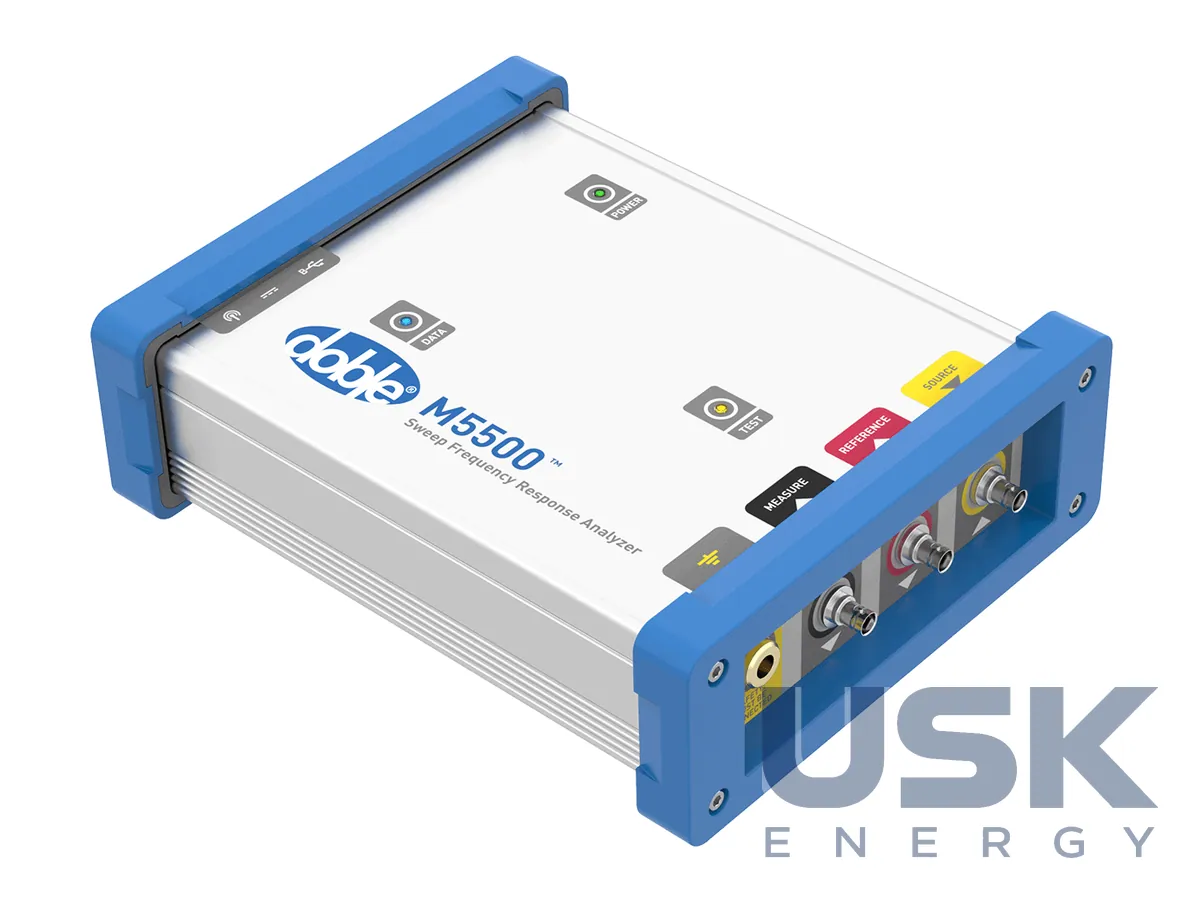
M5500 sweep frequency response analyser for transformer windings, up to 25 MHz
The M5500 checks the mechanical condition of transformers, reactors and other wound equipment by sweep frequency response analysis (SFRA). A typical sweep takes 15 to 30 seconds, and the dynamic range exceeds 150 dB.
- Method
- sweep frequency response analysis (SFRA)
- Applies to
- transformers, reactors and wound equipment
- Sweep time
- 15–30 s (typical)
- Default frequency range
- 20 Hz – 2 MHz
Price, availability and lead time on request. We help with analogue selection, customs clearance and delivery.
Description
SFRA relies on the fact that a winding's frequency response changes when the winding, the core or the tap leads move. The M5500 injects an excitation signal into the transformer and measures the response. Comparing the result with a baseline measurement, or with sister units, reveals deviations that confirm internal mechanical faults.
The results can reveal core displacement, winding deformation or movement, a faulty core earth, partial collapse of a winding, loss of turn stability, broken or loosened clamping structures, shorted turns and open circuits. Measurements repeat well, so even small changes carry diagnostic value.
A baseline SFRA is recommended during factory testing of a new transformer, and it should be repeated after each change of transport mode, after a crane lift, after network short circuits and during scheduled testing. This shows whether a transformer can safely return to service after an incident and whether it was damaged during shipment.
The instrument is light and rugged. The default frequency range is 20 Hz up to 2 MHz, and it can be extended down to 10 Hz and up to 25 MHz. The PC link is wired or wireless, and control and analysis run in the SFRA v6 software. The unit carries the CE mark.
The measuring leads comply with IEC 60076-18, and two cable kits are available. The SFRA Classic Plus ships as standard with an 18 m (60 ft) lead and a fixed 3.6 m (12 ft) earth conductor, and a 30 m (100 ft) variant is offered for large bushings. It has a ring-style reference earth for checking shorted cables and for Method 1 under IEC 60076-18 with the optional busbar kit. The IEC 1 kit with busbars is intended for Method 1 only, with the shortest busbar, and is used on bushings rated up to 800 kV.
Technical specifications
| Method | sweep frequency response analysis (SFRA) |
|---|---|
| Applies to | transformers, reactors and wound equipment |
| Sweep time | 15–30 s (typical) |
| Default frequency range | 20 Hz – 2 MHz |
| Extended frequency range | 10 Hz – 25 MHz |
| Dynamic range | over 150 dB |
| PC connection | wired or wireless |
| Software | SFRA v6 |
| SFRA Classic Plus lead | 18 m (60 ft), earth conductor 3.6 m (12 ft); 30 m (100 ft) variant |
| IEC 1 kit with busbars | Method 1 under IEC 60076-18, for 800 kV bushings |
| Standard | IEC 60076-18 |
| Marking | CE |
Part numbers
Show all part numbers (5)
030-2297-01, 030-1945-01, 030-2297-02, 030-2266-01, 030-2266-02
Request a price and lead time
M5500 sweep frequency response analyser for transformer windings, up to 25 MHz. We reply within one business day.
Or email sales@usk.ua or call 044 339-50-20.
Questions and answers
Which faults does the M5500 detect?
Core displacement, winding deformation or movement, a faulty core earth, collapsed winding sections, loosened clamping structures, shorted turns and open circuits. Conclusions are drawn by comparing with a baseline or with similar units.
Which cable kit should be chosen?
The SFRA Classic Plus ships as standard and suits checks of shorted cables and Method 1 with optional busbars. The IEC 1 kit is needed when measurements are made by Method 1 only, on bushings up to 800 kV.
When should SFRA measurements be taken?
A baseline is taken during factory testing, then again after transport, after a crane lift, after network short circuits and during scheduled testing.
Similar equipment from other manufacturers