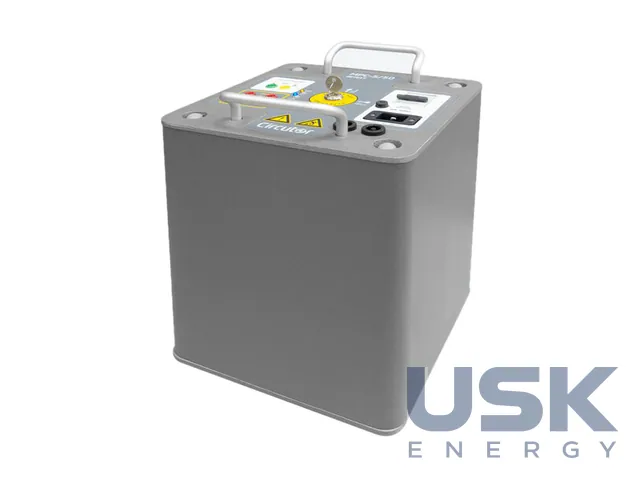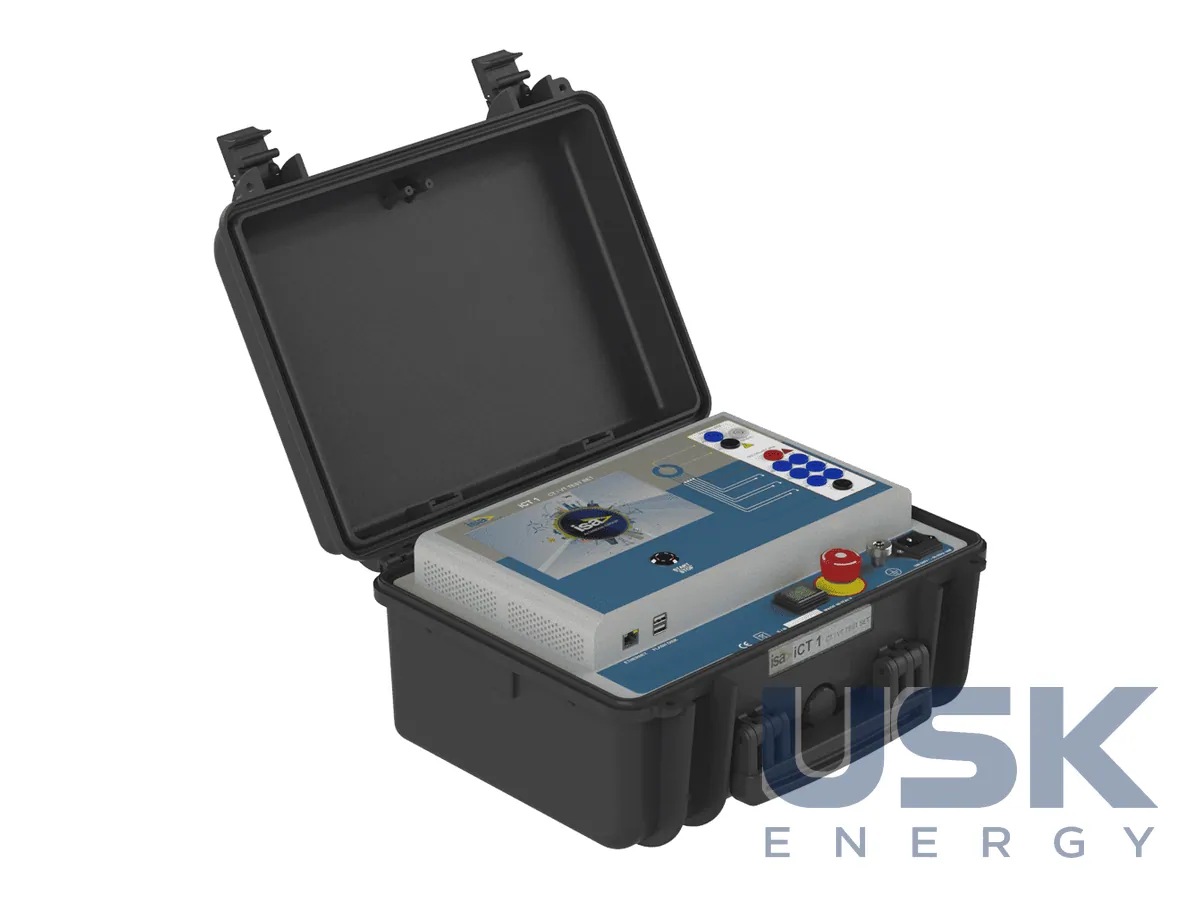
ICT1 portable test set for current and voltage transformers, up to 2000 V
The iCT1 is a portable automatic instrument for testing current transformers, voltage transformers and combined transformers. Every test runs from one connection, helped by a built-in five-tap switch on the secondary winding.
- Test objects
- CTs, VTs, combined transformers
- High voltage AC
- up to 2000 V (0.7 A when at 2000 V)
- AC current
- 6 A, 100 V, 200 VA
- DC current
- 6 A, 30 V, 180 W
Price, availability and lead time on request. We help with analogue selection, customs clearance and delivery.
Description
The iCT1 is used in transformer factories for acceptance testing and during commissioning at substations. One instrument checks current transformers (CTs), voltage transformers (VTs) and combined units, and measuring CTs up to accuracy class 0.1 are covered as well.
For CTs the set measures ratio and polarity, secondary burden, magnetisation characteristics including the DC method, winding and burden resistance, ALF and ISF, AC leakage current and accuracy. A CT Explorer function identifies the nameplate data of an unknown CT, and an integrated demagnetiser is fitted. For VTs it measures the ratio, including for electronic VTs, along with burden and no-load current.
The magnetisation curve is taken directly up to 2 kV, while the indirect DC method tests CTs with a knee-point voltage up to 30 kV without applying high voltage to the asset. The five-tap switch connects all secondary terminals at once, so no rewiring is needed between tests.
The main generator delivers up to 2000 V AC, 6 A AC at 100 V and 200 VA, 6 A DC at 30 V and 180 W, and 180 V AC at 3.5 A. For the DC magnetisation curve there is a 200 V DC output of 2 A rms with 15 A peak. The output frequency runs from 15 to 400 Hz, with total harmonic distortion below 2% on linear loads.
Control is by a 7-inch touchscreen. Results are kept in internal memory or on a USB drive and can be sent to a PC over Ethernet or Wi-Fi. The unit runs from 100 to 230 V, plus or minus 15%, at 48 to 62 Hz, and draws less than 1 kW in normal use. It measures 410 x 340 x 205 mm, weighs 16 kg, and tests to IEC 60044-1, IEC 61869-x and IEEE C57.13.1.
Technical specifications
| Test objects | CTs, VTs, combined transformers |
|---|---|
| High voltage AC | up to 2000 V (0.7 A when at 2000 V) |
| AC current | 6 A, 100 V, 200 VA |
| DC current | 6 A, 30 V, 180 W |
| Low voltage AC | 180 V, 3.5 A, 400 VA (230 V supply) |
| DC output for magnetisation curve | 200 V DC, 2 A rms, 15 A peak |
| CT saturation voltage | up to 2 kV directly, up to 30 kV by DC method |
| Frequency range | 15–400 Hz |
| CT ratio range | 0.8÷20000 |
| VT ratio range | 1÷2500 |
| Phase angle range | 0°÷360.0° |
| Total harmonic distortion | below 2% on linear loads |
| Power supply | 100÷230 V ± 15%; 48÷62 Hz |
| Power consumption | less than 1 kW |
| Dimensions | 410 x 340 x 205 mm |
| Weight | 16 kg |
| Standards | IEC 60044-1, IEC 61869-x, IEEE C57.13.1 |
Part numbers
Show all part numbers (4)
PII10183, PII12183, PII15183, PII18183
Request a price and lead time
ICT1 portable test set for current and voltage transformers, up to 2000 V. We reply within one business day.
Or email sales@usk.ua or call 044 339-50-20.
Questions and answers
Can transformers with a very high knee-point voltage be tested?
Yes. The direct method covers up to 2 kV, and the indirect DC method covers up to 30 kV. No high voltage is applied to the transformer under test in the DC method.
What is the difference between PII10183 and PII12183?
PII10183 is the advanced test kit with cables, while PII12183 is the standard kit with cables. The transport case carries code PII15183, and the long connection cables are PII18183.
How are results stored and transferred?
Results are saved in internal memory or on a USB drive. They can be sent to a PC over Ethernet, by cable or via Wi-Fi.
Similar equipment from other manufacturers