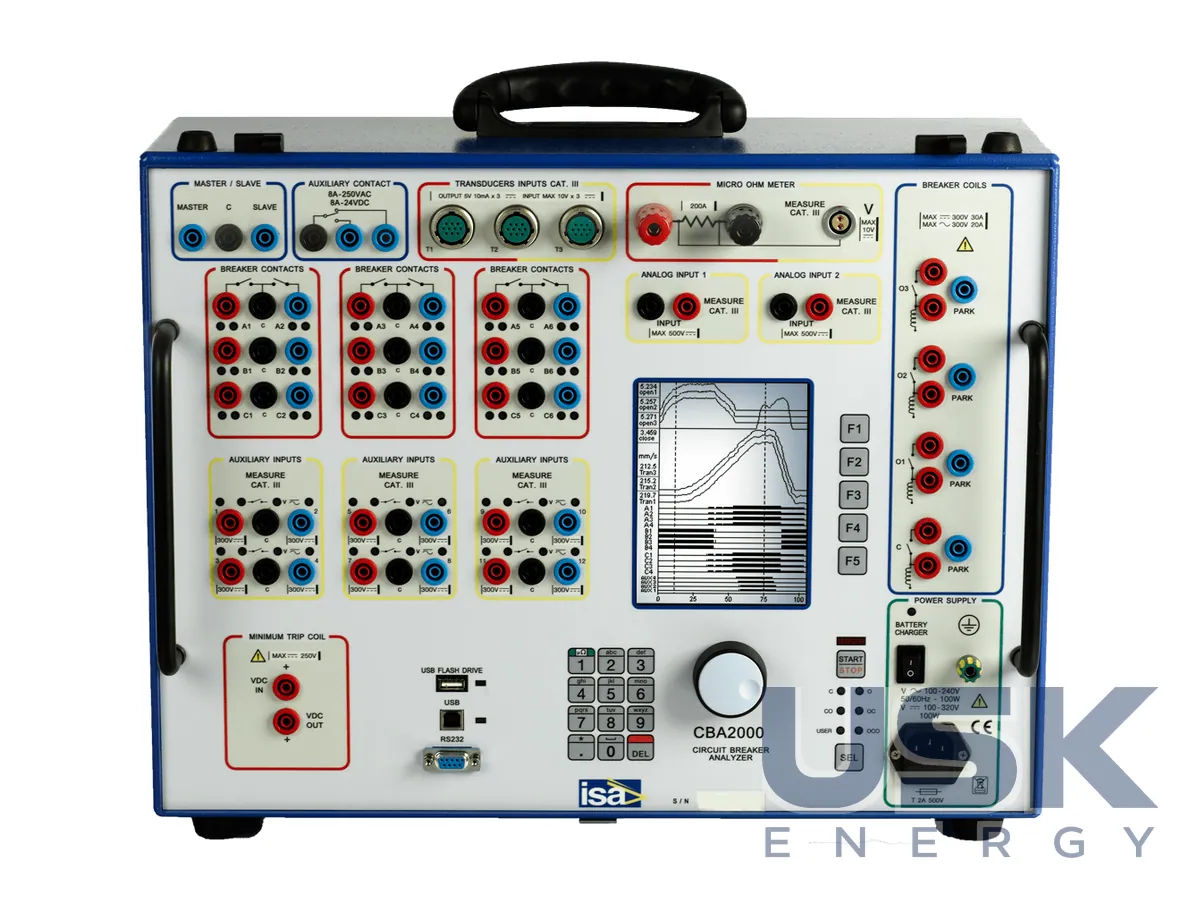
CBA 2000 HV breaker analyser with up to 18 main contacts and 200 A micro-ohmmeter
The CBA 2000 performs a full diagnosis of high voltage circuit breakers, covering timing, travel and contact speed, plus contact resistance in static and dynamic modes at 200 A. It provides up to 18 main and 18 resistor contact inputs, along with 12 auxiliary inputs.
- Breaks per phase
- 2, 4 or 6 depending on version
- Main and resistor contact inputs
- up to 18 + 18
- Auxiliary inputs
- up to 12
- Coil control circuits
- 2, option 4
Price, availability and lead time on request. We help with analogue selection, customs clearance and delivery.
Description
The CBA 2000 diagnostic system is used to test all types of circuit breakers at substations. It measures opening and closing times, pole discrepancy, first opening, coil and drive motor currents, contact resistance in static and dynamic modes, travel and speed, and, as an option, the minimum coil operating voltage.
Depending on the version, the instrument serves breakers with two, four or six breaks per phase. The base units 46169, 47169 and 48169 cover those configurations with 4, 8 and 12 auxiliary inputs respectively, and each includes three transducer inputs. A fully equipped unit offers up to 18 main and 18 resistor contact inputs. Pre-insertion resistance can be measured from 20 Ω to 10 kΩ, and contacts are checked with 24 V and 50 mA.
Coil control circuits are rated 300 V DC and 30 A DC, or 300 V AC and 20 A AC, with two circuits as standard and an option for four. Coil current can be measured in 2.5, 10 and 25 A spans, and timing accuracy is 0.025 % ± 50 µs. There are eight analogue inputs, expandable to ten as an option, with ±5, ±50 and ±500 V ranges and 16-bit resolution. Sampling runs from 20 Hz to 20 kHz, and recording lasts up to 200 s. Up to three digital transducers can be used for travel analysis, with input frequency up to 50 kHz and a supply of 5 V or 12 V from the instrument.
The built-in 200 A micro-ohmmeter measures across 200 µΩ, 1 mΩ, 10 mΩ and 100 mΩ ranges with 1 µΩ resolution. The minimum trip coil check comes in two versions, 250 V at 4 A and 70 V at 10 A. The BSG1000-1, BSG1000-2 and BSG2000 modules allow a breaker earthed on both sides to be tested. The 320 x 240 pixel display sits alongside 256 MB of memory holding 500 results and 64 programmes, with USB and RS232 interfaces.
Power comes from 85–265 V AC at 50–60 Hz, from 100–350 V DC, or from a Ni-Mh battery that gives 4 hours of breaker testing. The aluminium case measures 485 x 365 x 240 mm and weighs 13 kg, or 15 kg with the micro-ohmmeter. Protection is rated IP 2X.
Technical specifications
| Breaks per phase | 2, 4 or 6 depending on version |
|---|---|
| Main and resistor contact inputs | up to 18 + 18 |
| Auxiliary inputs | up to 12 |
| Coil control circuits | 2, option 4 |
| Coil control | 300 V DC, 30 A DC; 300 V AC, 20 A AC |
| Coil current spans | 2.5; 10; 25 A |
| Timing accuracy | 0.025 % ± 50 µs |
| Analogue inputs | 8, option 10; ± 5 / ± 50 / ± 500 V; 16 bit |
| Sampling rate | 20 Hz ... 20 kHz |
| Recording duration | up to 200 s |
| Digital transducers | up to 3, up to 50 kHz |
| Micro-ohmmeter current | 200 A |
| Resistance ranges | 200 µΩ; 1 mΩ; 10 mΩ; 100 mΩ |
| Minimum trip coil check | 250 V 4 A; 70 V 10 A |
| Memory | 256 MB, up to 500 results |
| Power supply | 85–265 V AC, 50-60 Hz; 100–350 V DC; Ni-Mh |
| Dimensions | 485 x 365 x 240 mm |
| Weight | 13 kg; 15 kg with micro-ohmmeter |
| Protection rating | IP 2X |
Part numbers
Show all part numbers (3)
46169, 47169, 48169
Request a price and lead time
CBA 2000 HV breaker analyser with up to 18 main contacts and 200 A micro-ohmmeter. We reply within one business day.
Or email sales@usk.ua or call 044 339-50-20.
Questions and answers
How do the 46169, 47169 and 48169 versions differ?
By the number of breaks per phase and auxiliary inputs: 2 breaks with 4 inputs, 4 breaks with 8 inputs and 6 breaks with 12 inputs.
Can a breaker earthed on both sides be tested?
Yes, using the BSG1000-1, BSG1000-2 or BSG2000 modules.
Which travel transducers are supported?
Analogue linear and rotary transducers, as well as up to three digital transducers with input frequency up to 50 kHz and a 5 V or 12 V supply from the instrument.
Similar equipment from other manufacturers