8VQ3 Blue GIB — gas-insulated busducts up to 420 kV with clean air insulation
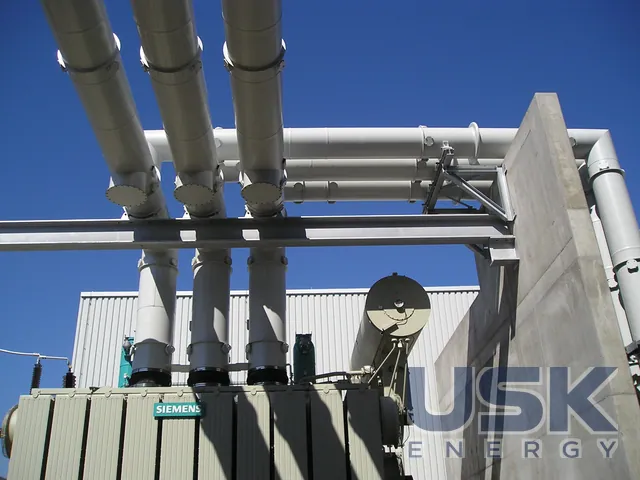
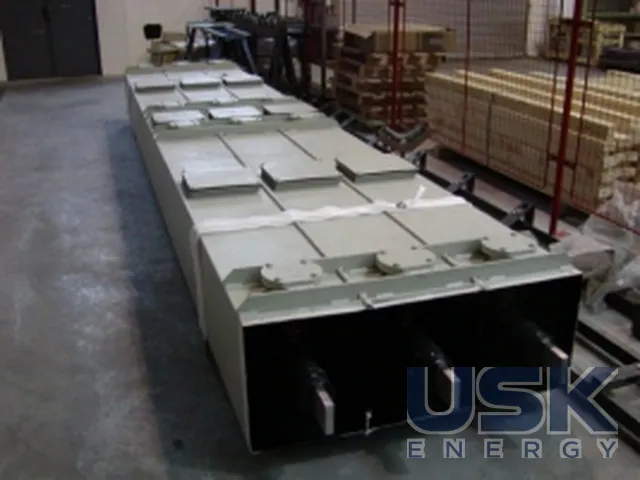
8VQ3 Blue GIB are gas-insulated busducts for 145 and 420 kV in which clean air serves as the insulating medium instead of SF6. They connect GIS with overhead lines, power transformers or air-insulated switchgear. Applications cover 110–400 kV substations, power plants, long connections in confined conditions and GIS-to-AIS transitions.
- Rated voltage
- up to 145 kV and up to 420 kV, 50/60 Hz
- Test voltage
- up to 275 kV (145 kV) / 650 kV (420 kV)
- Lightning impulse
- up to 650 / 1425 kV
- Switching impulse (420 kV)
- up to 1050 kV
Price, availability and lead time on request. We help with analogue selection, customs clearance and delivery.
Description
A gas-insulated busduct consists of rigid single-phase conductors in a grounded metal enclosure filled with insulating gas. It is used for long entries to substations and for power outlets at power plants. It is also needed where an overhead busbar or a high-power cable cannot be laid. In the Blue portfolio, busducts became one of the first elements mastered for 420 kV.
Two classes are offered. The busduct up to 145 kV is rated for a rated current of up to 3150 A, a power-frequency test voltage of up to 275 kV, a lightning impulse of up to 650 kV and a short-time current of up to 63 kA for 1 s. The busduct up to 420 kV carries up to 5000 A. Its test voltage is up to 650 kV, the lightning impulse up to 1425 kV, the switching impulse up to 1050 kV, the peak withstand current up to 170 kA, and the short-time current up to 63 kA for 3 s. The minimum distance between poles is 1200 mm.
Gas leakage in type tests is below 0.1 % per year per compartment. Operating temperatures range from −50 to +55 °C, and the insulating medium does not liquefy. The busducts are installed indoors and outdoors. The first major overhaul is needed no earlier than after 25 years, the expected service life is over 50 years, and the design complies with IEC and IEEE standards.
Clean air consists of 80 % nitrogen and 20 % oxygen. It is non-toxic, forms no decomposition products and does not require density monitoring, emission reporting, special personnel training or gas disposal. If a compartment loses tightness, the air escapes into the atmosphere without harm to people and the environment, so emergency procedures are simpler than for SF6. According to the manufacturer's calculation, the 420 kV 8VQ3 Blue GIB instead of an 8DQ1 GIB SF6 busduct of the same length reduces the life-cycle carbon footprint by about 2158 t of CO₂ equivalent.
Alongside the Blue GIB, the company produces SF6 busducts based on the 8DQ1 GIS. An example is 2700 m of single-pole busducts at the Bergen substation in the USA.
Technical specifications
| Rated voltage | up to 145 kV and up to 420 kV, 50/60 Hz |
|---|---|
| Test voltage | up to 275 kV (145 kV) / 650 kV (420 kV) |
| Lightning impulse | up to 650 / 1425 kV |
| Switching impulse (420 kV) | up to 1050 kV |
| Rated current | up to 3150 A (145 kV) / 5000 A (420 kV) |
| Short-time current | up to 63 kA (1 s for 145 kV, 3 s for 420 kV); peak 170 kA |
| Insulation | clean air, 0 kg of F-gases |
| Min. distance between poles (420 kV) | 1200 mm |
| Temperature | −50…+55 °C, indoor/outdoor |
| Service life | > 50 years |
Request a price and lead time
8VQ3 Blue GIB — gas-insulated busducts up to 420 kV with clean air insulation. We reply within one business day.
Or email sales@usk.ua or call 044 339-50-20.
Customs codes
| UKTZED (Ukraine) | 8544 60 90 00 |
|---|---|
| HS, 6 digits | 8544 60 |
| CN (EU) | 8544 60 90 |
| HTSUS (USA) | 8544 60 60 00 |
| China customs tariff | 8544 60 90 00 |
Codes are for reference: the final code is determined at declaration for the specific model.
Questions and answers
What current is the 8VQ3 Blue GIB busduct at 420 kV rated for?
A rated current of up to 5000 A, a short-time current of up to 63 kA for 3 s and a peak withstand current of up to 170 kA. The 145 kV busduct carries up to 3150 A.
Can Blue GIB be laid outdoors in a cold climate?
Yes, the busducts work indoors and outdoors at temperatures from −50 to +55 °C. Clean air does not liquefy in this range.
What distance between poles should be allowed for 420 kV?
The minimum distance between poles of the 420 kV busduct is 1200 mm. The final layout depends on the route and connection points.
Similar equipment from other manufacturers