
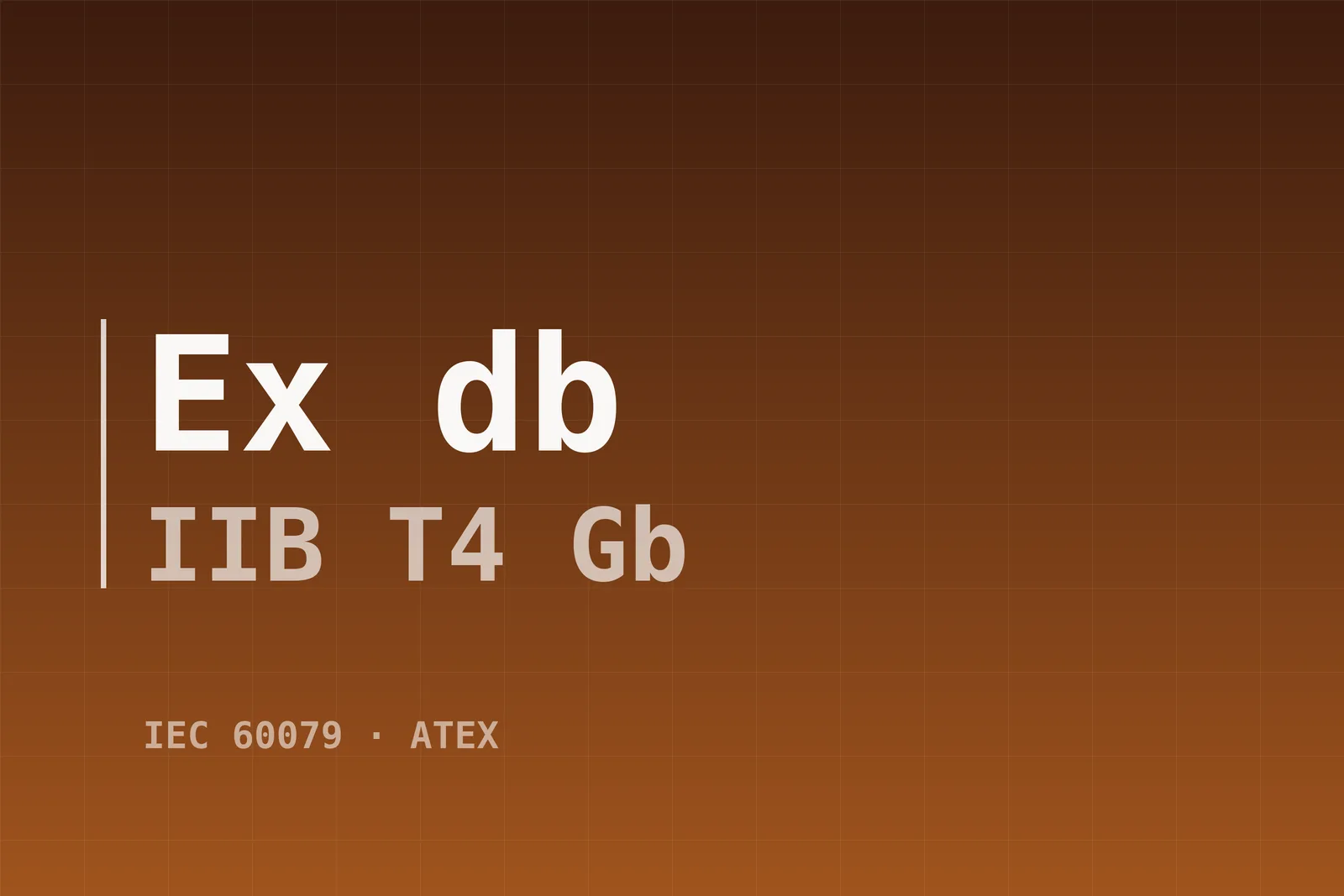
A marking such as "1Ex d IIB T4 Gb X" on a motor or a luminaire is made up of five or six independent fields. Each answers a separate question: what protects it, for which gas, how hot the surface can get, and in which zone it may be installed. Once you know the order of the fields, both the European marking and the GOST marking can be read in a minute.
Order of the fields
The part "II 2 G" is the European requirement of the ATEX Directive 2014/34/EU, and the part "Ex db IIB T4 Gb" is the requirement of the international standard IEC 60079. A nameplate for the EU market carries both. In Eurasian Economic Union (EAEU) countries, under GOST 31610 (identical to the IEC 60079 series; in Ukraine the corresponding standards are DSTU IEC/EN 60079), the explosion-protection level is often placed as a number in front of the Ex mark: 1Ex d IIB T4 Gb X.
Type of explosion protection
| Letter | Name | Principle |
|---|---|---|
| d (db, dc) | flameproof enclosure | an internal explosion does not escape outside; the gaps cool the flame |
| e (eb, ec) | increased safety | sparks and overheating are excluded in normal operation (terminal boxes, motors) |
| i (ia, ib, ic) | intrinsic safety | the energy in the circuit is too low to ignite the mixture |
| p (px, py, pz) | pressurisation | the enclosure is filled with protective gas under positive pressure |
| m (ma, mb, mc) | encapsulation | sparking parts are embedded in compound |
| o, q | oil immersion, sand filling | less common in modern equipment |
| t (ta, tb, tc) | dust protection by enclosure | dust cannot get inside, and the surface temperature is limited |
The second letter (a, b, c) indicates the protection level and corresponds to the EPL: "a" is Ga, "b" is Gb, "c" is Gc. In the 2014 edition of IEC 60079-1 the designation "d" changed to "db" and "dc", so older equipment will show plain Ex d, and newer equipment will show Ex db.
Explosion group and temperature class
Group I is for mines with firedamp. Group II is divided by the gas the enclosure is designed for, so that flame cannot pass through the gaps:
| Subgroup | Representative gas |
|---|---|
| IIA | propane |
| IIB | ethylene |
| IIC | hydrogen, acetylene |
Equipment rated IIC can be used where IIB or IIA is required, but not the other way round. So IIB permits propane but not hydrogen. There is also an intermediate IIB+H2 group for hydrogen-containing atmospheres.
| Class | Max. surface temperature |
|---|---|
| T1 | 450 °C |
| T2 | 300 °C |
| T3 | 200 °C |
| T4 | 135 °C |
| T5 | 100 °C |
| T6 | 85 °C |
The surface temperature must be lower than the auto-ignition temperature of the gas on site. A T4 motor (135 °C) is not suitable for carbon disulphide, which auto-ignites at 90 °C, but is quite suitable for petrol. The class applies at the stated ambient temperature; if none is stated, −20…+40 °C is assumed.
EPL level and zone
| EPL | ATEX category | Zone | When the mixture occurs |
|---|---|---|---|
| Ga | 1G | 0 | continuously or for long periods |
| Gb | 2G | 1 | likely in normal operation |
| Gc | 3G | 2 | unlikely, and then only for a short time |
| Da | 1D | 20 | dust continuously |
| Db | 2D | 21 | dust likely |
| Dc | 3D | 22 | dust unlikely |
The rule is simple: equipment with a higher protection level can be installed in a less hazardous zone. Gb suits zones 1 and 2, Gc suits zone 2 only, and zone 0 requires Ga. Dust levels Da/Db/Dc are never substituted for gas levels or the other way round: in an atmosphere with both hazards, dual marking is required.
The letters X and U
The letter X at the end means special conditions for safe use. They must be looked up in the certificate: limits on ambient temperature, tightening torque, protection against impact. Equipment marked X cannot be considered suitable until its certificate has been read. The letter U denotes a component (for example, a flameproof enclosure without its contents) that needs additional certification as part of the finished product.
How to compare markings from different systems
- Convert the numeric level "1Ex" into EPL: 0 — Ga, 1 — Gb, 2 — Gc. In the new marking, the EPL simply appears at the end in place of the digit.
- Match the type of protection: d — db, e — eb, ia — ia. The letter together with its second letter carries the same level.
- Check the group: IIB in GOST and IIB in IEC mean the same thing, and the gases are the same.
- Compare the temperature class, then the ambient temperature it is rated for.
- Check that the certificate is valid in the country of use: ATEX and IECEx do not replace a national approval where the law requires one.
The ingress protection rating (IP) is not part of explosion protection and is listed separately; see the article on IP, IK and NEMA. Motor designations in general are covered here.
Further reading
Discuss your project
Tell us about your challenge. We will help you find the right direction and define your next step.