
A customs code is needed twice for a transformer or a motor: the supplier enters it on the invoice, and the customs broker enters it on the declaration. If the two codes do not match, the question is who got it wrong. The code is not guessed from the product name; it is read from the nameplate. In most product groups of electrical equipment it depends on a few measured parameters: power, voltage, insulation type and type of current.
What the code consists of
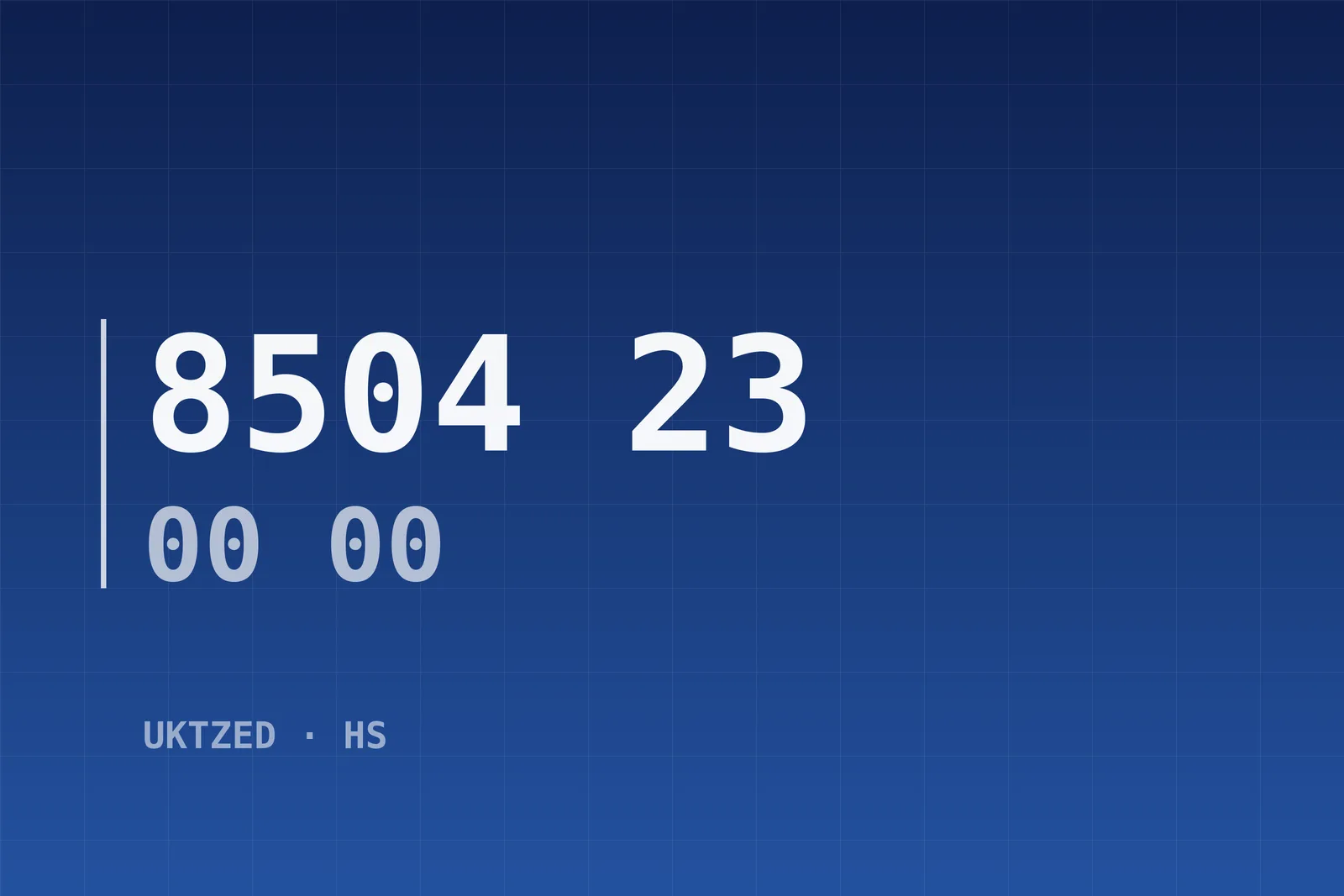
The first six digits are the Harmonized System (HS) of the World Customs Organization, understood in more than a hundred countries. The Combined Nomenclature of the EU uses eight digits, and the Ukrainian customs nomenclature (UKTZED) uses ten. So the code 8504 23 00 00 on a Ukrainian declaration and the code 8504 23 00 from the European one share the same root, 8504 23, and that is the part usually used to match codes between countries.
Duty rates and additional requirements in Ukraine are tied to the full ten-digit code, so the last digits should be checked against the current Customs Tariff, not the exporter's invoice. Six digits in foreign documents are almost always just the HS code, not the full Ukrainian code.
Example: power transformers, 8504
Two parameters decide it: what fills the tank and the rated power in kVA. For transformers with a liquid dielectric (oil, synthetic fluid) it looks like this:
| HS code | Power | Typical unit |
|---|---|---|
| 8504 21 | up to and including 650 kVA | distribution TM and TMG transformers, station-service transformers |
| 8504 22 | over 650 kVA, up to and including 10,000 kVA | TM/TMN 1000–10,000 kVA, substation transformers 6–35 kV |
| 8504 23 | over 10,000 kVA | transformers of 10 MVA and above, 110/10 kV and larger |
So a 16 MVA 110/10 kV transformer falls under 8504 23, and a 2.5 MVA one under 8504 22. Dry-type transformers (cast resin, air-insulated) fall under a different subheading: 8504 31 up to 1 kVA, 8504 32 from 1 to 16 kVA, 8504 33 from 16 to 500 kVA, 8504 34 above 500 kVA. The 650 kVA boundary between 21 and 22 applies to liquid-filled units only, so the same 1000 kVA transformer is 8504 22 in an oil-filled version and 8504 34 in a dry version.
The practical tip: in a price request, simply state the cooling type and the power in kVA. That is enough for the supplier and the broker to pick the same code.
Motors and generators, 8501
For motors, the rest of the classification is set by the type of current, the number of phases and the power. For polyphase AC motors the scale is as follows:
| HS code | Power |
|---|---|
| 8501 51 | up to and including 750 W |
| 8501 52 | over 750 W, up to and including 75 kW |
| 8501 53 | over 75 kW |
DC motors form a separate group, 8501 31–34: up to 750 W, up to 75 kW, up to 375 kW, and over 375 kW. Single-phase AC motors are 8501 40. AC (synchronous) generators are 8501 61–64, by power in kVA. The power used in the classification is the rated shaft output from the nameplate (kW), not the power drawn from the supply.
A 132 kW induction motor on the nameplate reads unambiguously: over 75 kW, so 8501 53. Confusion arises when the supplier states the power in hp, or lists a motor with a gearbox as a separate unit. Such a position is assessed by the main function of the set.
Cable, switching, converters, batteries
| Item | HS code | What decides it |
|---|---|---|
| Power cable | 8544 42, 8544 49, 8544 60 | presence of connectors at the ends; voltage up to 1000 V or over 1000 V |
| Equipment up to 1000 V | 8536 | circuit breakers, contactors, fuses, terminals |
| Equipment over 1000 V | 8535 | disconnectors, MV and HV switches |
| Panels, control cabinets, KRU switchgear | 8537 10, 8537 20 | voltage up to 1000 V or over 1000 V |
| Inverters, rectifiers, UPS | 8504 40 | static converters |
| Chokes, reactors | 8504 50 | inductance coils with no other functions |
| Lithium-ion batteries | 8507 60 | chemistry type; for BESS the position is assessed taking into account what the delivery contains |
| Photovoltaic modules | 8541 43 | solar cells assembled into a module (panel); individual cells are 8541 42 |
Composite deliveries (a containerised BESS with batteries, converters, panels and a cooling system) are the hardest case. The code depends on which units are shipped together and which function is the determining one. Do not rely on the table here: a customs broker's decision is needed and, if necessary, an advance ruling on the classification of the goods.
How to check the code before shipment
- Write down from the nameplate or the technical data sheet the parameters that determine the code: power, voltage, type of current, insulation and cooling type.
- Find the six-digit HS subheading in the table above or in the official nomenclature.
- Check the full ten-digit UKTZED code in the current Customs Tariff of Ukraine: the duty rate and certification requirements are tied to it.
- Compare it with the code on the exporter's invoice. If the first six digits differ, resolve it before shipment, not at customs clearance.
- For atypical or composite deliveries, ask the broker to prepare a justification or to apply for an advance ruling on the classification.
Disclaimer
This article explains the logic of classification and does not replace a decision of the customs authority. The final code is set by the customs authority on the actual goods, and duty rates and requirements change, so check them against the current edition of the Customs Tariff on the date of import. For the purchasing process in Europe, see the article on importing equipment from the EU.
Further reading
Discuss your project
Tell us about your challenge. We will help you find the right direction and define your next step.