
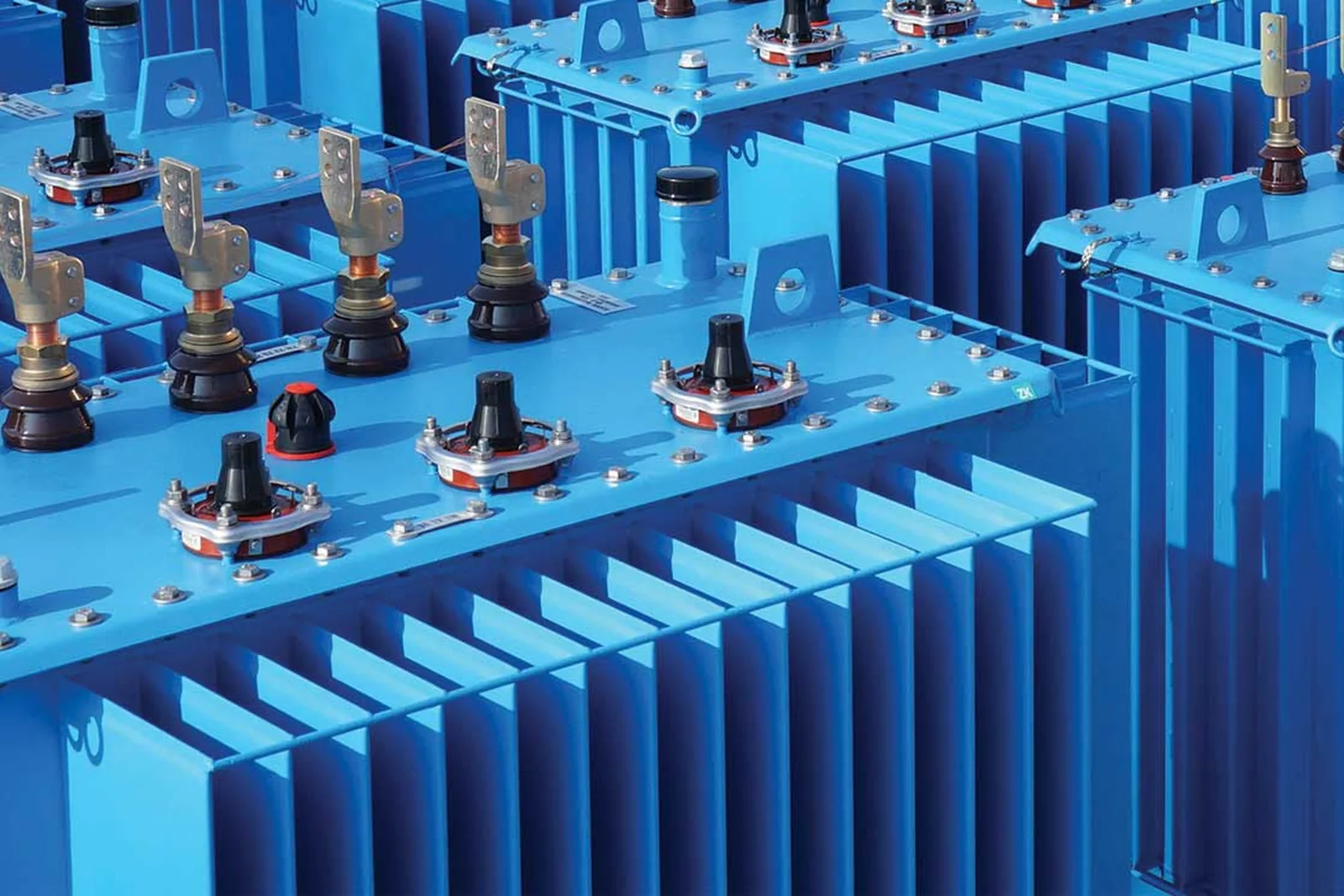
Most substations in Ukraine still run transformers with designations like ТМ-630/10 (TM) or ТСЗ-400/10 (TSZ). The designation tells you a lot: cooling type, rating, voltage class, climate category. But it isn’t enough to order a replacement, and the parameters it leaves out are what most often derail schedules.
How a designation is built
A power transformer designation consists of a letter code, the rating, the voltage class and the climate category. Here is an example broken down:
Three-phase (Т, T), oil-immersed with natural cooling (М, M), hermetically sealed with no conservator (Г, G), design series 11, rated 1,000 kVA, HV winding voltage class 10 kV, for a temperate climate and outdoor installation (У1, U1). The letters always come in the same order:
| Position | Letters | Meaning |
|---|---|---|
| Type | А | autotransformer; no letter means a conventional transformer |
| Number of phases | О, Т | single-phase; three-phase |
| LV winding | Р | split into two sections |
| Cooling | М, Д, ДЦ, Ц, С, СЗ, СГ | oil, natural; oil with forced air; forced air and forced oil circulation; oil-to-water; dry, open; dry, protected; dry, sealed |
| Number of windings | Т | three windings; no letter means two |
| Voltage regulation | Н | on-load tap changing (OLTC, РПН); no letter means off-circuit tap changing (ПБВ) |
| Special features | Г, З, Л, С, Ж | hermetically sealed; protected; cast-resin insulation; for power plant auxiliaries; for railway traction substations |
So ТДТН (TDTN) is three-phase, forced-air cooled, three-winding, with OLTC, and ТРДН (TRDN) is three-phase with a split winding, forced-air cooling and OLTC. Current and voltage transformers (ТОЛ, ТПЛ, НАМИ, ЗНОЛ, or TOL, TPL, NAMI, ZNOL) follow a different system; the decoder below recognizes them by series name.
Designation decoder
Enter the designation from the nameplate or a diagram. Latin letters that look like Cyrillic ones are converted automatically.
Examples:
The decoder follows the general designation rules. Some manufacturers added their own letters and indices, so always check the result against the data sheet.
What the designation leaves out
From the designation ТМ-630/10 you can tell it’s a three-phase oil-immersed 630 kVA transformer for 10 kV networks. That isn’t enough to order a replacement. Here is what else you need, and it’s usually all on the nameplate:
| Parameter | Where to find it | Why it matters |
|---|---|---|
| Winding connection and vector group | nameplate: Y/Yн-0, Д/Yн-11 (Yyn0, Dyn11 in IEC notation) | determines parallel operation and behavior under unbalanced load |
| LV voltage | nameplate: 0.4 or 0.69 kV | the “/10” in the designation is only the high-voltage side |
| Short-circuit voltage, uk | nameplate, % | fault currents on the 0.4 kV busbars and load sharing in parallel operation |
| Off-circuit (ПБВ) or on-load (РПН) tap range | nameplate, for example ±2×2.5% | whether voltage at the consumers can be maintained |
| Dimensions, weight, wheel gauge | data sheet or tape measure | whether the new transformer will fit in the КТП bay or on the foundation |
| Bushing type and connections | photos | busbars, cable, cable terminations, bushing layout |
Y/Yн-0 or Dyn11: the main trap
Many distribution transformers in rural and urban networks are connected star–star with neutral (Y/Yн-0). In Europe, the standard for distribution transformers is delta–star with neutral (Dyn11). For a new site, Dyn11 is the better choice: it copes better with unbalanced single-phase loads and suppresses third harmonics. For a Y/Yн-0 transformer, the electrical installation rules limit the neutral current to 25% of rated current.
For parallel operation, besides the vector group, the voltage ratio and the short-circuit voltage must match (uk within 10%), and the power ratio should preferably not exceed 1:3.
Dimensions and connections
Modern low-loss transformers are often heavier and larger than the old ones: reducing losses takes more steel and copper. The reverse also happens: a sealed transformer with no conservator is shorter than its predecessor. Either way, check the bay dimensions, doors, wheel gauge and clearances to the walls before you order.
Bushing layout matters too. In older КТП substations, the busbars are designed for a specific position of the insulators on the cover. If the new transformer’s bushings are placed differently, you’ll need new busbars or a switch to cable, and that should go into the budget.
Fittings
A transformer with a conservator is protected by a gas (Buchholz) relay; a sealed one, by a pressure relay or a combined device on the cover. If the substation already has a gas protection circuit, check that the new transformer’s fittings are compatible with it. Equivalents of the РЗТ (RZT) and РГТ (RGT) gas relays are in the transformer fittings section.
What to send us to find a replacement
- A photo of the nameplate, sharp enough that every number is legible.
- A photo of the whole transformer and close-ups of the bushings.
- Dimensions of the installation space: bay, doors, foundation.
- Operating mode: standalone or in parallel with another transformer, average and maximum load.
- Grid requirements: technical connection conditions or correspondence with the grid operator, if the rating is changing.
For series that already have catalog pages with European equivalents, the decoder shows a link. The full list is in the distribution, power and instrument transformer sections.
Discuss your project
Tell us about your challenge. We will help you find the right direction and define your next step.