
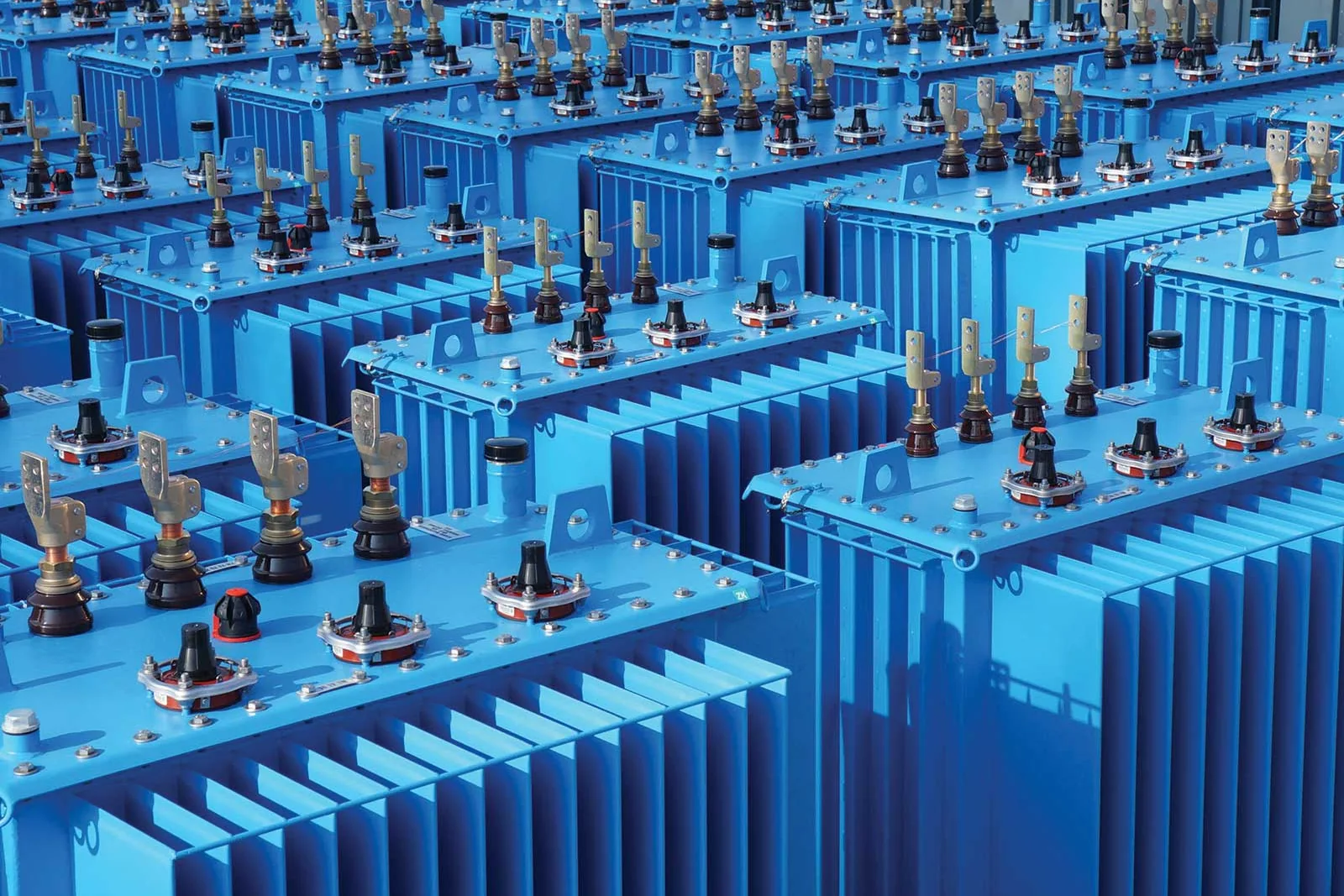
A distribution transformer runs for 25–40 years and spends all of that time heating the air. Even with no load. The difference between two models of the same rating is a few hundred watts, but multiplied by 8,760 hours a year and decades of service, it easily outweighs the difference in price.
Two kinds of losses that behave differently
No-load losses (P0) arise in the core as soon as the transformer is energized. They don’t depend on load: a transformer energized at an empty warehouse burns as much in no-load losses as it does at full load. They are set by the quality of the electrical steel and the core design.
Short-circuit losses (Pk), also called load losses, arise in the windings because of their resistance. The data sheet gives them at rated current; at lower load they fall with the square of the current, so at half load they drop to a quarter of the rated value.
How to calculate annual losses
The form factor is needed because the square of the average is smaller than the average of the squares. If a transformer is loaded to 80% for half the day and runs almost empty for the other half, the average loading is 40%, but the winding losses come out as if it were about 57%.
Calculator: comparing two transformers
By default the calculator compares two 630 kVA transformers: a notional old unit with rated losses of 1.3 and 7.6 kW, and a modern one that meets the EU Tier 2 requirements (0.54 and 4.6 kW). Enter the figures from your own data sheets and your own tariff.
Transformer A
Transformer B
For transformer A, 0% of annual losses come from no-load operation and 0% from the windings. Over the whole period the difference comes to 0 kWh.
Transformer B is more economical. If it costs more, compare the price difference with the amount above.
Under these conditions transformer A loses less energy. This can happen at very low or very high loading; check that you haven’t mixed up which model is which.
The losses are the same.
The calculation doesn’t discount future payments or account for tariff increases; tender comparisons use loss capitalization, covered below.
What the EU requires: Ecodesign Tier 2
Since July 1, 2021, only distribution transformers whose losses stay within the second-stage (Tier 2) limits of Regulation 548/2014, as amended by 2019/1783, can be placed on the EU market. For oil-immersed transformers with windings up to 24 kV and a low-voltage side up to 1.1 kV, the limits are:
| Rating | P0, max | Pk, max |
|---|---|---|
| 400 kVA | 387 W | 3,250 W |
| 630 kVA | 540 W | 4,600 W |
| 1,000 kVA | 693 W | 7,600 W |
For comparison, data sheets of older-series 630 kVA oil-immersed transformers often show no-load losses above 1 kW and load losses of 7–8 kW. That’s why replacing an old transformer that still works sometimes pays for itself on losses alone, without any failure.
Dry-type transformers and other voltage classes have different limits, given in the same regulation. For ratings between the table values, the limit is found by linear interpolation.
Where a transformer is most efficient
A transformer’s efficiency peaks when the winding losses equal the no-load losses. That gives a simple expression for the optimum loading:
Modern distribution transformers are deliberately designed for partial loading, because that’s how most of them actually run. Two practical conclusions follow.
- An oversized transformer bought “just in case” costs money every year: its no-load losses are higher and its windings are barely loaded. Size the spare capacity for real growth, not for “we might need it someday.”
- At a two-transformer substation with a light night-time or seasonal load, one transformer can be switched off. That eliminates its P0 entirely, but it requires a suitable circuit arrangement and a decision by the operations team.
Loss capitalization in tenders
EU utilities compare transformers on cost of ownership rather than on price. Every kilowatt of losses is converted into money over the full service life:
The A factor is always larger than B: no-load losses run all the time, winding losses only part of the time. If you put A and B in the technical brief, the manufacturer will optimize the design for your conditions, adding steel in one place and copper in another.
What to ask the supplier
- Guaranteed P0 and Pk at rated voltage and 75 °C (for oil-immersed units), not “typical” catalog values.
- A factory test report for the specific unit, with measured losses and short-circuit voltage.
- Ecodesign Tier 2 compliance if the transformer is made in the EU for the EU market, or a justification if it isn’t.
- Short-circuit voltage uk, which determines fault currents on the 0.4 kV side and whether the unit can run in parallel with existing transformers.
How to match an old transformer’s designation to European parameters is covered in our guide to ТМГ (TMG), ТСЗ (TSZ) and ТДН (TDN) designations. Ready-made options are in the oil-immersed distribution transformers section of the catalog.
Further reading
Discuss your project
Tell us about your challenge. We will help you find the right direction and define your next step.