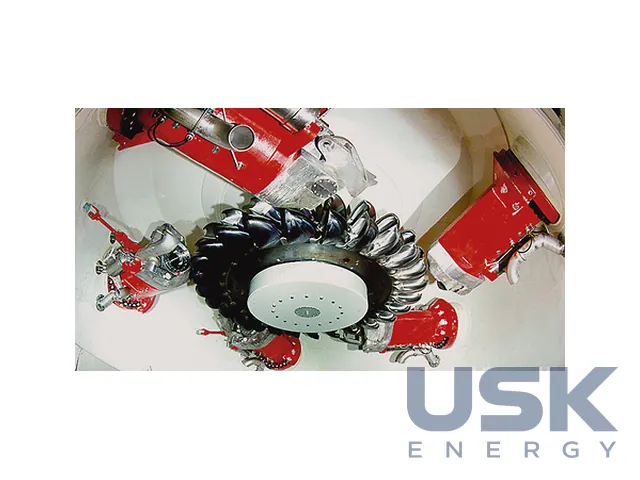
Kaplan turbines 10–200 MW, head 10–50 m
Kaplan hydro units are intended for run-of-river and dam-toe hydropower plants at medium and low heads with variable water flow. Unit power from 10 to 200 MW for heads from 10 to 50 m. In total, 134 such units have been supplied.
- Power
- 10–200 MW (1.25–190 MW per the general list)
- Head
- 10–50 m
- Deliveries
- 134 units
- Largest
- Angu 190 MW; Tongjilin 4×150 MW; Gezhouba 170 MW (runner 11.3 m, 1981)
Price, availability and lead time on request. We help with analogue selection, customs clearance and delivery.
Description
Hydropower is historically the manufacturer’s core business, and the enterprise was founded in 1958 in Deyang as a hydropower equipment plant. The manufacturer has a national hydraulic laboratory, test benches for model testing of turbines and thrust bearings, and its own calculation and design centre. Bulb, Pelton and Francis turbines are produced at the same capacities.
According to the manufacturer, Kaplan units are designed and built for heads from 10 to 50 m and unit power from 10 to 200 MW. In the general product list, 1.25–190 MW is given for this type. The two figures differ, so the upper power limit is clarified for a specific project.
A historical milestone is the 170 MW units of the Gezhouba plant on the Yangtze, commissioned in 1981. Their runner with a diameter of 11.3 m remains the largest in the world among Kaplan turbines, and the development itself was awarded China’s highest state prize for science and technology. Later projects include four 150 MW units of the Tongjilin plant, commissioned in 2016, and the 190 MW Kaplan turbine of the Angu plant. The Gezhouba units have also been modernised with runner replacement.
The adjustable runner blades are controlled in coordination with the guide vanes, so efficiency remains high over a wide range of heads and loads. The turbines are supplied complete with hydrogenerators, governing and excitation systems. Production is located in Deyang (Sichuan, China).
For comparison, the manufacturer’s Francis turbines work at heads of 40–500 m, and Pelton turbines at heads of 300–1200 m. The choice of type depends on the head and water flow at a specific station. The flow in a Kaplan turbine passes through the runner in the axial direction, and the flow is controlled jointly by the guide vanes and the blade angle. That is why the type works well at run-of-river stations where the flow varies during the year. For pumped-storage plants, the manufacturer separately offers reversible units for heads of 50–850 m with a power of 10–450 MW, and contracts have been signed for 60 units. These data are given from the manufacturer’s materials.
Technical specifications
| Power | 10–200 MW (1.25–190 MW per the general list) |
|---|---|
| Head | 10–50 m |
| Deliveries | 134 units |
| Largest | Angu 190 MW; Tongjilin 4×150 MW; Gezhouba 170 MW (runner 11.3 m, 1981) |
Request a price and lead time
Kaplan turbines 10–200 MW, head 10–50 m. We reply within one business day.
Or email sales@usk.ua or call 044 339-50-20.
Questions and answers
What power range do Kaplan units have?
According to the manufacturer, from 10 to 200 MW for heads from 10 to 50 m. The general product list gives 1.25–190 MW, so the upper limit is clarified for the project.
For which hydropower plants are Kaplan turbines intended?
For run-of-river and dam-toe plants at medium and low heads with variable water flow. Adjustable blades keep efficiency high over a wide range of heads and loads.
Which well-known sites have such units?
The Gezhouba plant with 170 MW units commissioned in 1981, the Tongjilin plant with four 150 MW units, and the Angu plant with a 190 MW turbine.
Similar equipment from other manufacturers