Geothermal steam turbines up to 160 MW
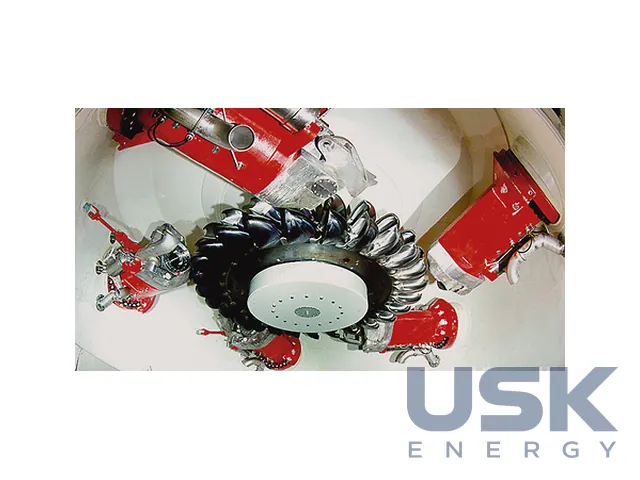
Geothermal steam turbines rated up to 160 MW in condensing versions, with extractions, steam admission or back pressure. Reaction blading, a solid-forged drum rotor and stellite protection of blades against erosion and corrosion. The largest delivered unit is rated 140 MW.
- Rating
- up to 160 MW (largest delivered unit is 140 MW, Nga Awa Purua, New Zealand)
- Types
- condensing; with one or two extractions; with steam admission; with back pressure
- Geothermal plant schemes
- single, double and triple flash expansion; binary cycle
- Rotational speed
- 3000 and 3600 rpm
Price, availability and lead time on request. We help with analogue selection, customs clearance and delivery.
Description
Geothermal steam turbines are a field in which the manufacturer has worked since 1960, when it delivered the first practical thermal power plant in Japan. Since then about 60 geothermal turbines have been delivered in Japan and abroad, including the world's largest single unit rated 140 MW (Nga Awa Purua, New Zealand). The turbines are built with ratings up to 160 MW in condensing versions, with one or two extractions, with steam admission and with back pressure. Rotational speed is 3000 and 3600 rpm.
Geothermal steam contains water droplets, solid particles and aggressive impurities, so the design is made to withstand erosion and corrosion. The blading is of the reaction type. Steam velocity in a reaction stage is roughly half that in an impulse stage, and the erosion rate of blades is proportional to the cube of steam velocity, so the blades last long without replacement. A reaction stage allows a larger gap between the nozzle and rotor blades without a loss of efficiency, and this reduces excitation from nozzle passing.
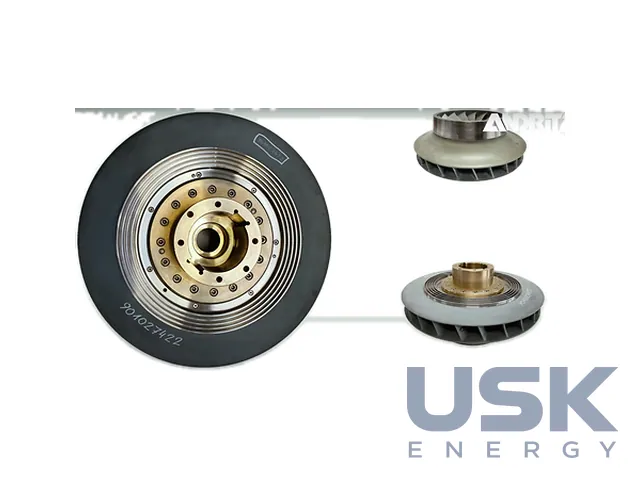
Blades with a rounded leading edge are less sensitive to erosion and have a higher natural frequency. A wide cascade throat rules out clogging by deposits. The high-pressure blades have a solid-milled shroud, and the long low-pressure blades are free-standing, without a shroud wire and rivets, with protective stellite shields on the leading edge. The internal design is kept simple so that the aggressive medium causes fewer problems. The free-standing design of the long blades simplifies precise tuning away from resonances, because the vibration mode of the blade remains simple. The rotor is solid-forged, of the drum type.
The manufacturer supplies both the turbines and the generators, and also carries out design, manufacture and construction of the whole geothermal power plant. Schemes with single, double and triple flash expansion and binary plants for low-temperature sources are offered.
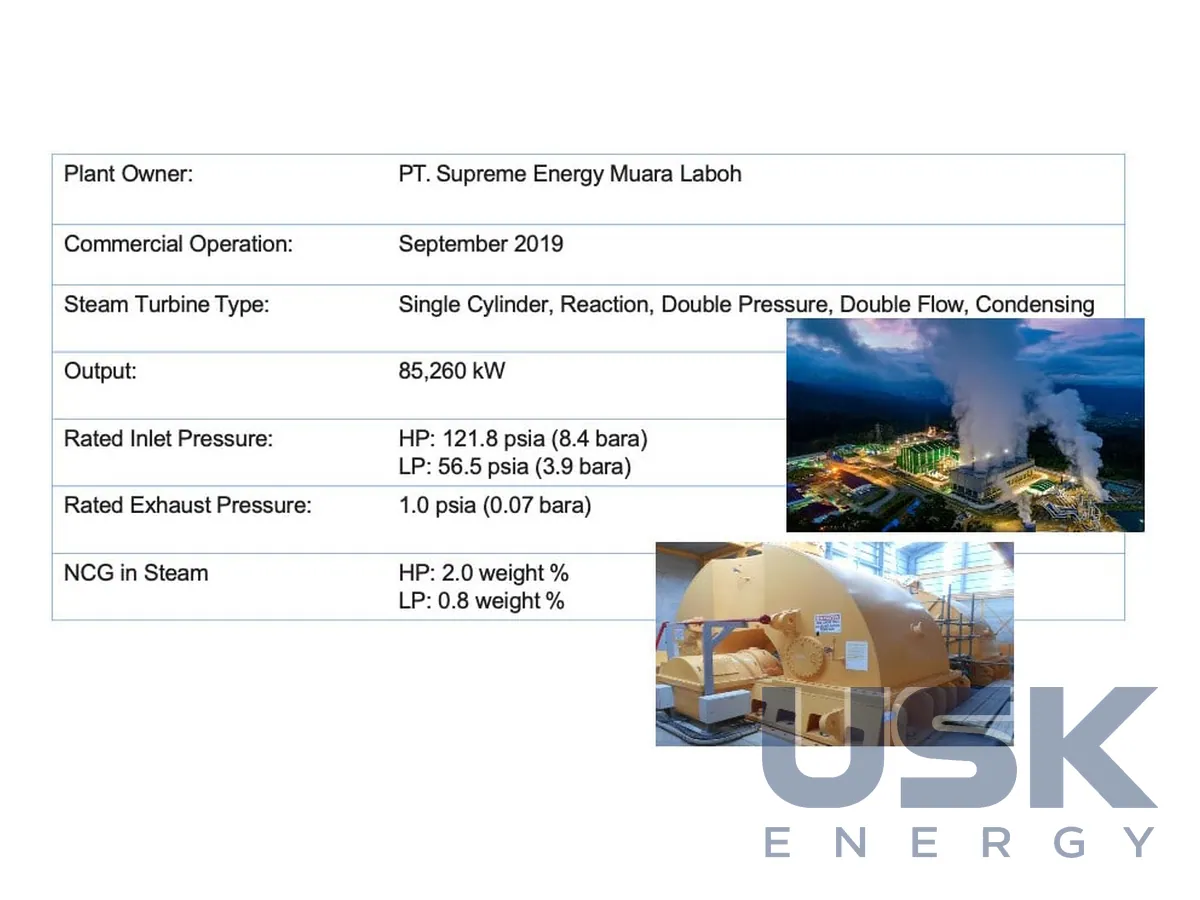
References: Tauhara (New Zealand), Muara Laboh, Ulubelu 3–4 and Rantau Dedap (Indonesia), Theistareykir 1–2 (Iceland), Olkaria I, unit 6 (Kenya), Kizildere II (Turkey), San Jacinto-Tizate 3–4 (Nicaragua), Maibarara (Philippines), John L. Featherstone (US), and also the binary plants Takigami and Yamagawa (Japan).
Technical specifications
| Rating | up to 160 MW (largest delivered unit is 140 MW, Nga Awa Purua, New Zealand) |
|---|---|
| Types | condensing; with one or two extractions; with steam admission; with back pressure |
| Geothermal plant schemes | single, double and triple flash expansion; binary cycle |
| Rotational speed | 3000 and 3600 rpm |
| Rotor | solid-forged drum type, reaction blading |
| Protection against erosion and corrosion | rounded leading edge, wide cascade throat, stellite shields on LP blades |
| Experience | about 60 geothermal turbines in Japan and abroad |
Request a price and lead time
Geothermal steam turbines up to 160 MW. We reply within one business day.
Or email sales@usk.ua or call 044 339-50-20.
Questions and answers
What is the maximum rating of the geothermal turbines?
Up to 160 MW. The largest delivered unit is rated 140 MW (Nga Awa Purua, New Zealand).
What geothermal power plant schemes can be implemented?
Single, double and triple flash steam expansion and a binary cycle for low-temperature sources.
How is the turbine protected against erosion and corrosion?
Steam velocity in a reaction stage is roughly half that in an impulse stage. In addition, there is a rounded leading edge, a wide cascade throat and stellite shields on the low-pressure blades.
Similar equipment from other manufacturers