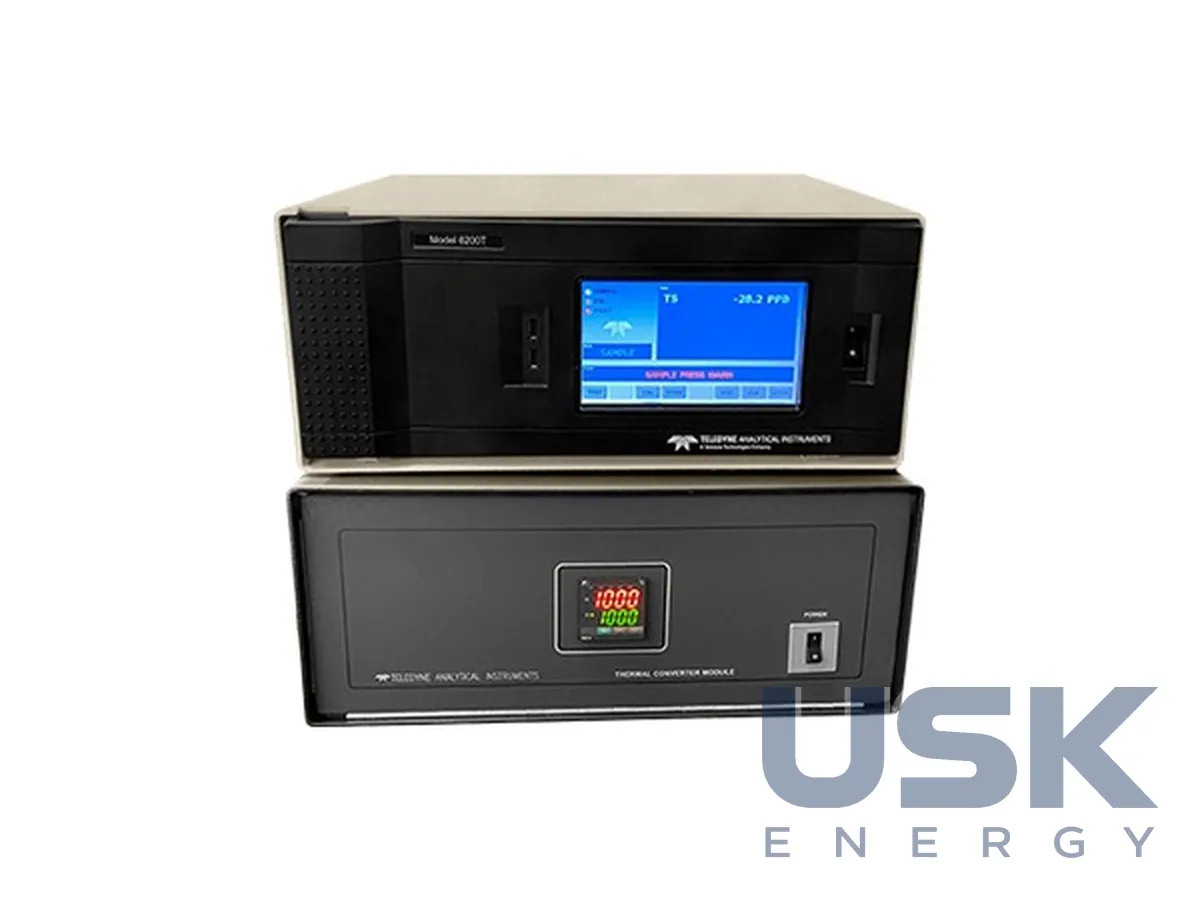
6200T total sulphur analyser, UV fluorescence, 0–50 ppb up to 0–20 ppm
Built to watch carbon dioxide destined for food and drink, this analyser oxidises every sulphur species in the sample to SO2 and reads it by UV fluorescence. Detection goes down to 0.4 ppb.
- Method
- UV fluorescence of SO2 after thermal oxidation
- Ranges
- 0–50 ppb up to 0–20 ppm, dual range, auto-ranging
- Units
- ppb, ppm, µg/m3, mg/m3
- Detection floor
- 0.4 ppb
Price, availability and lead time on request. We help with analogue selection, customs clearance and delivery.
Description
Inside the reaction cell, SO2 molecules are excited by 214 nm ultraviolet light and the resulting fluorescence, proportional to concentration, is picked up by a photomultiplier tube. Getting every sulphur compound into that form is the job of the M501TS quartz catalytic converter, which runs at 1000 °C and oxidises H2S, CS2, COS and mercaptans after mixing the sample with scrubbed ambient air. In a CO2 matrix its conversion efficiency is at least 98 % for H2S and 90 % for COS and CS2. An internal vacuum pump draws both sample and air through the system.
Gas suppliers and beverage producers check CO2 because contamination can come from many points upstream. The instrument can sit at the CO2 generating plant, at the bottling site, or at both.
Two user-selectable ranges run from 0–50 ppb up to 0–20 ppm, with auto-ranging, and readings can be shown in ppb, ppm, µg/m3 or mg/m3. Zero noise stays under 0.2 ppb RMS and zero drift under 0.5 ppb per 24 hours; the detection floor is 0.4 ppb. Lag time is 20 s and rise or fall to 95 % takes under 100 s. Signals are temperature and pressure compensated, and adaptive filtering shortens response.
Analyser and converter are separate units of 178 × 432 × 597 mm (16.2 kg) and 178 × 432 × 559 mm (10.8 kg), powered from 100–120 V or 220–240 V mains at 50/60 Hz and operated between 5 and 40 °C. A colour touchscreen, front USB ports for firmware updates and an internal data log come as standard, along with Ethernet, two RS-232 ports, 8 digital outputs, 6 digital inputs and 4 analogue outputs. Eight analogue inputs and 4 alarm outputs are optional.
Technical specifications
| Method | UV fluorescence of SO2 after thermal oxidation |
|---|---|
| Ranges | 0–50 ppb up to 0–20 ppm, dual range, auto-ranging |
| Units | ppb, ppm, µg/m3, mg/m3 |
| Detection floor | 0.4 ppb |
| Zero noise | < 0.2 ppb (RMS) |
| Zero drift | < 0.5 ppb / 24 h |
| Linearity | 1 % FS |
| Lag / rise time | 20 s / < 100 s to 95 % |
| Sample flow | 650 cm3/min ±10 % |
| Converter | M501TS, 1000 °C; efficiency 98 % H2S, 90 % COS and CS2 |
| Analogue outputs | 10 V, 5 V, 1 V, 0.1 V |
| Interfaces | Ethernet, 2 × RS-232, 2 × USB, 8 DO, 6 DI, 4 AO |
| Power | 100–120 V, 220–240 V, 50/60 Hz |
| Operating temperature | 5–40 °C |
| Dimensions and weight | analyser 178 × 432 × 597 mm, 16.2 kg; converter 178 × 432 × 559 mm, 10.8 kg |
Request a price and lead time
6200T total sulphur analyser, UV fluorescence, 0–50 ppb up to 0–20 ppm. We reply within one business day.
Or email sales@usk.ua or call 044 339-50-20.
Questions and answers
Which sulphur compounds are included in the reading?
The converter oxidises H2S, CS2, COS, mercaptans and similar species to SO2, so the result is total sulphur. Conversion in CO2 is at least 98 % for H2S and 90 % for COS and CS2.
What is the lowest concentration it can detect?
Detection starts at 0.4 ppb; the most sensitive range covers 0–50 ppb.
How does it connect to a plant control system?
Ethernet, two RS-232 ports, 4 analogue outputs and opto-isolated digital I/O are standard; 4 alarm outputs can be added.
Similar equipment from other manufacturers