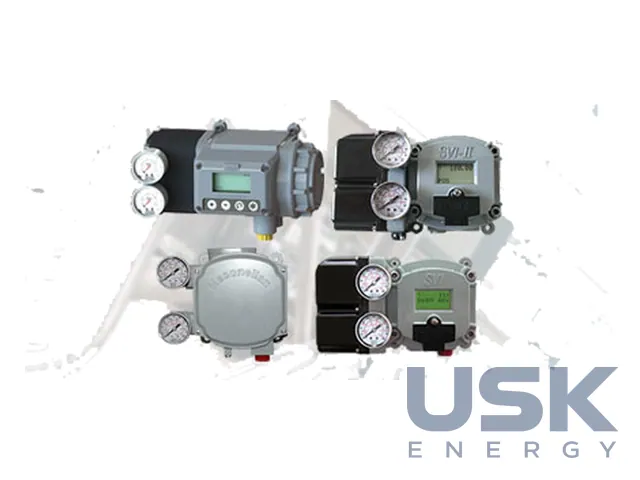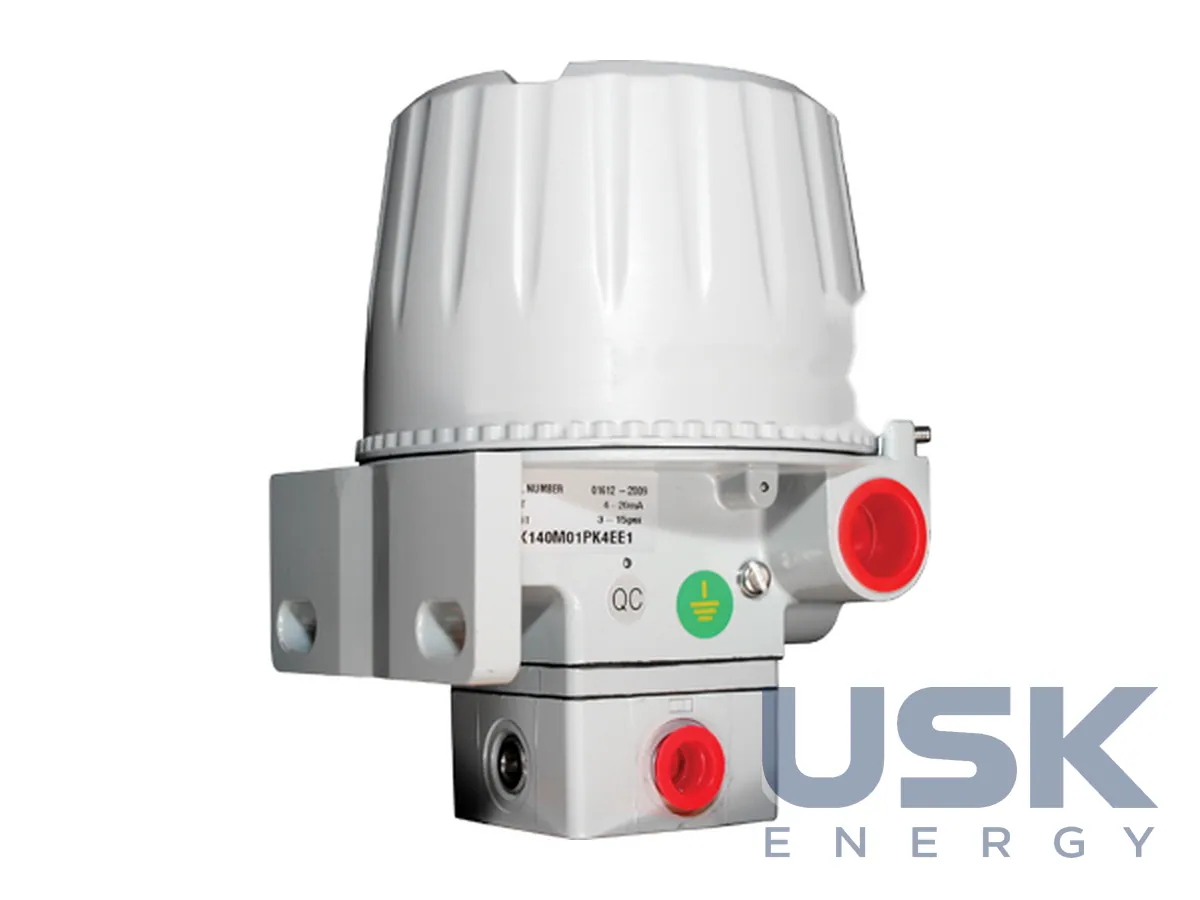
4411 Electro-Pneumatic I/P Transducer, 4-20 mA to 3-15 psig or 6-30 psig
A proportional current-to-pressure converter that turns a 4-20 mA loop signal into a pneumatic output for valve actuators and positioners on continuous processes. A feedback sensor closes the loop inside the unit, and flameproof and intrinsically safe builds are available.
- Input signal
- 4-20 mA, two-wire
- Output pressure
- 3-15 psig (0.2-1 barg) or 6-30 psig (0.4-2.1 barg)
- Supply pressure
- 18 to 150 psig (1.3 to 10 bar)
- Flow capacity
- over 300 Nl/min
Price, availability and lead time on request. We help with analogue selection, customs clearance and delivery.
Description
Two output spans are offered: 3-15 psig (0.2-1 barg) and 6-30 psig (0.4-2.1 barg), both driven from a two-wire 4-20 mA input. A pressure sensor inside the unit feeds back to the electronics, giving stable long-term output and very little sensitivity to supply pressure, and the output drops to low pressure if the loop current is lost.
Flow capacity exceeds 300 Nl/min, yet the transducer still holds pressure accurately on closed, dead-end volumes; consumption is under 2.5 l/min at 50 % signal. Into a 500 cc load it moves from 10 % to 90 % of output in 1 second or less, total error is no more than 0.1 % of span above 500 cc, and temperature effect is typically 0.035 % of span per °C.
Supply air must be oil-free and dry, filtered to 50 microns, at 18 to 150 psig (1.3 to 10 bar); a filter is also fitted internally. Pneumatic ports are 1/4 inch NPT female with 1/8 inch NPT gauge ports, and the cable entry is 1/2 inch NPT or M20. Minimum operating current is below 3.5 mA, terminal voltage is up to 6.5 V and the input is protected against reversed current up to 100 mA.
The housing is die-cast aluminium and zinc with nitrile diaphragms and an epoxy powder coat, sealed to IP66 and NEMA Type 4X, and works from -40 °C to 85 °C. It weighs 2.07 kg, and its modular layout keeps servicing simple. Hazardous area versions carry Ex d IIC T4 Gb or Ex ia IIC T4 Ga marking plus FM and CSA approval for Class I, Division 1, and EMC complies with BS EN61000-6-2 and BS EN61000-6-4.
Typical homes are control loops in power stations, including nuclear plant, refineries and petrochemical sites, upstream and midstream gas, liquefaction and regasification: steam and gas turbines, heat recovery steam generators, condensers, cooling towers, distillation, hydroprocessing, reforming, cracking, compression, dehydration and loading.
Technical specifications
| Input signal | 4-20 mA, two-wire |
|---|---|
| Output pressure | 3-15 psig (0.2-1 barg) or 6-30 psig (0.4-2.1 barg) |
| Supply pressure | 18 to 150 psig (1.3 to 10 bar) |
| Flow capacity | over 300 Nl/min |
| Air consumption | under 2.5 l/min at 50 % signal |
| Response time | 1 s or less (10-90 %, 500 cc load) |
| Total error | 0.1 % of span or less |
| Temperature effect | 0.035 % of span/°C |
| Operating temperature | -40 °C to 85 °C |
| Enclosure | IP66, NEMA Type 4X |
| Pneumatic connections | 1/4 inch NPT |
| Cable entry | 1/2 inch NPT or M20 |
| Hazardous area rating | Ex d IIC T4 Gb; Ex ia IIC T4 Ga; FM, CSA |
| Weight | 2.07 kg |
Request a price and lead time
4411 Electro-Pneumatic I/P Transducer, 4-20 mA to 3-15 psig or 6-30 psig. We reply within one business day.
Or email sales@usk.ua or call 044 339-50-20.
Questions and answers
Which output ranges are available?
3-15 psig (0.2-1 barg) and 6-30 psig (0.4-2.1 barg), each from a 4-20 mA input, with supply air at 18 to 150 psig.
What happens if the loop signal is lost?
The output falls to a low pressure, so the actuator moves to the position set by its spring.
Is there a version for hazardous areas?
Yes, flameproof Ex d IIC T4 Gb and intrinsically safe Ex ia IIC T4 Ga versions are available, together with FM and CSA approval for Class I, Division 1.
Similar equipment from other manufacturers