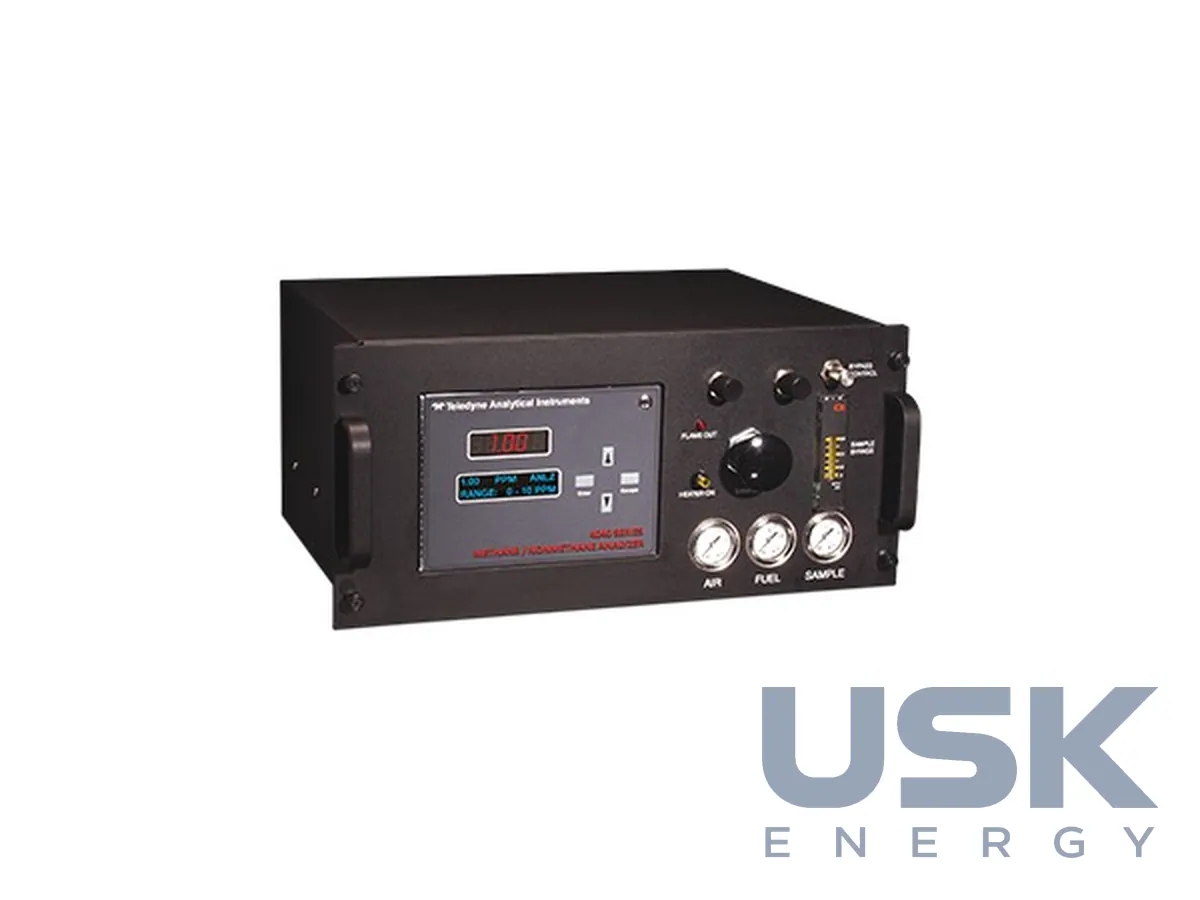
4040 FID Analyser for Methane and Non-Methane Hydrocarbons, GC Separation
An online analyser that reports methane and the remaining hydrocarbons as separate values. A chromatographic column splits off CH4 before a flame ionisation detector measures concentration on standard scales of 0–10 ppm, 0–100 ppm or 0–1000 ppm.
- Method
- flame ionisation detector with GC column separation
- Standard ranges
- 0–10, 0–100, 0–1000 ppm
- Sensitivity
- 1% of scale
- Accuracy
- +2% FS at constant temperature
Price, availability and lead time on request. We help with analogue selection, customs clearance and delivery.
Description
Inside, the sample first passes a GC column, which holds methane apart from heavier hydrocarbons, and then reaches a flame ionisation detector fitted with a flame guard. Organic compounds burn in a hydrogen flame, the carbon fragments pick up a charge at the anode, and the collector passes the signal to the amplifier. Depending on the application, the sample compartment is held at 50–80 °C.
The 4040 belongs on process streams carrying organic solvents, crude oil or other hydrocarbon-bearing chemicals, and on the outlet of VOC abatement plant such as thermal or catalytic incinerators, scrubbers and carbon adsorbers. It also checks catalytic converters and diesel combustion, oven and dryer atmospheres, fugitive emissions, workplace air and leaks around solvent stores.
Sensitivity is 1% of scale and accuracy +2% FS at constant temperature. Linearity and repeatability are each 1% FS on every range, zero and span noise stays below 0.5% and drift is limited to 2% FS per week. A 90% response takes less than 15 s.
Utilities are a hydrogen-based fuel, instrument air free of hydrocarbons at 30 psi and nitrogen as carrier. Ignition is automatic; if the flame goes out the fuel valve closes, a red lamp lights and the system fail relay drops. Allow roughly 4 hours before use and about 8 hours for full stability.
Signals are 0–1 V dc and an isolated 4–20 mA output into up to 500 ohms. Two programmable C-type concentration relays are rated 3 A at 250 V ac. Mains supply is 115 or 220 V ac, 50/60 Hz. The standard chassis is a steel 19-inch rack unit, and for potentially explosive atmospheres a purged, pressurised enclosure version is built to EN 60079-2 and Directive 2014/34/EU with temperature class T4.
Technical specifications
| Method | flame ionisation detector with GC column separation |
|---|---|
| Standard ranges | 0–10, 0–100, 0–1000 ppm |
| Sensitivity | 1% of scale |
| Accuracy | +2% FS at constant temperature |
| Linearity / repeatability | 1% FS |
| Zero and span drift | 2% FS per week |
| Response | 90% in under 15 s |
| Operating temperature | 40–110 °F |
| Outputs | 0–1 V dc; isolated 4–20 mA, max 500 ohms |
| Alarms | 2 concentration relays 3 A, 250 V ac; C contact on flame-out |
| Power supply | 115 or 220 V ac, 50/60 Hz |
| Sample flow | 1 l/min |
| Warm-up | about 4 h, stable after 8 h |
| Enclosure | steel, 19-inch rack; purged version optional |
Request a price and lead time
4040 FID Analyser for Methane and Non-Methane Hydrocarbons, GC Separation. We reply within one business day.
Or email sales@usk.ua or call 044 339-50-20.
Questions and answers
Why does the analyser need a GC column?
The column separates methane from the other hydrocarbons, so CH4 and the non-methane fraction are reported individually, as emissions reporting usually requires.
Which support gases must be supplied?
A hydrogen-based fuel, instrument air cleaned of hydrocarbons at 30 psi and nitrogen carrier gas.
Is a hazardous-area version offered?
Yes, a purged and pressurised enclosure to EN 60079-2 with temperature class T4.
Similar equipment from other manufacturers