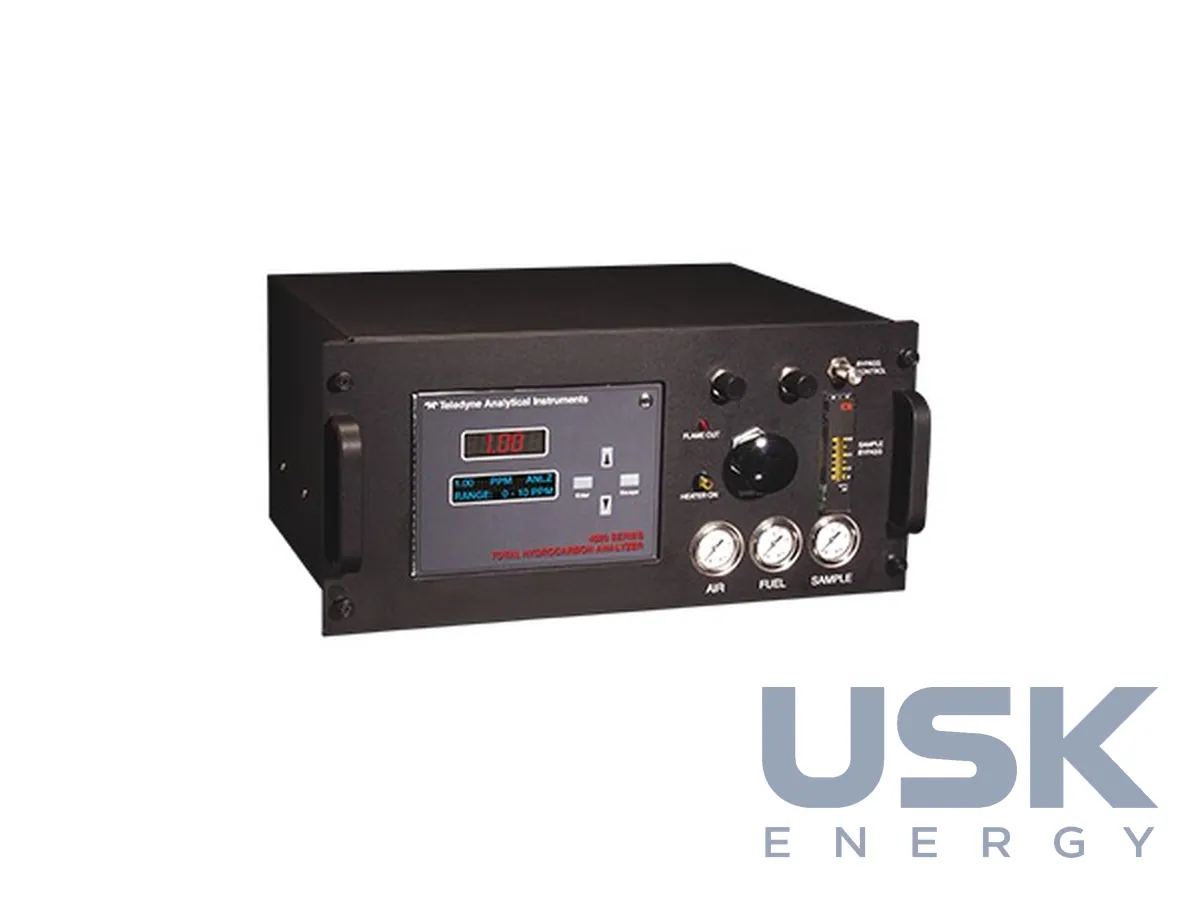
4020 total hydrocarbon analyser with flame ionisation detector, 0–10 to 0–1000 ppm
A rack-mounted analyser that reports the total hydrocarbon content of a gas stream as methane equivalent, using a flame ionisation detector. Standard ranges run from 0–10 to 0–1000 ppm, and 90 % response comes in under 15 seconds.
- Measuring principle
- flame ionisation detector (FID)
- Ranges
- 0–10, 0–100, 0–1000 ppm (CH4 equivalent)
- Resolution
- 10 ppb on 0–1 ppm range
- Accuracy
- ±2 % of full scale at constant temperature
Price, availability and lead time on request. We help with analogue selection, customs clearance and delivery.
Description
Inside the 4020 is a flame-arrested flame ionisation detector, so no separation column is involved: every hydrocarbon in the sample contributes to one reading, expressed as CH4 equivalent. The burner runs on a 40 % hydrogen and 60 % nitrogen blend, with hydrocarbon-free instrument air, free of oil and water, supplied at 30 psig. Ignition is automatic, and if the flame goes out the fuel is shut off, a red lamp lights and the system failure relay drops.
Gas producers use it to check the purity of oxygen, argon and nitrogen, for example in supply to semiconductor plants, and to watch for hydrocarbon contamination in air separation. Other duties include trace hydrocarbons in ambient air, fuel leaks and toxic solvent vapours.
Standard ranges are 0–10, 0–100 and 0–1000 ppm, with lower ranges on request. Resolution is 10 ppb on the 0–1 ppm range, accuracy ±2 % of full scale at constant temperature, linearity and repeatability 1 % of full scale, noise below 0.5 % and drift 2 % of full scale per week. Sample flow is 1 litre per minute. The analyser is usable after roughly 4 hours and settles after roughly 8.
Signals leave as 0–1 V DC and an isolated 4–20 mA loop into up to 500 ohms. A C-type contact flags power failure or flame-out, and two fully programmable concentration alarm relays are rated 3 A at 250 V AC. Mains supply is 115 or 220 V AC, 50/60 Hz, 90 VA maximum, and ambient operating temperature is 40–110 °F. The steel 19 in rack case measures 48.3 × 22.2 × 39.4 cm. A built-in span manifold for automatic span checks is optional for samples below 60 °C.
Technical specifications
| Measuring principle | flame ionisation detector (FID) |
|---|---|
| Ranges | 0–10, 0–100, 0–1000 ppm (CH4 equivalent) |
| Resolution | 10 ppb on 0–1 ppm range |
| Accuracy | ±2 % of full scale at constant temperature |
| Response time | 90 % in under 15 s |
| Zero and span drift | 2 % of full scale per week |
| Sample flow | 1 l/min |
| Fuel | 40 % H2 / 60 % N2 |
| Combustion air | hydrocarbon-free instrument air, 30 psig |
| Outputs | 0–1 V DC, isolated 4–20 mA (up to 500 ohms) |
| Alarms | 2 concentration relays plus failure relay, 3 A, 250 V AC |
| Power | 115 or 220 V AC, 50/60 Hz, 90 VA |
| Operating temperature | 40–110 °F |
| Enclosure | steel, 19 in rack, 48.3 × 22.2 × 39.4 cm |
Request a price and lead time
4020 total hydrocarbon analyser with flame ionisation detector, 0–10 to 0–1000 ppm. We reply within one business day.
Or email sales@usk.ua or call 044 339-50-20.
Questions and answers
What ranges does the 4020 cover?
0–10, 0–100 and 0–1000 ppm as methane equivalent are standard, and lower ranges can be supplied.
Which fuel gas does the detector need?
A blend of 40 % hydrogen and 60 % nitrogen is recommended, with hydrocarbon-free instrument air at 30 psig for combustion.
How does it connect to a DCS or PLC?
Through 0–1 V DC and isolated 4–20 mA outputs, two programmable concentration relays and a C-type failure contact.
Similar equipment from other manufacturers