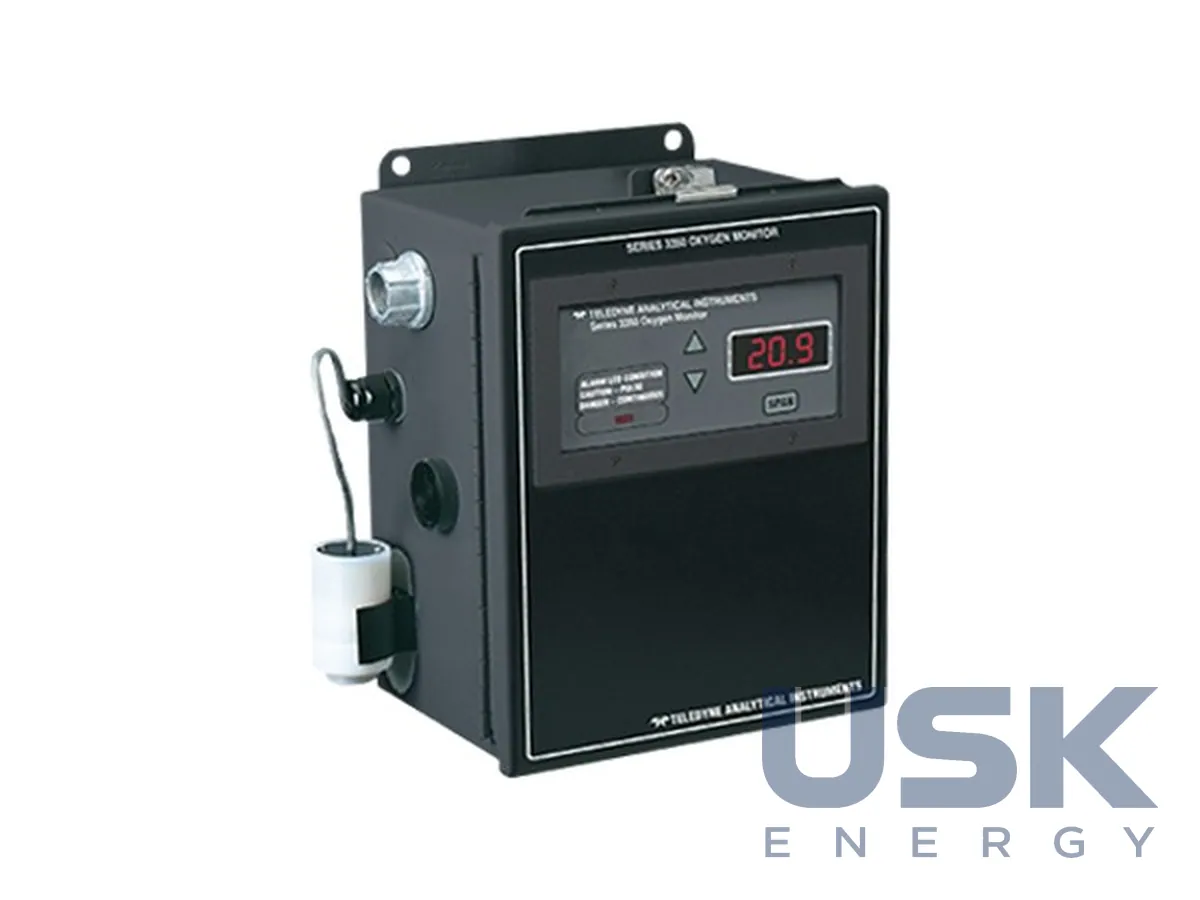
3350 Wall-Mounted Oxygen Deficiency Alarm, 0–25% O₂, with Optional Battery Standby
A microprocessor-based alarm unit that keeps watch on the oxygen level of the air around its sensor and raises a light and sounder when it falls too low. It is fitted wherever people work in enclosed or controlled atmospheres and a fail-safe air check is required.
- Range
- 0–25% O₂
- Sensor
- micro-fuel cell, class B-3
- Accuracy
- ±2% FS (steady temperature); ±5% FS (operating range)
- Sensitivity
- 0.5% FS
Price, availability and lead time on request. We help with analogue selection, customs clearance and delivery.
Description
Two alarm points come preset in line with OSHA guidance: CAUTION at 20% oxygen and DANGER at 19.5%. They sit inside the case, out of reach of unauthorised hands, though a limited amount of adjustment is possible. When either trips, relay contacts change over, a red panel lamp lights and an audible annunciator sounds, and both stay on until the oxygen level climbs back above the trip point.
Sensing relies on a sealed B-3 class micro-fuel cell, an electrochemical transducer with no electrolyte to top up and no electrodes to clean; at the end of its life it is simply swapped. Because its output is linear from zero to 100% oxygen, calibration needs nothing more than ambient air or instrument air at 20.9% O₂.
The LED display reads 0–25% O₂. Sensitivity is 0.5% of full scale and reproducibility ±1% of full scale. Error stays within ±2% of full scale at a steady temperature and ±5% of full scale across the operating band once the unit has settled. A step change reaches 90% of its final reading in less than 20 s at 25 °C.
Standard units run from 100–240 V AC mains at 50/60 Hz, drawing at most 0.3 A. The optional standby pack keeps a 12 V 7 Ah lead-acid battery on continuous charge; if the mains fails, the alarm carries on for about 17 hours in fail-safe mode or 48 hours otherwise, and a pushbutton inside the panel tests the battery. Analogue outputs are 4–20 mA and 0–10 V DC (10 mA max).
The NEMA-4 wall case measures 20.3 x 25.4 x 15.2 cm. It works between 0 and 50 °C, at 0–95% RH non-condensing and up to 2000 metres altitude, and carries CE marking.
Technical specifications
| Range | 0–25% O₂ |
|---|---|
| Sensor | micro-fuel cell, class B-3 |
| Accuracy | ±2% FS (steady temperature); ±5% FS (operating range) |
| Sensitivity | 0.5% FS |
| Reproducibility | ±1% FS |
| Response | 90% in less than 20 s at 25 °C |
| Alarm set points | 20% (caution), 19.5% (danger) |
| Outputs | 4–20 mA; 0–10 V DC (10 mA max) |
| Supply | 100–240 V AC 50/60 Hz, 0.3 A max; standby 12 V 7 Ah |
| Battery run time | 17 h (fail-safe); 48 h (non-fail-safe) |
| Enclosure | NEMA-4 wall mount, 20.3 x 25.4 x 15.2 cm |
| Ambient conditions | 0–50 °C; 0–95% RH; up to 2000 m |
Request a price and lead time
3350 Wall-Mounted Oxygen Deficiency Alarm, 0–25% O₂, with Optional Battery Standby. We reply within one business day.
Or email sales@usk.ua or call 044 339-50-20.
Questions and answers
What gas is needed for calibration?
None beyond ambient air or instrument air at 20.9% oxygen, since the sensor output is linear from zero to 100% O₂.
How long does it run during a power cut?
With the optional 12 V 7 Ah battery, about 17 hours in fail-safe mode and 48 hours in non-fail-safe mode.
At what oxygen levels do the alarms trip?
Factory settings are 20% oxygen for CAUTION and 19.5% for DANGER, with internal set points that allow limited adjustment.
Similar equipment from other manufacturers