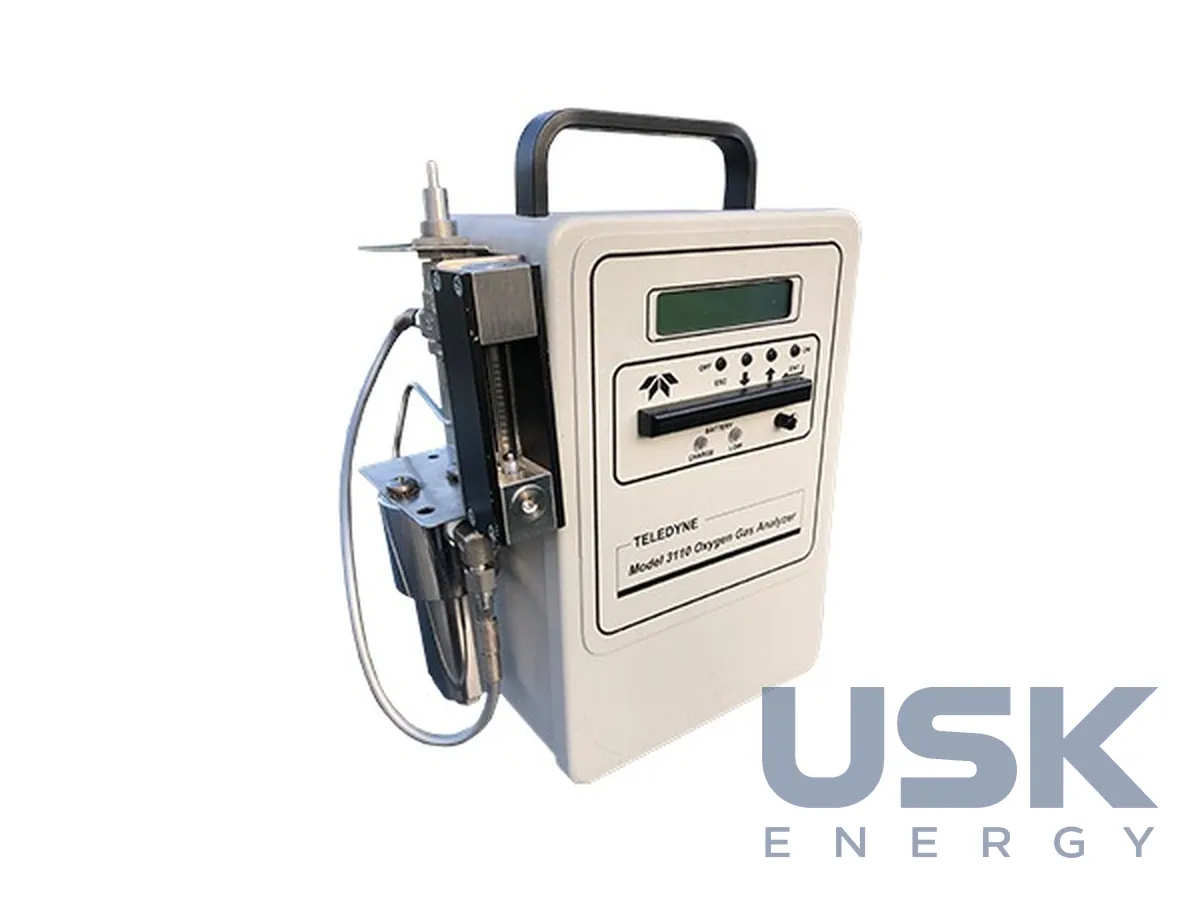
3110, 3110XL and 3110P portable oxygen analysers, intrinsically safe, 0–2 ppm up to 0–25 %
A battery-powered oxygen analyser that an engineer can carry into a hazardous area to check trace or percent O2 on the spot. Three models share the same aluminium case and micro-fuel cell sensor but differ in range.
- Sensor
- micro-fuel cell
- Ranges, 3110
- 0–10 ppm up to 0–25 % O2
- Ranges, 3110XL
- 0–2 ppm up to 0–25 % O2
- Ranges, 3110P
- 0–1 % up to 0–25 % O2
Price, availability and lead time on request. We help with analogue selection, customs clearance and delivery.
Description
Spot checks are where this instrument earns its keep: certifying gas purity, hunting leaks in glove boxes and pipelines, protecting catalysts, and testing natural gas during treatment and transmission. It is also taken onto inert gas welding of exotic metals, wave and reflow soldering lines, heat treating and bright annealing furnaces, crystal growth, plastics production, air separation plants and semiconductor fabs.
At 156 × 241 × 143 mm and 2.71 kg, the aluminium case holds sub-C nickel-cadmium cells good for more than 100 hours per charge. Recharging takes roughly 16 hours from a 100–240 VAC 50/60 Hz charger. The unit operates between 0 and 40 °C with a sample flow of 0.2 to 2.5 SCFH. Readings appear on a two-line, 20-character LCD, a 0–1 VDC analogue output is provided, and an optional data logger stores results in internal memory for download over a 9-pin serial link.
The standard 3110 reads from 0–10 ppm up to 0–25 % O2. Where lower levels matter, the 3110XL starts at 0–2 ppm, while the 3110P is set up for percent work from 0–1 % to 0–25 %. Trace ranges respond in under 60 s and percent ranges in under 7 s. Accuracy is ±1 ppm or ±2 % of full scale, whichever is larger, and reproducibility is ±1 % at constant temperature.
For hazardous locations the analyser is certified Ex ia IIC T3 under ATEX, tested to EN 60079-0, EN 60079-11 and EN 60079-26, and carries FM/FMc approval for Class I, Division 1, Groups A to D, temperature class T6. Third-party approval covers oxygen levels below 20.9 % only. CE marking is applied.
Technical specifications
| Sensor | micro-fuel cell |
|---|---|
| Ranges, 3110 | 0–10 ppm up to 0–25 % O2 |
| Ranges, 3110XL | 0–2 ppm up to 0–25 % O2 |
| Ranges, 3110P | 0–1 % up to 0–25 % O2 |
| Response time | < 60 s (trace); < 7 s (percent) |
| Accuracy | ±1 ppm or ±2 % FS, whichever is larger |
| Operating temperature | 0–40 °C |
| Sample flow | 0.2–2.5 SCFH |
| Output | 0–1 VDC |
| Power | Ni-Cd sub-C cells, over 100 h per charge |
| Charger | 100–240 VAC, 50/60 Hz, about 16 h |
| Dimensions and weight | 156 × 241 × 143 mm, 2.71 kg |
| Case | aluminium |
| Hazardous area | ATEX Ex ia IIC T3; FM/FMc Class I, Division 1, Groups A to D, T6 |
Request a price and lead time
3110, 3110XL and 3110P portable oxygen analysers, intrinsically safe, 0–2 ppm up to 0–25 %. We reply within one business day.
Or email sales@usk.ua or call 044 339-50-20.
Questions and answers
Which model reaches the lowest oxygen levels?
The 3110XL, with a bottom range of 0–2 ppm. The 3110 starts at 0–10 ppm and the 3110P at 0–1 %.
Is it approved for use in a hazardous area?
Yes, it is intrinsically safe, certified Ex ia IIC T3 under ATEX and FM/FMc approved for Class I, Division 1. The approval applies to oxygen levels below 20.9 %.
How long does one charge last?
More than 100 hours on the Ni-Cd cells, with a recharge time of about 16 hours.
Similar equipment from other manufacturers