3000PB Bulkhead-Mount Percent Oxygen Analyser, 0–1%…0–100% O₂, Air Calibration
A wall or bulkhead-mounted instrument that measures oxygen as a percentage in process and product gases. Air separation plants, inert gas blanketing, petrochemical units, semiconductor fabs and gas certification laboratories are where it usually works.
- Ranges
- three, 0–1% up to 0–100% O₂; plus 0–25% for spanning on air
- Sensor
- micro-fuel cell B-1 (A3, A5, B3, C3 optional)
- Accuracy
- ±2% FS (constant temperature); ±5% FS (operating range)
- Sensitivity
- 0.5% FS
Price, availability and lead time on request. We help with analogue selection, customs clearance and delivery.
Description
No bottled span gas is needed for routine checks. The micro-fuel cell sensor gives an output that stays linear from 0% to 100% O₂, so the instrument is spanned on ambient air at 20.9% using a dedicated 0–25% range reserved for air calibration. Zero and span gases can still be introduced when a procedure calls for them.
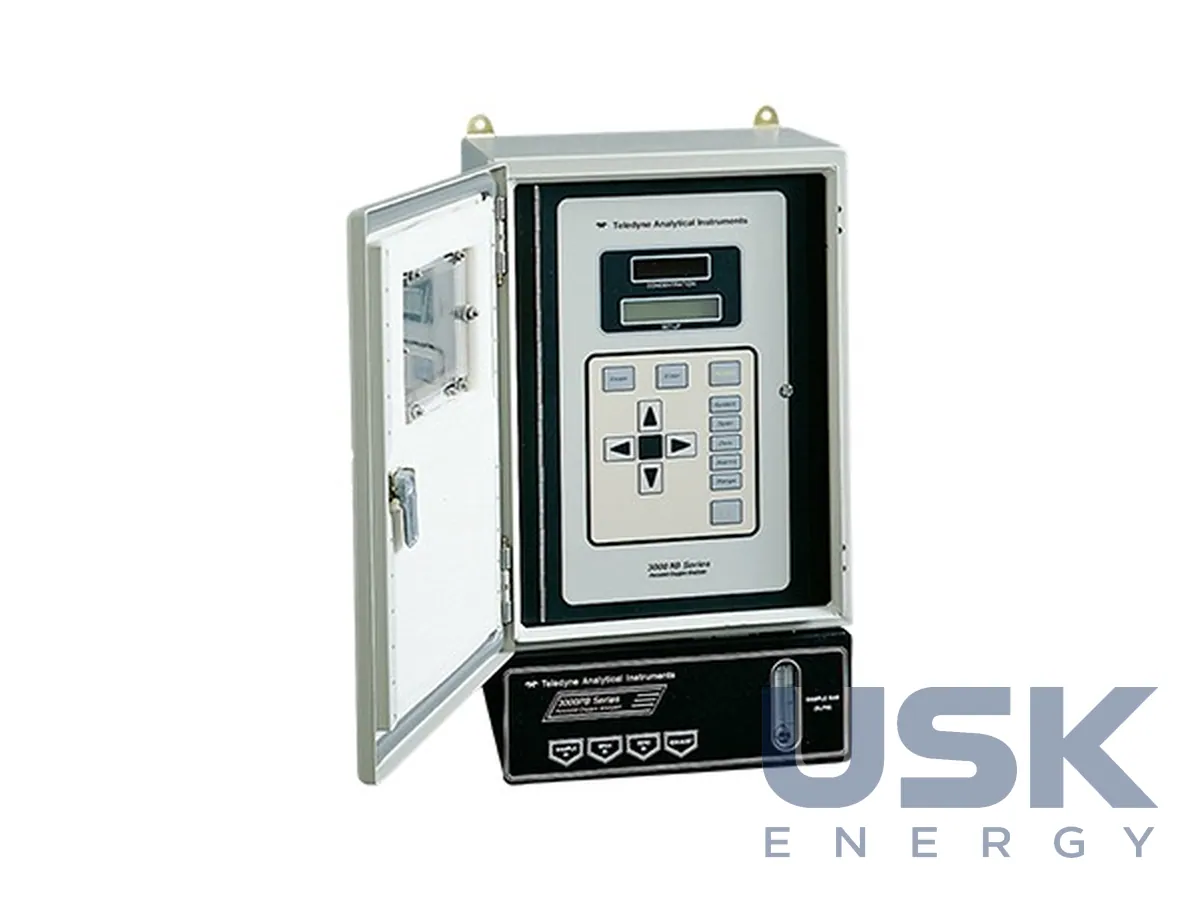
The operator sets up three ranges anywhere between 0–1% and 0–100% oxygen, and auto-ranging moves between them without the need to recalibrate. With the standard B-1 cell, the reading reaches 90% FS within 10 s; A3, A5, B3 and C3 cells are alternatives. Error is ±2% FS while the temperature holds steady, or ±5% FS across the operating range once it has stabilised, and sensitivity is 0.5% of full scale. Set-up runs on an LCD screen while a five-digit LED shows the O₂ value, and a security code locks the menus.
Two fully adjustable concentration alarms are joined by a system failure alarm and self-diagnostics. Standard 0–1 V DC outputs carry the percentage of range and a range identifier; option -M adds isolated 4–20 mA signals. Every function can be reached from a host computer over RS-232C, including switching in zero and span gas.
Further options are -C, electrically operated calibration and zero valves with separate gas ports; -V for vacuum service; and -S, which puts the cell block and sample system in stainless steel. Stainless sample tubing, a nylon cell holder and a flowmeter are fitted as standard.
Supply is 85–240 V AC at 50/60 Hz and the operating range 0–50 °C. The sheet steel NEMA 4 case measures 11.81 × 20.28 × 8.9 in and is suitable for Class I, Division 2, Groups A, B, C and D locations. For Division 1 areas the related 3010PB splits the design, with an explosion-proof analysis unit remote from the control unit.
Technical specifications
| Ranges | three, 0–1% up to 0–100% O₂; plus 0–25% for spanning on air |
|---|---|
| Sensor | micro-fuel cell B-1 (A3, A5, B3, C3 optional) |
| Accuracy | ±2% FS (constant temperature); ±5% FS (operating range) |
| Sensitivity | 0.5% FS |
| Response time | 90% FS in 10 s (B-1) |
| Analogue outputs | 0–1 V DC (value and range ID); isolated 4–20 mA option |
| Digital interface | RS-232C |
| Alarms | 2 concentration + system failure |
| Displays | LCD set-up screen; 5-digit LED |
| Supply | 85–240 V AC, 50/60 Hz |
| Operating temperature | 0–50 °C |
| Enclosure | NEMA 4 bulkhead, 11.81 × 20.28 × 8.9 in |
| Area classification | Class I, Division 2, Groups A, B, C, D |
Request a price and lead time
3000PB Bulkhead-Mount Percent Oxygen Analyser, 0–1%…0–100% O₂, Air Calibration. We reply within one business day.
Or email sales@usk.ua or call 044 339-50-20.
Questions and answers
Does it need calibration gas cylinders?
No, the sensor output is linear up to 100% O₂, so ambient air on the 0–25% range is enough; zero and span gas can be used when required.
What outputs are provided?
0–1 V DC for value and range ID plus RS-232C as standard, with isolated 4–20 mA available as option -M.
Can the 3000PB go into a hazardous area?
It is suitable for Class I, Division 2, Groups A–D; for Division 1 the 3010PB with a remote explosion-proof analysis unit is used.
Similar equipment from other manufacturers