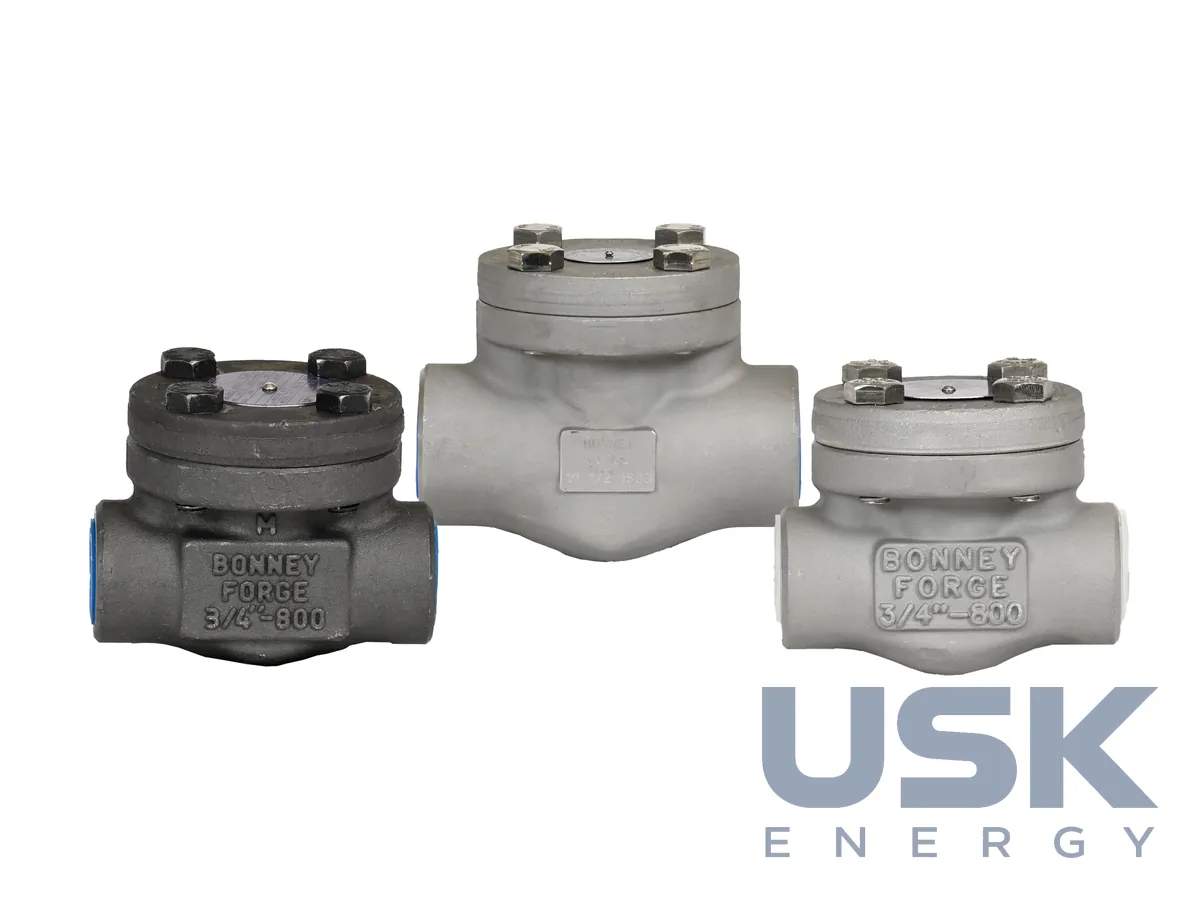
Forged Steel Check Valves, Piston, Ball and Swing Types, NPS 1/4 up to 24
Check valves of forged steel that stop reverse flow, available as piston (lift), ball and swing designs from NPS 1/4 up to 24 in classes 150 to 4500.
- Types
- Piston (lift), ball and swing check
- Sizes
- 1/4 to 24 NPS
- Pressure classes
- 150 to 4500
- Design
- ASME B16.34, API 594, API 602
Price, availability and lead time on request. We help with analogue selection, customs clearance and delivery.
Description
These valves serve pipework in hydrocarbon handling, power plants, chemical works, refineries, petrochemical sites and general industrial systems.
A check valve opens under the pressure of the fluid passing through the system and closes whenever the flow direction changes. In a piston or lift design, the disc travels in a bore that guides it, keeping disc and seat coaxial during closure. The valve is installed so that the flow enters beneath the disc, where inlet pressure and flow lift the disc off the seat. When the flow suddenly reverses, the disc drops back onto the seat under its own weight and the flow. On contaminated media piston valves should be used with care, because debris can jam the disc in the bore.
A ball check valve works in the same way, but the closure member is a ball. The ball rotates freely, so it wears evenly and bears on the seat in a uniform way, which makes ball checks suitable for viscous media.
The standard version without a spring has a low cracking pressure and a small pressure loss, but works correctly only on a horizontal line. A spring can be fitted as an option. It helps closure, gives positive closure in any position, and is needed for the 90° angle versions on vertical lines. All pressure parts are made by die forging, and flanged valves have flanges forged with the body. The body and bonnet joint is bolted or welded, and the seat is integral as standard, while a screwed-in seat is offered instead. The sealing surfaces are machined to close tolerances and low roughness, and the closure member is precisely guided against the seat.
End connections are socket weld to ASME B16.11, NPT threaded to ASME B1.20.1, flanged to ASME B16.5 and butt weld to ASME B16.25, with overall length to ASME B16.10. API 598 covers testing, MSS SP-25 governs marking, and emissions fall under ISO 15848, API 624 and TA Luft.
Technical specifications
| Types | Piston (lift), ball and swing check |
|---|---|
| Sizes | 1/4 to 24 NPS |
| Pressure classes | 150 to 4500 |
| Design | ASME B16.34, API 594, API 602 |
| Testing | API 598 |
| Fugitive emissions | API 624, ISO 15848, TA Luft |
| Marking | MSS SP-25 |
| Overall length | ASME B16.10 |
| Socket weld ends | ASME B16.11 |
| Screwed ends | NPT to ASME B1.20.1 |
| Flanged ends | ASME B16.5, forged integrally with the body |
| Butt weld ends | ASME B16.25 |
| Body-bonnet joint | Bolted or welded |
| Gasket | Spiral wound to class 1500; RJ type from class 2500 |
| Seat | Integral as standard, screwed-in seat optional |
| Spring | Optional |
Request a price and lead time
Forged Steel Check Valves, Piston, Ball and Swing Types, NPS 1/4 up to 24. We reply within one business day.
Or email sales@usk.ua or call 044 339-50-20.
Questions and answers
Can the valve be installed on a vertical line?
The standard version without a spring works only on a horizontal line. For vertical lines a spring version is ordered, including the 90° angle type.
Which type suits a viscous medium?
The ball type. The ball rotates freely, wears evenly and bears uniformly on the seat.
Which gaskets are fitted in the bolted bonnet?
Spiral wound gaskets up to ASME class 1500 and RJ gaskets from class 2500. On request, either type can be supplied for any class.
Similar equipment from other manufacturers